Quality control on the production floor or at a repair bench depends on seeing what a circuit is actually doing, not what it should be doing. A handheld digital oscilloscope puts that view in one hand: it draws the waveform on a screen, measures voltage and timing automatically, and travels to the equipment instead of making the equipment come to a bench. The best handheld digital oscilloscopes for quality control combine enough bandwidth to catch real faults with the portability and battery life to work through a full shift of checks.
The three instruments below cover the two main shapes of handheld scope. Tablet-style scopes use a large touchscreen and suit detailed inspection and documentation, while pistol-grip scopes add a multimeter and a waveform generator in one compact body for fast go/no-go checks. All three run on internal batteries and store waveforms, which is what a quality control workflow needs.
What to Look For
Bandwidth is the first specification to match to the job. Bandwidth sets the fastest signal the scope can display accurately, so a 70 MHz instrument covers most power, audio, sensor, and control signals, while 100 MHz adds headroom for faster digital edges and communication buses.
Sample rate is the second number to check. A 1 GSa/s rate captures fine detail on fast signals, while 250 MSa/s is enough for the slower waveforms found in power supplies, motor drives, and sensor circuits. More channels help too: two channels let the user compare an input and an output at the same time, which is how many faults are isolated.
Beyond the scope itself, look at the extras that speed up checks. A built-in multimeter removes the need for a second instrument during voltage and continuity checks. Automatic measurements for peak-to-peak voltage, frequency, and duty cycle cut the time each check takes. Battery life, screen size, and waveform storage decide how practical the instrument is on a long shift, and a waveform generator helps when a known test signal is needed to exercise a circuit.
The 3 Best Handheld Digital Oscilloscopes
FNIRSI 1013D Plus Portable Handheld Tablet Oscilloscope

Amazon link: https://www.amazon.com/dp/B0BHHYMVKV
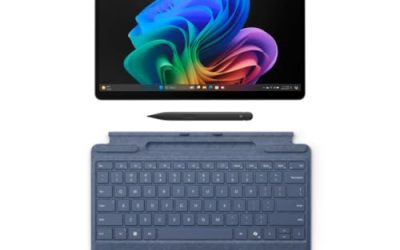
The FNIRSI 1013D Plus is a tablet-style oscilloscope built around a 7-inch touchscreen, and it is the best pick here for detailed inspection work. It provides two channels with 100 MHz bandwidth and a 1 GSa/s real-time sampling rate, which covers fast digital signals as well as slower analogue waveforms. The large screen shows both channels clearly, with room for measurement readouts alongside the traces.
Automatic measurements cover peak-to-peak voltage, maximum and average voltage, frequency, period, and duty cycle, and the instrument includes FFT display, X-Y mode, cursor measurements, and screenshot capture. A 6000 mAh battery powers the unit for field use, and 1 GB of internal memory stores waveforms and screenshots for records.
This instrument suits quality control stations where waveforms need to be examined closely and documented, or where fast signals must be checked on the spot. The consideration is size: as a tablet, it is larger than a pistol-grip scope, so it suits a bench or a cart better than a pocket or a tool belt.
Hantek 2D72 3-in-1 Handheld Oscilloscope, Multimeter, and Waveform Generator

Amazon link: https://www.amazon.com/dp/B07MQJR6W9
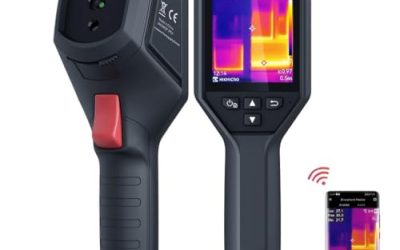
The Hantek 2D72 packs three instruments into one handheld body: a two-channel oscilloscope, a digital multimeter, and an arbitrary waveform generator. Its oscilloscope section provides 70 MHz bandwidth and a 250 MSa/s sampling rate, which covers power, audio, sensor, and control signals found in most products under test. The multimeter measures voltage, current, resistance, and capacitance, and the generator can output test signals to exercise a circuit.
At around 400 grams, the 2D72 is light enough to carry through a full shift, and battery power means it works anywhere on the floor without a mains outlet. A carrying case, probes, and cables are included, so the kit is ready to use on arrival. Self-calibration and an auto-set function speed up routine checks, since the instrument can find a stable display without manual adjustment.
This instrument suits technicians who move between stations and need scope, meter, and generator functions in a single tool. The consideration is screen size: the compact display shows the essentials, but detailed waveform analysis is easier on the larger screen of the FNIRSI tablet above.
OWON HDS272S 3-in-1 Handheld Digital Oscilloscope, Multimeter, and Waveform Generator

Amazon link: https://www.amazon.com/dp/B094FR78JB
The OWON HDS272S is a rugged 3-in-1 handheld that pairs a two-channel oscilloscope with a 20,000-count digital multimeter and a waveform generator. Its oscilloscope section provides 70 MHz bandwidth and a 250 MSa/s sampling rate with an 8,000-point record length, and the 3.5-inch colour LCD shows waveforms clearly in workshop light. Seven automatic measurements appear at the bottom of the screen during checks.
The multimeter function covers auto-ranging voltage, current, resistance, diode, capacitance, and continuity checks, and one key switches between the three instrument modes. A rubber-covered shell gives grip and drop protection, and the replaceable battery provides around 6 hours of continuous use. USB Type-C connects the instrument to a computer for data transfer.
This instrument suits quality control work in workshops and on production lines, where durability and a long battery life matter as much as measurement range. The consideration is that its record length is shorter than a bench scope, so very long captures of slow signals are better handled by a larger instrument.
Comparison
| Feature | FNIRSI 1013D Plus | Hantek 2D72 | OWON HDS272S |
|---|---|---|---|
| Bandwidth | 100 MHz | 70 MHz | 70 MHz |
| Sample rate | 1 GSa/s | 250 MSa/s | 250 MSa/s |
| Channels | 2 | 2 | 2 |
| Display | 7-inch touchscreen | Compact colour LCD | 3.5-inch colour LCD |
| Multimeter | Not included | Included | 20,000-count, included |
| Waveform generator | Not included | Included | Included |
| Battery | 6000 mAh | Internal battery | Replaceable, around 6 hours |
| Storage | 1 GB internal memory | Waveform storage | Waveform storage |
| Weight | Tablet size | Around 400 g | Handheld, rubber shell |
FAQ
How much bandwidth does quality control work need?
It depends on the fastest signal under test. A common rule is to choose bandwidth at least five times the highest frequency being measured. For power supplies, sensors, motor drives, and audio circuits, 70 MHz is ample. For fast digital buses and sharp edges, 100 MHz gives more headroom.
Can a handheld oscilloscope replace a bench oscilloscope?
For field checks, incoming inspection, and production-line verification, yes. Handheld scopes cover the measurements quality control most often needs, with the advantage of battery power and portability. For deep analysis, long captures, and high-channel-count work, a bench oscilloscope still has the edge.
Why do some handheld scopes include a multimeter?
Combining the two avoids a tool change during a check. A technician can measure DC voltage or continuity with the meter, then switch to the scope to look at the waveform, without picking up a second instrument. That is why the Hantek and OWON models here are popular for walk-around quality checks.
What should be checked before buying a handheld scope?
Confirm the bandwidth, sample rate, and channel count against the signals under test, check the battery life against the length of a shift, and confirm the probes and accessories in the box match the connectors on the equipment.
Conclusion
The FNIRSI 1013D Plus is the best pick for detailed inspection and documentation, with its 100 MHz bandwidth, 1 GSa/s sampling, and large touchscreen. The Hantek 2D72 is the most versatile single tool for moving between stations, combining scope, multimeter, and generator in a light handheld body. The OWON HDS272S is the toughest of the three, with its rubber shell and replaceable battery for workshop use.
Disclosure: As an Amazon Associate, we earn from qualifying purchases.