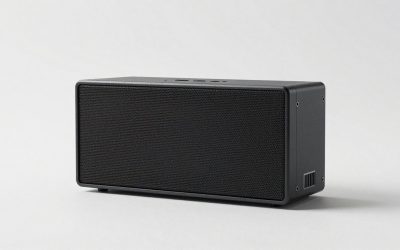
- Top Pick: LINKUP – AVA 50cm PSU Cable Extension Sleeved Custom Mod GPU PC Braided w/Comb Kit | 1 x 24 P (20+4) | 1 x 8 P (4+4) CPU | 2 x 8 P (6+2) GPU Set | 500mm – Blueblack
- Best Value: LINKUP – 50cm Super Soft and Flexible PSU Cable Extension Sleeved Custom Mod GPU PC Braided w/Comb Kit┃1 x 24 P (20+4)┃1 x 8 P (4+4) CPU┃2 x 8 P (6+2) GPU Set┃500mm – BlackRed
- Premium Choice: LINKUP – 50cm Super Soft and Flexible PSU Cable Extension Sleeved Custom Mod GPU PC Braided w/Comb Kit┃1 x 24 P (20+4)┃1 x 8 P (4+4) CPU┃2 x 8 P (6+2) GPU Set┃500mm – BlackBlue
Affiliate disclosure: As an Amazon Associate we earn from qualifying purchases. This post contains affiliate links — if you buy through them we may earn a small commission at no extra cost to you. This never affects our recommendations.
The $350–$500 GPU bracket is where serious 1440p gaming begins. Cards in this range can push 144fps at high settings in most AAA titles without relying heavily on upscaling — and with DLSS 4 or FSR 4 enabled, high-refresh 165Hz and even 240Hz targets become realistic.
2025 has brought an exciting refresh to this tier. NVIDIA’s RTX 5060 Ti on the Blackwell architecture brings DLSS 4 Multi Frame Generation and dual NVENC encoders. AMD’s RX 9060 XT counters with 16GB VRAM at around $440 — a significant advantage for VRAM-limited scenarios. The competition keeps prices honest and buyers winning.
We evaluated each card below for 1440p benchmark performance, thermal performance, noise levels, and feature sets. Here are our top picks under $500 in 2025.
In a hurry? See the top-rated Graphics Cards Under $500 deals available right now:
🛒 Check Graphics Cards Under $500 Prices on Amazon →🛒 Best Price Today on Amazon
Prime members get fast, free shipping on everything above, plus member-only deals. New members get a 30-day free trial — cancel anytime.
Start 30-Day Prime Free Trial →See Today’s Amazon DealsTop Picks at a Glance
| Product | Best For |
|---|---|
| ASUS Dual RTX 5060 OC 8GB | Best entry into this bracket |
| MSI RTX 5060 Ti 8G Ventus 3X OC | Best overall under $400 |
| ZOTAC RTX 5060 Ti 8GB Twin Edge OC | Best compact 5060 Ti |
| PNY RTX 5060 Ti OC Dual Fan | Best value 5060 Ti with OC |
| XFX Swift RX 9060 XT OC 16GB | Best AMD / most VRAM |
As an Amazon Associate we earn from qualifying purchases at no extra cost to you.




ASUS Dual RTX 5060 OC 8GB — Best Entry Point
The ASUS Dual RTX 5060 OC at around $350 is the entry into next-gen Blackwell performance with a dual-fan cooler and factory overclock. It handles 1440p high settings well and benefits fully from DLSS 4 Multi Frame Generation. ASUS’s build quality and GPU Tweak III software add value, while the dual NVENC encoders make it an attractive streaming option. For buyers who want Blackwell at the lowest possible price with ASUS’s reliability, this is the card.
- Pros: DLSS 4 MFG, ASUS quality, dual NVENC, solid 1440p performance
- Cons: 8GB VRAM, dual-fan may run warmer than triple-fan options
MSI RTX 5060 Ti 8G Ventus 3X OC — Best Overall Under $400
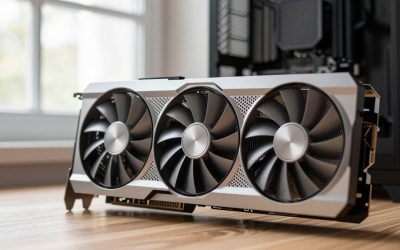
The MSI RTX 5060 Ti 8G Ventus 3X OC at around $380 is the top recommendation in this guide. The Ti designation means a higher-spec Blackwell chip with more CUDA cores and bandwidth than the base RTX 5060. The triple Ventus fans keep temperatures low under extended gaming sessions, and noise levels are impressive for a triple-slot card. DLSS 4 MFG pushes frame rates into high-refresh territory at 1440p, and dual NVENC encoders handle 4K streaming without breaking a sweat.
- Pros: RTX 5060 Ti chip, triple-fan cooling, DLSS 4 MFG, excellent 1440p performance
- Cons: 8GB VRAM is the only real limitation at this price
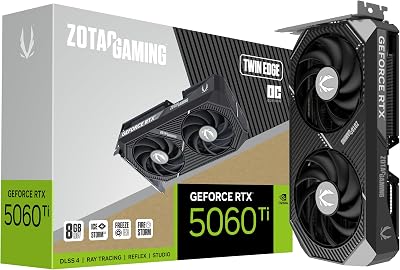
ZOTAC RTX 5060 Ti 8GB Twin Edge OC — Best Compact Option
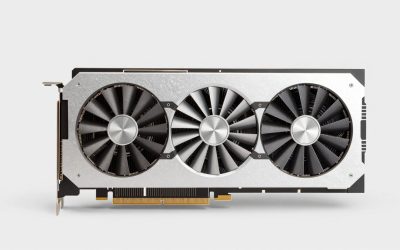
At the same around $380 price as the MSI, the ZOTAC RTX 5060 Ti Twin Edge OC stands out for its compact dual-slot, dual-fan design. It fits easily into mini-ITX and mATX cases where triple-slot cards won’t go. Performance is essentially identical to other RTX 5060 Ti cards with the same GPU specs, and ZOTAC’s FIRESTORM software provides solid tuning capabilities. An excellent choice for small form factor builds that don’t want to sacrifice next-gen features.

- Pros: Compact dual-slot design, RTX 5060 Ti performance, DLSS 4 MFG
- Cons: Dual-fan runs slightly warmer than triple-fan, 8GB VRAM
PNY RTX 5060 Ti OC Dual Fan — Reliable Budget Ti Option
The PNY RTX 5060 Ti OC Dual Fan at around $400 delivers the same Blackwell Ti performance as competing cards with PNY’s no-frills approach. You get solid factory overclocks, reliable cooling, and all RTX 5060 Ti features including DLSS 4 and dual NVENC. PNY cards typically carry a 3-year warranty and have a strong reliability record. The $20 premium over ZOTAC and MSI is modest given the longer warranty and PNY’s reputation for consistent quality control.
- Pros: RTX 5060 Ti performance, 3-year warranty, reliable brand
- Cons: $20 more than competing RTX 5060 Ti cards, dual-fan only
XFX Swift RX 9060 XT OC 16GB — Best AMD Card Under $500
The XFX Swift RX 9060 XT OC 16GB at around $440 is AMD’s answer to the RTX 5060 Ti — and its 16GB VRAM is a genuine differentiator. Double the VRAM of competing NVIDIA cards means you can run max settings in VRAM-hungry titles without memory compression artifacts. The Swift cooler is XFX’s premium triple-fan design, keeping the RDNA 4 GPU cool and quiet. FSR 4 and Radeon’s AV1 encoding make it competitive for streaming. The 16GB advantage becomes more meaningful as 2025 titles push texture budgets higher.
- Pros: 16GB GDDR6, excellent 1440p raster, FSR 4, triple-fan cooling
- Cons: No DLSS (uses FSR instead), slightly pricier than RTX 5060 Ti alternatives
Buying Guide
RTX 5060 Ti vs. RX 9060 XT — Which Architecture Wins?
Both architectures deliver strong 1440p performance in this price range, but they prioritize differently. NVIDIA’s RTX 5060 Ti has a decisive advantage in AI-powered upscaling — DLSS 4 Multi Frame Generation is significantly more advanced than AMD’s FSR 4 in terms of image quality and frame multiplication. However, AMD’s RX 9060 XT packs 16GB VRAM versus NVIDIA’s 8GB, which matters for max-settings gaming in texture-heavy titles. If you play games with strong DLSS 4 support (most major releases), go NVIDIA. If you want maximum VRAM headroom and open-source upscaling, go AMD.

Is 8GB VRAM a Problem at 1440p High Refresh?
For the majority of high-refresh 1440p gaming in 2025, 8GB is adequate. Competitive titles (Valorant, CS2, Apex, Fortnite) rarely exceed 4GB. Most AAA titles at 1440p high settings stay within 8GB. The edge cases are ultra-settings in games like Star Wars Outlaws, Cyberpunk 2077 with RT Overdrive, and similar VRAM-intensive titles. If you regularly play those at max settings, the RX 9060 XT’s 16GB is worth the extra $60. If you primarily play competitive or mid-range settings, 8GB handles everything fine through 2026.
Triple Fan vs. Dual Fan — Does It Matter?
In this $350–$450 range, thermal performance differences between dual- and triple-fan coolers are modest. Both keep GPU junction temps below 80°C in most scenarios. Triple-fan designs like the MSI Ventus 3X offer a few degrees cooler operation and typically quieter fans at load, which matters for extended sessions. Dual-fan designs like the ZOTAC Twin Edge and PNY Dual Fan are physically smaller — critical for small form factor builds. Choose based on your case size first, then thermals.
Streaming and Content Creation Considerations
All RTX 5060 and RTX 5060 Ti cards include dual NVENC encoders — a major upgrade over the single encoder in RTX 3000 and RTX 4000 series cards. Dual NVENC lets you stream and record simultaneously at high quality without impacting gaming performance. The RX 9060 XT also encodes AV1 hardware, keeping AMD competitive for streaming. If you stream on Twitch or YouTube while gaming, any card in this list handles it — the NVIDIA cards’ NVENC implementation is slightly more mature in OBS integration.
Power Supply Requirements
RTX 5060 and RTX 5060 Ti cards typically draw 150–180W under load — a 550–600W quality PSU is sufficient for most gaming systems. The RX 9060 XT draws slightly more at around 175W. None of these cards require exotic power connectors — standard 8-pin or the new 16-pin (with adapter) handles the job. Avoid budget PSUs regardless of wattage rating — a Tier-A unit from Corsair, Seasonic, or be quiet! protects your GPU investment.
Frequently Asked Questions
Is the RTX 5060 Ti worth the extra money over the RTX 5060?
Yes, at around $380 vs. around $350 ($25 difference), the RTX 5060 Ti is worth the premium. You get more CUDA cores, higher memory bandwidth, and better raster performance that translates to 10–15% higher frame rates at 1440p. The Ti also tends to have more stable performance in demanding scenarios. For long-term gaming at 1440p 144Hz, the Ti is the smarter buy.
Can these GPUs run games at 1440p 144Hz without upscaling?
In less demanding titles (Valorant, CS2, Apex Legends, Rocket League), yes — all cards here exceed 144fps natively at 1440p. In AAA open-world titles at max settings, native 1440p 144fps requires DLSS or FSR on most of these cards. The RTX 5060 Ti with DLSS 4 Quality mode typically delivers 144+ fps in demanding games while maintaining excellent image quality indistinguishable from native for most players.
How does FSR 4 compare to DLSS 4 at 1440p?
DLSS 4 (NVIDIA) and FSR 4 (AMD) are both excellent in 2025, but DLSS 4 has a quality edge — particularly in motion and ghosting scenarios. DLSS 4’s Transformer model produces sharper, more temporally stable images than FSR 4 in most tested scenarios. However, FSR 4 runs on any GPU (not just AMD cards), has no vendor lock-in, and the quality gap has narrowed significantly with RDNA 4. For pure image quality, DLSS 4 wins. For flexibility and 16GB VRAM, the RX 9060 XT package is compelling.
Which card is best for a 1440p 165Hz monitor?
For a 1440p 165Hz gaming monitor, the MSI RTX 5060 Ti 8G Ventus 3X OC is the top pick. With DLSS 4 Quality mode enabled, it hits 165fps in most AAA titles and exceeds it in competitive games. The RTX 5060 Ti + DLSS 4 combination at this price point is one of the best performance-per-dollar setups in 2025 for high-refresh 1440p gaming.
Verdict
The $350–$500 GPU market in 2025 is dominated by RTX 5060 Ti cards from NVIDIA and AMD’s compelling RX 9060 XT. For most buyers, the MSI RTX 5060 Ti 8G Ventus 3X OC at around $380 is the best all-around pick — excellent 1440p performance, DLSS 4, triple-fan cooling, and dual NVENC for streaming. If 16GB VRAM is a priority, the XFX Swift RX 9060 XT OC 16GB at around $440 is the clear choice. Either way, this price bracket delivers genuine high-refresh 1440p gaming in 2025.
Related Articles
Looking for more on this topic? Browse the hand-picked guides below — each one applies the same scoring rubric used in this review.
Ready to decide? Our #1 pick for 2026 is the ASUS Dual RTX 5060 OC 8GB.
Live price & availability on Amazon.