Affiliate disclosure: As an Amazon Associate we earn from qualifying purchases. This post contains affiliate links — if you buy through them we may earn a small commission at no extra cost to you. This never affects our recommendations.
Competitive gaming monitors are a different breed. Where casual gaming monitors prioritize immersion and image quality, competitive monitors prioritize one thing above all: speed. High refresh rates, ultra-low response times, and minimal input lag are non-negotiable at the top level.
In a hurry? See the top-rated Gaming Monitors for Competitive Gaming deals available right now:
🛒 Check Gaming Monitors For Competitive Gaming Prices on Amazon →🛒 Best Price Today on Amazon
Prime members get fast, free shipping on everything above, plus member-only deals. New members get a 30-day free trial — cancel anytime.
Start 30-Day Prime Free Trial →See Today’s Amazon DealsBest Monitors for Competitive Gaming
As an Amazon Associate we earn from qualifying purchases at no extra cost to you.


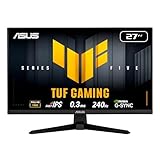





What Makes a Monitor “Competitive”?
Refresh Rate: Why Higher Is Better
At 144Hz, each frame displays for 6.9ms. At 240Hz, that drops to 4.2ms. At 360Hz, just 2.8ms. In practice, moving from 144Hz to 240Hz is noticeably smoother — especially in games like CS2, Valorant, and Apex Legends where tracking moving targets is critical.
Response Time: What Numbers Actually Matter
Manufacturers advertise GtG (gray-to-gray) and MPRT (moving picture response time) — these measure different things. GtG is the actual pixel transition time. 1ms GtG is the minimum for competitive gaming; 0.5ms is ideal. MPRT is achieved through backlight strobing (which causes flicker) and isn’t the same metric.

Input Lag vs Response Time
Input lag is the time from controller input to on-screen result. It’s separate from response time and panel type. Look for monitors with under 4ms input lag at native refresh rate. Most good competitive monitors hit 1–3ms.
Resolution for Competitive Gaming
1080p — The Competitive Standard
Most professional esports players use 1080p — not because it looks better, but because it’s easier to push 240–360fps at 1080p. Lower resolution = higher frame rates. At the highest level, frame rate beats pixel count.

1440p Competitive Gaming
With GPUs like the RTX 4080 and RX 7900 XTX, hitting 240fps at 1440p is realistic in esports titles. The sharper image aids target acquisition at range. Many semi-pro players are moving to 1440p 240Hz as GPUs get more powerful.

Monitor Size for Competitive Gaming
24–25 inches is preferred by most competitive players. The entire screen is visible in peripheral vision without moving eyes, and target size relative to screen is optimal for aiming. 27″ works fine but 24″ is the esports standard.
Frequently Asked Questions
Is 360Hz noticeably better than 240Hz?
Less noticeably than the jump from 144Hz to 240Hz. At 360Hz, you’re in diminishing returns territory. The benefit is real — smoother tracking, more responsive feel — but requires a very powerful GPU (RTX 4090) to actually reach those frame rates consistently in most games.
Should I use a curved monitor for competitive gaming?
Most competitive players avoid curved monitors because curvature distorts the image geometry, which can make horizontal aiming feel slightly off. Flat is standard in esports.
Do I need G-Sync or FreeSync for competitive gaming?
Less critical than for casual gaming. Competitive players often disable VRR and use the monitor at a fixed refresh rate with V-Sync off. When frame rates consistently exceed the monitor refresh rate (which they do for top competitive players), VRR doesn’t apply anyway.
What game genres benefit most from 240Hz+?
FPS games (CS2, Valorant, Apex Legends, Overwatch 2) benefit the most. Battle royale, MOBA (LoL, Dota 2), and fighting games also see meaningful improvements. RPGs, strategy games, and turn-based games see no benefit whatsoever.
Related Articles
Looking for more on this topic? Browse the hand-picked guides below — each one applies the same scoring rubric used in this review.