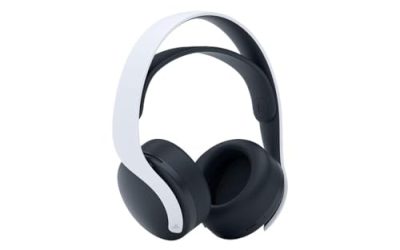
In a competitive shooter, the most valuable sound is often the quietest one: a single step on metal stairs, a shift of weight behind a wall, a landing on the floor above you. A headset built for footstep clarity does not make those sounds louder so much as it keeps them separate — from gunfire, from explosions, and from your own team’s callouts — so you can tell where a step came from and how far away it was.
Disclosure: As an Amazon Associate we earn from qualifying purchases.
This guide compares five headsets currently sold on Amazon US that approach that job in different ways: an open-back wired model with a wide stage, two closed wired and wireless designs with restrained tuning, and two low-latency wireless models with app-based EQ you can aim at the frequencies where footsteps live. Every figure below is a published maker or listing specification; where a feature is software-based, that is stated, because software processing behaves differently on PC and console.
What Actually Makes Footsteps Readable
Imaging and soundstage are different things. Soundstage is how wide and deep the sound field feels; imaging is how precisely a single sound can be placed inside it. Footstep detection depends mostly on imaging. An open-back design usually offers the wider stage, while a well-tuned closed design can image just as precisely while blocking room noise — the right trade depends on how quiet your playing space is.
Tuning matters more than driver size. Footsteps sit largely in the midrange and lower treble. Headsets with heavily boosted bass can bury those cues under explosions and gunfire. A flatter or gently lifted upper-midrange presentation, whether it comes from the driver tuning itself or from an EQ preset, keeps steps distinct. Several makers now publish FPS-oriented EQ profiles for exactly this reason; treat them as starting points, not magic.
Wired versus wireless latency. A wired connection adds no meaningful delay. Modern 2.4 GHz gaming wireless (HyperSpeed, LIGHTSPEED, and similar proprietary links) is designed to be low-latency and is the standard choice for competitive wireless play; standard Bluetooth is the slowest of the three and is best treated as a convenience connection for chat or a second device, not for ranked matches. If a headset offers both, play on the 2.4 GHz link and keep Bluetooth for your phone.
Virtual surround is a tool, not a guarantee. DTS Headphone:X, THX Spatial Audio, and 360° spatial processing all reshape stereo into a wider field. In some games that helps vertical placement; in others, plain stereo images more cleanly. Every pick below works in stereo, so you can compare the processed and unprocessed sound in your own games and keep whichever reads better.
The microphone is half the purchase. Footstep information only wins rounds if your callouts are clear. Each pick below states its microphone type — detachable boom, retractable boom, flip-to-mute — because mic design and noise handling differ as much as the drivers do.
If your shortlist is wider than footstep-focused play, our roundup of the best headsets for gaming covers general-purpose picks for every platform.
The Picks
1. Drop + Epos PC38X — Open-Back Wired Pick for Quiet Rooms

The PC38X is the specialist of this group: an open-back, over-ear headset whose drivers are angled to present a wide, natural sound field, which is the classic recipe for placing footsteps in space. Because the backs are open, sound leaks in and out — in a quiet room that openness is the point; in a shared or noisy space it is a real limitation, and one of the closed picks below will serve you better.
Drop publishes a 10 Hz–30 kHz frequency response and a low 28 Ω impedance, so the PC38X runs easily from a controller, a laptop jack, or a phone without a separate amplifier. The boom microphone is noise-cancelling, flips up to mute, and the headset ships with both velour and mesh-knit ear pads so you can choose the cooler or the softer fit.
Specs
- Design: Open-back, over-ear, wired
- Driver: 42 mm dynamic
- Frequency response (maker): 10 Hz–30 kHz
- Impedance: 28 Ω
- Connection: 3.5 mm (console and PC cables included)
- Microphone: Noise-cancelling boom, flip-up to mute
- Platforms: PC, PS5, PS4, Xbox, Switch, Mac, mobile
Best for: PC and console players in quiet rooms who want the widest, most natural placement of footsteps and do not need isolation.
2. HyperX Cloud III — Closed Wired Pick With Angled 53 mm Drivers

The Cloud III takes the opposite approach: a closed-back design with sound isolation for noisier rooms, built around angled 53 mm drivers that HyperX says are retuned to accent the dynamic sounds of gaming. Angling the drivers is an imaging decision — it shapes how sound reaches the ear — and the closed cups keep outside noise from competing with quiet cues.
It connects three ways (USB-C, USB-A, and 3.5 mm are all in the box) and supports DTS Spatial Audio over the USB connection on PC. The detachable 10 mm microphone has an LED mute indicator, so you can confirm at a glance that you are not broadcasting. Memory foam in the headband and ear cushions and a durable metal frame round out a design aimed at long sessions.
Specs
- Design: Closed-back, over-ear, wired
- Driver: 53 mm dynamic, angled
- Spatial audio: DTS Spatial Audio (via USB on PC)
- Connection: USB-C, USB-A, 3.5 mm
- Microphone: Detachable 10 mm boom, LED mute indicator
- Build: Metal frame, memory foam cushions
- Platforms: PC, PS5, PS4, Xbox Series X|S, Xbox One, Switch, Mac, mobile
Best for: Players in shared or noisy spaces who want a wired headset with precise cue placement and a microphone that comes off when the match ends.
3. Razer BlackShark V2 Pro (2023) — Wireless Pick With FPS EQ Profiles

The 2023 edition of the BlackShark V2 Pro is built specifically around competitive play. Its 50 mm TriForce Titanium drivers are a closed-back design with noise-isolating earcups, and Razer publishes pro-tuned FPS audio profiles for specific shooters — ready-made EQ curves aimed at the frequencies where footsteps and reloads sit, adjustable further in Razer’s software.
Connection is Razer HyperSpeed 2.4 GHz wireless for play, with Bluetooth as the second channel and a wired option in the box; Razer rates the battery at up to 70 hours. The detachable HyperClear Super Wideband microphone is the headline comms feature — “super wideband” refers to the wider voice frequency range it captures compared with the previous generation. THX Spatial Audio is available on PC for players who prefer processed surround.
Specs
- Design: Closed-back, over-ear, wireless
- Driver: 50 mm TriForce Titanium
- Frequency response (maker): 12 Hz–28 kHz
- Connection: 2.4 GHz HyperSpeed wireless, Bluetooth, wired
- Battery (maker figure): Up to 70 hours
- Spatial audio: THX Spatial Audio (PC)
- Microphone: Detachable HyperClear Super Wideband boom
- Platforms: PC, PlayStation, Switch (check the listing for the exact edition and console support)
Best for: Competitive players who want wireless freedom plus published, game-specific EQ profiles they can fine-tune for footstep frequencies.
4. Logitech G Pro X 2 Lightspeed — Graphene Drivers and Long Battery

The Pro X 2 Lightspeed is Logitech’s pro-line wireless headset, built around 50 mm graphene drivers. Logitech’s published claim for the graphene diaphragm is greater sensitivity and lower distortion, which in practical terms targets exactly the small, fast sounds — steps, pin pulls, distant doors — that distortion smears together.
LIGHTSPEED 2.4 GHz wireless is the primary connection, rated by Logitech at up to 50 hours of battery and up to 30 m of range, with Bluetooth and a 3.5 mm cable as fallbacks. DTS Headphone:X 2.0 provides the virtual surround option on PC. The detachable 6 mm cardioid boom microphone works with Logitech’s Blue VO!CE filters in G Hub, and the aluminium-and-steel frame ships with both leatherette and velour ear pads.
Specs
- Design: Closed-back, over-ear, wireless
- Driver: 50 mm graphene (PRO-G)
- Connection: LIGHTSPEED 2.4 GHz wireless, Bluetooth, 3.5 mm
- Battery (maker figure): Up to 50 hours; range up to 30 m
- Spatial audio: DTS Headphone:X 2.0 (PC)
- Microphone: Detachable 6 mm cardioid boom, Blue VO!CE support in G Hub
- Build: Aluminium and steel frame; leatherette and velour pads included
- Platforms: PC, PS5, PS4, Switch
Best for: Players who want a premium wireless headset with low-distortion drivers, swappable ear pads, and software-tuned microphone filtering.
5. SteelSeries Arctis Nova 7 — Dual Wireless With Parametric EQ

The Arctis Nova 7’s footstep tool is its software: SteelSeries’ Sonar app offers a parametric EQ — finer-grained than the usual preset list — so you can lift the exact band where your game’s footsteps sit and pull down the bass that masks them. The headset itself uses 40 mm neodymium magnetic drivers and supports 360° Spatial Audio.
Its dual-wireless design is the practical highlight: a 2.4 GHz USB-C dongle carries game audio while Bluetooth connects simultaneously, so a phone call or a second device mixes in without a cable swap. The retractable ClearCast Gen 2 microphone uses AI noise cancelling, and the ChatMix dial on the earcup balances game and voice on the fly. SteelSeries rates the battery at 38 hours, with a 15-minute USB-C fast charge returning about 6 hours of play. Note the platform split in the Nova line: this Nova 7 covers PC, PlayStation, Switch, VR, and mobile; Xbox players need the Nova 7X variant instead.
Specs
- Design: Closed-back, over-ear, wireless
- Driver: 40 mm neodymium magnetic
- Connection: 2.4 GHz wireless (USB-C dongle) plus simultaneous Bluetooth; 3.5 mm cable included
- Battery (maker figure): 38 hours; fast charge 15 minutes for about 6 hours
- Spatial audio: 360° Spatial Audio; parametric EQ via Sonar (PC)
- Microphone: Retractable ClearCast Gen 2 boom, AI noise cancelling, ChatMix dial
- Platforms: PC, PS5, PS4, Switch, VR, mobile (no Xbox on this variant)
Best for: PC players who want to tune EQ precisely for one or two main games, and anyone who wants game audio and a phone connected at the same time.
How to Choose
- Quiet room, maximum placement accuracy: the open-back PC38X. Its openness is both the advantage and the catch — everyone nearby will hear your game faintly, and their noise reaches you.
- Noisy room or shared space: any of the four closed-back picks. Isolation protects quiet cues better than any processing feature.
- Wired and simple: the PC38X for openness, the Cloud III for isolation and three-in-one cabling. Neither needs charging, drivers, or a dongle.
- Wireless for ranked play: the BlackShark V2 Pro (2023), Pro X 2 Lightspeed, or Arctis Nova 7 — all on 2.4 GHz links. Keep Bluetooth for the second device, not the match.
- You play one main shooter: favour the headsets with published FPS profiles or parametric EQ (BlackShark V2 Pro, Arctis Nova 7) and spend ten minutes tuning; a small lift in the upper midrange and a small cut in the deep bass is the usual starting point.
- Console-first: check the variant before ordering. The Cloud III and PC38X cover Xbox through their wired connections; the Nova 7 does not support Xbox at all, and wireless console support differs by edition on the Razer and Logitech models.
FAQ
Is open-back or closed-back better for footsteps?
Neither is automatically better. Open-back designs such as the PC38X usually present a wider field that makes direction easier to judge, but they isolate nothing. Closed-back designs protect quiet cues from room noise and are the safer choice anywhere other people, traffic, or a loud PC share the space.
Does virtual surround help you hear footsteps?
It can help with vertical placement in some games and blur imaging in others. All five headsets here work in plain stereo, so the sensible approach is to try both in your main game and keep the setting that makes test footsteps — a friend walking a circle around you in a private lobby — easiest to place.
Is wireless fast enough for competitive shooters?
The proprietary 2.4 GHz links on the wireless picks here (HyperSpeed, LIGHTSPEED, and SteelSeries’ dongle connection) are built for gaming and are the standard in pro play. Standard Bluetooth is noticeably slower and is better used for a phone or media device alongside the game link.
Can EQ really make footsteps clearer?
EQ cannot create information the driver does not reproduce, but it can rebalance what is there: trimming deep bass reduces the masking effect of explosions, and a modest lift where footstep transients sit makes them stand out against background sound. Published FPS profiles and parametric EQ are two ways of doing the same job — presets for convenience, parametric for precision.
Verdict
For pure footstep placement in a quiet space, the Drop + Epos PC38X remains the purest tool here: open-back, wired, and easy to drive. For most players, though, a closed headset is the more practical answer — the HyperX Cloud III if you want wired simplicity and isolation, the Razer BlackShark V2 Pro (2023) if you want FPS-ready EQ profiles on a wireless link, the Logitech G Pro X 2 Lightspeed for its low-distortion graphene drivers and long battery, and the SteelSeries Arctis Nova 7 if precise parametric tuning and dual-device mixing matter most. Match the design to your room first, the connection to your platform second, and the tuning tools to the games you actually play.