If you want one gaming desktop that handles nearly everything in 2026 without overspending, our top pick is the CyberPowerPC Gamer Supreme with a Ryzen 7 9800X3D and RTX 5070 Ti. It pairs the most respected gaming CPU class of this generation with a 16GB graphics card that is comfortable at 1440p high refresh and capable at 4K with upscaling. The runner-up is the Skytech Azure 3 with a Ryzen 7 9850X3D and Radeon RX 9070 XT, a strong choice for competitive players who chase very high frame rates at 1440p and prefer AMD graphics.
- Top Picks at a Glance
- Gaming Desktop Comparison Table
- 1. CyberPowerPC Gamer Supreme – Best for 1440p High Refresh
- 2. MSI Codex Z2 – Best for 1080p Esports on a Budget
- 3. Skytech Azure 3 – Best for Competitive High-Refresh Gaming
- 4. Lenovo Legion Tower 5i – Best for Streaming While You Play
- 5. Alienware Aurora – Best for 4K With Big-Brand Support
- 6. STORMCRAFT Phantom – Best Value for 4K Gaming
- 7. Alienware Area-51 – Best Flagship for 4K Max Settings
- Also Consider
- How We Chose
- Gaming Desktop Buying Guide for 2026
- Mistakes to Avoid When Buying a Gaming Desktop
- Frequently Asked Questions
- Which Gaming Desktop Should You Buy?
- Final Verdict
- Sources
This guide is written for gamers, not builders. Instead of motherboard chipsets and cable management, we frame every pick around the questions that matter at your desk: which resolution and refresh rate you play at, whether you live in esports titles or big single-player games, whether you stream, how much noise and space your room can take, and how long the machine should stay relevant.
Disclosure: gamingpcguru.com earns a commission from qualifying purchases made through links on this page, at no extra cost to you.
Quick answer: For most people in 2026, the best gaming desktops for every resolution (october 2026) is the CyberPowerPC Gamer Supreme — our #1 rated choice. See the full ranked comparison, alternatives and buying advice below.
Top Picks at a Glance
- Best Overall (1440p high refresh): CyberPowerPC Gamer Supreme, Ryzen 7 9800X3D + RTX 5070 Ti
- Best Budget (1080p esports): MSI Codex Z2, Ryzen 7 8700F + RTX 5060 Ti
- Best for Competitive High Refresh: Skytech Azure 3, Ryzen 7 9850X3D + RX 9070 XT
- Best for Streaming While You Play: Lenovo Legion Tower 5i, Core Ultra 7 265F + RTX 5070 Ti
- Best for 4K With Big-Brand Support: Alienware Aurora, Core Ultra 9 285 + RTX 5080
- Best Value for 4K: STORMCRAFT Phantom, Ryzen 7 9800X3D + RTX 5080
- Best Premium / Flagship: Alienware Area-51, Core Ultra 9 285K + RTX 5090
Gaming Desktop Comparison Table
| Product | Best For | CPU | GPU | RAM / Storage | Watch For | Price Tier | Details |
|---|---|---|---|---|---|---|---|
| CyberPowerPC Gamer Supreme | 1440p high refresh | Ryzen 7 9800X3D | RTX 5070 Ti 16GB | 32GB DDR5 / 2TB | PSU brand not listed | Mid-range | See pick |
| MSI Codex Z2 | 1080p esports | Ryzen 7 8700F | RTX 5060 Ti | 16GB DDR5 / 1TB | 16GB RAM, often 8GB VRAM | Budget | See pick |
| Skytech Azure 3 | Competitive 1440p | Ryzen 7 9850X3D | RX 9070 XT 16GB | 32GB DDR5 / 2TB | Wi-Fi 5 only | Upper-mid | See pick |
| Lenovo Legion Tower 5i | Streaming + gaming | Core Ultra 7 265F | RTX 5070 Ti 16GB | 32GB DDR5 / 1TB | Small 1TB drive | Upper-mid | See pick |
| Alienware Aurora | 4K with support | Core Ultra 9 285 | RTX 5080 16GB | Varies by config | Premium for the badge | High-end | See pick |
| STORMCRAFT Phantom | 4K value | Ryzen 7 9800X3D | RTX 5080 16GB | 32GB DDR5 / 2TB | Smaller support network | High-end | See pick |
| Alienware Area-51 | 4K max settings | Core Ultra 9 285K | RTX 5090 32GB | 64GB DDR5 / 4TB | Very large, very costly | Flagship | See pick |
1. CyberPowerPC Gamer Supreme – Best for 1440p High Refresh
As an Amazon Associate we earn from qualifying purchases at no extra cost to you.

- CPU: AMD Ryzen 7 9800X3D (8 cores / 16 threads, 96MB L3 with 3D V-Cache)
- GPU: NVIDIA GeForce RTX 5070 Ti, 16GB GDDR7
- Memory / storage: 32GB DDR5, 2TB NVMe SSD
- Cooling: liquid CPU cooler on this Gamer Supreme series; PSU wattage not stated in the listing title
- Connectivity: Wi-Fi and Bluetooth on sibling configurations; HDMI plus DisplayPort outputs on the graphics card
Best for: players with a 1440p monitor at 144Hz to 240Hz who play a mix of shooters and modern AAA games. Skip if: you only play esports at 1080p, where a cheaper machine gets you most of the way.
This is the sweet-spot machine of the list. The Ryzen 7 9800X3D has been the reference gaming CPU since its launch because its large stacked cache keeps frame times steady in CPU-heavy games such as large-scale shooters, simulation titles and open-world games. That matters most at high refresh rates, where the processor, not the graphics card, often sets the ceiling. The RTX 5070 Ti brings 16GB of video memory, which is the amount we would treat as the comfortable floor for 1440p with high textures in 2026, and it supports DLSS 4 with Multi Frame Generation for extra smoothness in supported games.
Compared with the Skytech below, you trade a slightly faster-clocked CPU and a Radeon card for NVIDIA’s feature set, which includes stronger ray tracing and the widest upscaler support in current games. Compared with the Lenovo Legion, you get the better gaming CPU and twice the storage for a similar tier. Based on the spec class, expect this machine to run most current AAA games at 1440p high settings well above 60fps natively, and to push past 144fps in many esports titles; actual numbers vary by game, settings and driver version.
Longevity is solid: the AM5 platform has a known upgrade path, 32GB of RAM is enough for gaming plus background apps, and 2TB means you will not be uninstalling games every week. Check the listing for the exact power supply rating before planning a future GPU upgrade.
Pros
- Top-class gaming CPU for steady frame times at high refresh
- 16GB GPU memory suits 1440p and entry 4K
- Generous 2TB storage for a large game library
- AM5 platform leaves room for future CPU upgrades
Cons
- Power supply brand and wattage are not clearly listed
- RGB-heavy styling will not suit every room
2. MSI Codex Z2 – Best for 1080p Esports on a Budget

- CPU: AMD Ryzen 7 8700F (8 cores / 16 threads, up to 5.0GHz, no integrated graphics)
- GPU: NVIDIA GeForce RTX 5060 Ti (most Codex Z2 configurations ship with the 8GB version; check the listing)
- Memory / storage: 16GB DDR5, 1TB NVMe SSD
- Power / cooling: 650W 80 Plus Gold PSU and ARGB air cooler per MSI’s spec sheet for the series
- Connectivity: Wi-Fi 6E, Bluetooth 5.3, keyboard and mouse included
Best for: esports players at 1080p on a 144Hz to 240Hz monitor and newcomers buying their first real gaming PC. Skip if: you plan to play the newest AAA games at 1440p high settings, where 8GB of video memory and 16GB of RAM become limits.
The Codex Z2 is the entry point of this list, and it comes from a brand that makes its own motherboards and graphics cards, which helps with driver and BIOS support. The Ryzen 7 8700F is a Zen 4 eight-core chip without the extra stacked cache of the X3D parts, but in titles like Valorant, Counter-Strike 2, Fortnite with performance settings, Rocket League and Overwatch 2 it has more than enough speed for high refresh at 1080p. The RTX 5060 Ti handles those games easily and supports DLSS 4, which helps stretch it into heavier titles.
The trade-offs are clear. Sixteen gigabytes of RAM is workable for gaming alone, but Discord, a browser and a launcher running in the background eat into it, and some recent games already recommend 32GB. If your configuration has the 8GB version of the RTX 5060 Ti, high-texture settings in new AAA releases may need to be dialled back. Based on the spec class, expect well above 144fps in most esports games at 1080p and roughly 60fps or more at 1080p high in demanding AAA games, with wide variation by title.
The good news for long-term value is that the case uses standard parts with four memory slots on some configurations, so adding a second RAM stick is a cheap, easy first upgrade.
Pros
- Lowest-cost route into the current RTX 50 generation in this list
- Eight-core CPU is plenty for esports at high refresh
- Wi-Fi 6E and peripherals included
- Standard parts make RAM and storage upgrades simple
Cons
- 16GB RAM is the minimum for modern gaming
- 8GB VRAM on many configurations limits AAA texture settings
- Air cooler and 650W PSU limit major GPU upgrades later
3. Skytech Azure 3 – Best for Competitive High-Refresh Gaming

- CPU: AMD Ryzen 7 9850X3D (8 cores / 16 threads, up to 5.6GHz, 96MB L3)
- GPU: AMD Radeon RX 9070 XT, 16GB GDDR6 (card brand may vary)
- Memory / storage: 32GB DDR5-5600, 2TB Gen4 NVMe SSD
- Power / cooling: 850W 80 Plus Gold ATX 3 PSU, 360mm AIO liquid cooler
- Connectivity: Wi-Fi 5 (802.11ac), tempered-glass Azure case
Best for: competitive shooter players on 1440p 240Hz or faster panels who want the highest CPU-bound frame rates in this tier. Skip if: you care most about path-traced lighting in single-player games, where NVIDIA’s RTX cards still have the edge.
The Ryzen 7 9850X3D is essentially a higher-clocked 9800X3D. Independent reviews such as Gamers Nexus found it at best a few percent faster than the 9800X3D and sometimes identical, so do not pay a large premium for the name alone. Where it does help is exactly the situation competitive players live in: CPU-limited scenarios at high refresh rates, where a little extra clock speed and the large cache keep frame pacing tight. Paired with an RX 9070 XT, which has 16GB of memory and supports AMD’s FSR 4 upscaling, this is a balanced 1440p machine with real 4K capability in lighter games.
Against the CyberPowerPC at number one, this Skytech has the confirmed 360mm liquid cooler and 850W Gold power supply listed up front, which is reassuring if you plan to keep it for years. The RX 9070 XT trades blows with the RTX 5070 Ti in traditional rendering, while NVIDIA keeps the lead in heavy ray tracing and DLSS adoption. Based on the spec class, expect very high frame rates in esports titles at 1440p and smooth high settings in most AAA games at the same resolution; numbers vary by game.
The one real miss is Wi-Fi 5. If you game wirelessly in a busy home, plan on a wired Ethernet connection or a cheap Wi-Fi 6E adapter.
Pros
- Fastest 8-core gaming CPU class available
- 360mm AIO and 850W Gold PSU clearly listed
- 16GB GPU memory with FSR 4 support
- 2TB storage as standard
Cons
- Wi-Fi 5 is dated for a 2026 machine
- Graphics card brand may vary between units
- Small real-world gain over the 9800X3D
4. Lenovo Legion Tower 5i – Best for Streaming While You Play

- CPU: Intel Core Ultra 7 265F (20 cores / 20 threads, P-cores up to 5.2GHz)
- GPU: NVIDIA GeForce RTX 5070 Ti, 16GB GDDR7
- Memory / storage: 32GB DDR5, 1TB SSD
- Power: comparable 265F / RTX 5070 Ti Legion Tower 5i listings show an 850W PSU; confirm on the listing
- Extras: three months of PC Game Pass included per the listing; Wi-Fi 6E on comparable configurations
Best for: gamers who stream to Twitch or YouTube, record clips, or keep lots of apps open while they play at 1440p. Skip if: you want the absolute highest frame rates in CPU-bound esports, where the X3D chips above have an advantage.
The Core Ultra 7 265F has 20 cores, with eight performance cores and twelve efficiency cores. In pure gaming it trails the Ryzen X3D chips in this list, but those extra cores are useful when the game shares the machine with OBS, a browser full of tabs, chat apps and a music player. The RTX 5070 Ti handles the encoding side with NVIDIA’s dedicated NVENC hardware encoder, which streamers rely on because it offloads video encoding from the CPU. Note that the “F” suffix means no integrated graphics, so Intel Quick Sync is not available here; NVENC does the job instead.
Lenovo’s Legion chassis is a mainstream big-brand design with standard ATX-style parts on recent generations, according to independent coverage, which helps for later upgrades. Compared with the CyberPowerPC at number one, you get the same graphics card class and RAM but half the storage and a CPU that is better at multitasking than at peak gaming. Based on the spec class, expect strong 1440p high-setting performance in AAA games and very playable 4K with DLSS; results vary by title.
Pros
- 20-core CPU handles gaming plus streaming and multitasking
- RTX 5070 Ti with NVENC for clean stream encoding
- Big-brand support network and warranty options
- Game Pass trial adds immediate value
Cons
- 1TB SSD fills quickly
- Lower peak gaming speed than X3D Ryzen systems
5. Alienware Aurora – Best for 4K With Big-Brand Support

- CPU: Intel Core Ultra 9 285 (24 cores, up to 5.6GHz, 65W class)
- GPU: NVIDIA GeForce RTX 5080, 16GB GDDR7
- Memory / storage: varies by configuration; check the listing for this exact build
- Power / cooling: Aurora ACT1250 builds with this CPU and GPU are listed with a 240mm liquid cooler and 1000W Platinum PSU
- Connectivity: Wi-Fi 7 and Bluetooth 5.4 on comparable configurations, Killer Ethernet
Best for: 4K and ultrawide players who want a polished, well-supported machine for a living room or shared space. Skip if: you are price-sensitive; the STORMCRAFT Phantom delivers the same graphics card class with a stronger gaming CPU for less.
The redesigned Aurora is the more grown-up Alienware: a cleaner, quieter-looking case than past generations, standard-style internals, and a configuration that pairs the RTX 5080 with a 1000W Platinum power supply in the listings we checked. That headroom matters for long-term value because it leaves room for a bigger graphics card later. The RTX 5080 is the graphics card class we consider the starting point for 4K at high settings, especially with DLSS 4 enabled, and its 16GB of GDDR7 suits current 4K texture packs.
The Core Ultra 9 285 is a 24-core chip that is excellent for multitasking and creative work but, like other Intel Core Ultra 200S parts, is not the fastest pure gaming CPU. At 4K the graphics card does most of the work, so that gap narrows sharply. Based on the spec class, expect 4K high settings in most AAA games at playable-to-smooth frame rates with upscaling, and very high frame rates at 1440p; results vary.
The real reason to pick this over a boutique build is the support network. Dell’s service options, on-site plans in many regions and parts availability matter if you are not comfortable troubleshooting hardware yourself.
Pros
- RTX 5080 handles 4K with DLSS comfortably
- Generous PSU headroom in comparable configurations
- Large support and service network
- Modern connectivity with Wi-Fi 7 on comparable builds
Cons
- Costs more than equal-GPU boutique systems
- Core Ultra 9 285 trails X3D Ryzen chips in CPU-bound games
- Memory and storage differ between listings, so check carefully
6. STORMCRAFT Phantom – Best Value for 4K Gaming

- CPU: AMD Ryzen 7 9800X3D (8 cores / 16 threads, up to 5.2GHz, 96MB L3)
- GPU: NVIDIA GeForce RTX 5080, 16GB GDDR7
- Memory / storage: 32GB DDR5-6000, 2TB Gen4 NVMe SSD
- Power / cooling: 850W 80 Plus Gold PSU, 360mm AIO, seven ARGB fans
- Other: B850 motherboard, Wi-Fi and Bluetooth, keyboard and mouse included; 3 years labor / 2 years parts warranty per retailer listings
Best for: 4K and 1440p high-refresh players who want RTX 5080 performance without paying a big-brand premium. Skip if: you want a large service network with on-site repair options.
The Phantom pairs the two components gamers care about most at the high end: the Ryzen 7 9800X3D for CPU-bound frame rates and the RTX 5080 for 4K. That combination makes it the most flexible high-end pick here. It can drive a 4K 144Hz monitor with DLSS in demanding AAA games, and drop to a 1440p 240Hz panel for competitive play without the CPU becoming a bottleneck. DDR5-6000 is the memory speed widely considered the sweet spot for AM5 Ryzen chips, and 2TB of storage is the right size for a modern library.
Compared with the Alienware Aurora above, you get the stronger gaming CPU, faster memory and a 360mm cooler, while giving up Dell’s support ecosystem and some PSU headroom (850W versus 1000W). For an RTX 5080 system, 850W Gold is adequate; a future RTX 5090 upgrade would call for a bigger unit. Based on the spec class, expect very high frame rates at 1440p and strong 4K performance with upscaling in most current games; numbers vary.
STORMCRAFT is a smaller system integrator, so read the warranty terms and keep your packaging for the first weeks in case anything shifted during shipping, a common precaution with any large prebuilt.
Pros
- Best gaming CPU class paired with an RTX 5080
- 360mm AIO and DDR5-6000 memory
- 2TB SSD and peripherals included
- Strong at both 4K and 1440p high refresh
Cons
- Smaller support network than Dell or Lenovo
- 850W PSU limits a future flagship GPU swap
7. Alienware Area-51 – Best Flagship for 4K Max Settings
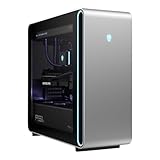
- CPU: Intel Core Ultra 9 285K (24 cores, up to 5.7GHz)
- GPU: NVIDIA GeForce RTX 5090, 32GB GDDR7
- Memory / storage: 64GB DDR5, 4TB SSD
- Power / cooling: liquid cooled; Dell pairs the 285K with a 360mm cooler and a 1500W Platinum ATX12VO PSU
- Connectivity: Wi-Fi 7, 2.5Gb Ethernet; positive-pressure airflow with all fans pulling air in
Best for: players who want 4K at maximum settings with path tracing, or high-refresh 4K OLED owners. Skip if: your room is small or your desk is tight; this is a full-size 80-litre tower.
The Area-51 is the no-compromise option. The RTX 5090 is the fastest consumer graphics card NVIDIA sells, and its 32GB of memory means texture limits are simply not a concern for gaming. It is the only card in this list we would describe as comfortable with path-traced games at 4K, especially with DLSS 4 Multi Frame Generation. Dell backs it with a 1500W Platinum power supply and a 360mm liquid cooler for the 285K, plus a positive-pressure design that uses large intake fans, which reviewers noted helps keep fan speeds and noise in check under load.
There are trade-offs beyond the cost. The case is huge and heavy, the power supply uses the ATX12VO standard rather than a regular ATX unit, and Dell’s implementation has two memory slots with 64GB as the ceiling. For gaming, 64GB is far more than enough. Compared with the Skytech RTX 5090 system in Also Consider, the Area-51 offers Dell’s support and polish, while the Skytech offers AMD’s 16-core X3D chip, which is better for CPU-bound games and heavy creative work.
Based on the spec class, expect the highest frame rates available in any prebuilt at 4K, with upscaling and frame generation pushing many AAA games well past 100fps; results vary by game and settings.
Pros
- RTX 5090 with 32GB handles 4K path tracing
- 64GB RAM and 4TB storage, nothing to upgrade soon
- 1500W Platinum PSU and 360mm liquid cooling
- Positive-pressure airflow keeps dust and noise in check
Cons
- Flagship cost that few gamers truly need
- Very large footprint and heavy
- ATX12VO PSU and two DIMM slots limit DIY changes
Also Consider
Skytech RTX 5090 Flagship (Ryzen 9 9950X3D)

Best for: gamers who also edit video, render or run local AI models. This Skytech pairs AMD’s 16-core Ryzen 9 9950X3D with an RTX 5090 32GB, 64GB of RAM and a 4TB SSD. The 9950X3D keeps the gaming strengths of 3D V-Cache while adding twice the cores of the 8-core X3D chips. Trade-off: it sits in the same flagship tier as the Area-51, and for pure gaming the extra cores add little over a 9800X3D-class chip.
KOTIN Ryzen 7 9800X3D + RTX 5070

Best for: 1440p players who want the top gaming CPU and plan to upgrade the graphics card later. The listing pairs the 9800X3D with an RTX 5070 12GB, 32GB of DDR5 and a 1TB SSD. Trade-off: 12GB of video memory is the tightest in this tier for 1440p high textures, and our number one pick offers a 16GB RTX 5070 Ti plus double the storage in a similar tier.
KOTIN Ryzen 7 9800X3D + RX 9070 XT

Best for: AMD-graphics fans who want 16GB of video memory at 1440p. It combines the 9800X3D with an RX 9070 XT 16GB, 32GB of DDR5 and a 1TB SSD. That is essentially the same gaming core as the Skytech Azure 3, with a slightly older-clocked CPU. Trade-off: 1TB of storage is small, and cooler and power supply details are less clearly listed than on the Skytech.
STORMCRAFT Falcon (Ryzen 7 7800X3D + RX 9070 XT)

Best for: value-minded 1440p gamers. The Ryzen 7 7800X3D is the previous-generation X3D chip but remains a very capable gaming CPU, and the RX 9070 XT 16GB is current. With 32GB DDR5 and a 1TB SSD, it is one of the cheaper ways into a 16GB-card system here. Trade-off: the CPU is a generation behind, so it has slightly less headroom for future high-refresh play.
ZOTAC MEK (Ryzen 7 9700X + RTX 5060 Ti 16GB)

Best for: 1080p and light 1440p gamers who want more video memory than the MSI Codex Z2 offers. ZOTAC builds the graphics card itself, and the listing specifies the 16GB RTX 5060 Ti alongside a Zen 5 Ryzen 7 9700X. Trade-off: it lands close in tier to the CyberPowerPC at number one, which has a much faster GPU, so check pricing carefully before choosing it.
ASUS ROG NUC 16 Mini PC

Best for: small desks, dorm rooms and living-room TVs. This roughly 3-litre mini PC uses a Core Ultra 9 290HX Plus and the laptop version of the RTX 5070 Ti with 12GB, plus 32GB DDR5, Thunderbolt 4, HDMI 2.1 and Wi-Fi 7, powered by an external 380W adapter. Trade-off: the mobile GPU is clearly slower than the desktop RTX 5070 Ti, and you pay a premium for the size.
How We Chose
We did not physically test these machines. Our picks are research-based: we compared manufacturer spec sheets, retailer listing specs and independent reviews of the core components and, where available, the systems themselves. We started from the gaming desktops currently listed and in stock, removed outdated or off-intent systems, and kept no more than two main picks per brand.
Our selection criteria were:
- Graphics tier versus target resolution: does the GPU class match the resolution and refresh rate the machine is aimed at?
- Video memory: 16GB preferred at 1440p and above; 8GB accepted only at the budget 1080p tier.
- Gaming CPU strength: priority to X3D Ryzen chips for high-refresh play, with Intel Core Ultra picks where multitasking or brand support adds value.
- Balance and longevity: 32GB RAM, at least 1TB storage, a power supply with sensible headroom and a known upgrade path.
- Room fit: cooling design, case size and noise-related design choices such as large intake fans or 360mm coolers.
- Support: warranty terms and the size of the maker’s service network.
Performance figures in this guide are estimates based on component class and published reviews of those components. They are not measurements, and real results vary with game, settings, drivers and room temperature. You can learn more about how graphics cards compare on cost in our graphics card performance-per-dollar guide.
Gaming Desktop Buying Guide for 2026
Match the GPU Tier to Your Resolution and Refresh Rate
Your monitor decides most of the budget. Use this table as a starting point. Frame-rate ranges are approximate estimates for modern games at high settings, and they vary widely by title, settings and upscaling.
| Target | Recommended GPU class | Minimum VRAM | Approximate AAA range (varies) | Typical system budget band |
|---|---|---|---|---|
| 1080p 144Hz to 240Hz, esports | RTX 5060 Ti or similar | 8GB (16GB better) | Roughly 60 to 100fps | Around $1,300 to $2,000 |
| 1440p 144Hz to 165Hz | RTX 5070 / RTX 5070 Ti / RX 9070 XT | 12GB (16GB better) | Roughly 70 to 120fps | Around $1,800 to $2,700 |
| 1440p 240Hz+, competitive | RTX 5070 Ti / RX 9070 XT with an X3D CPU | 16GB | Esports far above 200fps; AAA roughly 90 to 140fps | Around $2,000 to $3,000 |
| 4K 60Hz to 144Hz | RTX 5080 | 16GB | Roughly 60 to 120fps with upscaling | Around $3,000 to $4,000 |
| 4K max settings / path tracing | RTX 5090 | 32GB | Roughly 80fps and up with upscaling and frame generation | Well above $5,000 |
Budget bands reflect the 2026 memory shortage, which has pushed both RAM and graphics card prices higher than in previous years. For a deeper look at the 1440p sweet spot, see our 1440p 144Hz graphics card guide, and for card-by-card options see our best graphics cards roundup.
Pick a CPU for Your Game Types
For esports and high-refresh play, the processor often caps your frame rate before the GPU does. AMD’s X3D chips (7800X3D, 9800X3D, 9850X3D, 9950X3D) are the strongest choice here because their large cache smooths out frame times. For AAA single-player games at 4K, the GPU matters far more, so a Core Ultra 9 or a regular Ryzen 7 is perfectly fine. If you stream, record or run many background apps, a higher core count such as the 20-core Core Ultra 7 265F or the 16-core 9950X3D helps. Eight modern cores is the sensible minimum for any gaming desktop in 2026.
How Much RAM and Storage You Actually Need
Treat 32GB of DDR5 as the standard for a new gaming desktop. Some recent AAA games list 32GB in their recommended specs, and Discord, browsers and launchers add a few gigabytes on top. 16GB still works for esports, but plan to upgrade. 64GB only makes sense if you also do heavy video editing or AI work. For storage, 1TB is the floor, and 2TB is the comfortable target; big AAA titles commonly need 100GB or more each. An NVMe Gen4 SSD is plenty fast for gaming, including games that use DirectStorage.
Noise, Heat and Size for Your Room
Think about where the PC will live. In a bedroom or shared living space, look for a 280mm or 360mm liquid cooler or a large air cooler, plenty of intake fans and a case with room to breathe; more fans at lower speed are usually quieter than a few fans at high speed. RTX 5090 systems put out a lot of heat, which can warm a small room noticeably during long sessions. If space is the main limit, mini PCs like the ROG NUC 16 fit almost anywhere but give up GPU performance. Leave several inches of clearance behind and above any tower for airflow.
Power Supply and Upgrade Headroom
The power supply decides how far you can upgrade later. As a rough guide, 650W suits RTX 5060 Ti class builds, 750W to 850W suits RTX 5070 Ti and RTX 5080 class builds, and RTX 5090 systems should have 1000W or more. Look for 80 Plus Gold or better, and for an ATX 3.x unit with a native 12V-2×6 connector on high-end NVIDIA builds. Standard ATX parts make upgrades easy; proprietary motherboards, ATX12VO units or limited memory slots make them harder.
Warranty, Support and What Is in the Box
Big brands such as Dell and Lenovo offer larger service networks and optional on-site plans. Boutique builders often use more standard parts and better coolers at a given tier but have smaller support teams. Check the parts and labor warranty length, who pays return shipping, and whether a keyboard, mouse or Wi-Fi is included. Wi-Fi 6E or Wi-Fi 7 is worth having if you cannot run Ethernet; for competitive play, a wired connection is still best, as covered in our input lag guide.
Mistakes to Avoid When Buying a Gaming Desktop
Buying more GPU than your monitor can show. An RTX 5090 on a 1080p 144Hz monitor is mostly wasted. Match the graphics tier to your display first, or budget for a monitor upgrade at the same time.
Ignoring video memory. Two cards can carry the same model name with different memory amounts, as with the RTX 5060 Ti 8GB and 16GB versions. At 1440p and above, 8GB can force lower texture settings in new games. Always confirm the VRAM figure on the listing.
Pairing a weak CPU with a high-refresh monitor. If you play Counter-Strike 2, Valorant or Fortnite on a 240Hz or faster panel, the processor matters a lot.
Overlooking storage and RAM. A 1TB drive and 16GB of RAM can feel fine on day one and cramped within months.
Forgetting the room. A full-tower flagship under a small desk in a warm bedroom will be louder and hotter than you expect.
Judging by the CPU name alone. A 24-core chip is not automatically a better gaming CPU than an 8-core X3D chip. For gaming, cache and per-core speed matter more than core count. If you are already dealing with performance problems on an older PC, our FPS drop troubleshooting guide can help you find out whether the CPU or GPU is your real bottleneck before you buy.
Frequently Asked Questions
Is it cheaper to build or buy a gaming PC in 2026?
In 2026, buying prebuilt is often close to or even cheaper than building. The memory shortage raised retail RAM and GPU prices, while large system builders buy parts in bulk. Building still gives you full control over part quality, but the old rule that DIY always saves money no longer holds for most mid-range and high-end configurations.
What is a good GPU for 1440p gaming?
An RTX 5070 Ti or Radeon RX 9070 XT is the best all-round 1440p choice in 2026. Both have 16GB of video memory and handle high settings at high refresh rates in most games. The RTX 5070 with 12GB works at 1440p too, but leaves less room for high-resolution textures in newer games.
Is the Ryzen 7 9800X3D still worth it over the 9850X3D?
Yes, for most gamers the 9800X3D is still the better value. The 9850X3D is a higher-clocked version with the same 96MB of L3 cache, and independent reviews found it only a few percent faster at best. Choose the 9850X3D only when the system price difference is small.
How much RAM does a gaming desktop need in 2026?
32GB of DDR5 is the right amount for a new gaming desktop in 2026. Several recent AAA games recommend it, and it leaves room for Discord, browsers and streaming software. 16GB still works for esports titles but should be treated as a minimum, while 64GB mainly benefits creators and heavy multitaskers.
Is an RTX 5090 overkill for gaming?
For most gamers, yes. The RTX 5090 makes sense for 4K at maximum settings, path-traced games or very high-refresh 4K OLED monitors. At 1440p, an RTX 5070 Ti or RTX 5080 delivers most of the experience for far less. The 5090 also needs a large power supply and puts out significant heat.
Are mini gaming PCs as fast as towers?
No, mini gaming PCs are usually slower than towers at the same price. Most use laptop-class graphics chips, such as the RTX 5070 Ti Laptop GPU in the ROG NUC 16, which run at lower power than desktop cards. They are a great fit when space matters more than raw speed, such as under a TV.
How long will a gaming desktop last?
A well-balanced gaming desktop typically stays capable for four to six years, with a graphics card upgrade extending that further. Systems with 16GB GPUs, 32GB of RAM, a quality power supply and a modern platform like AM5 or Intel’s LGA 1851 age best. Budget machines with 8GB GPUs tend to need settings cuts sooner.
Is AMD or NVIDIA better for a gaming desktop?
Both are good choices in 2026; the right one depends on your games. NVIDIA leads in ray tracing, path tracing and DLSS support, and its NVENC encoder is popular with streamers. AMD’s RX 9070 XT offers 16GB of memory and strong traditional rendering, with FSR 4 for upscaling, often at a lower tier than comparable NVIDIA systems.
Which Gaming Desktop Should You Buy?
- First gaming PC, esports at 1080p: MSI Codex Z2, or the ZOTAC MEK if you want a 16GB card.
- Most gamers at 1440p 144Hz to 240Hz: CyberPowerPC Gamer Supreme.
- Competitive shooters on a 240Hz+ panel, AMD fans: Skytech Azure 3.
- Streamers and multitaskers: Lenovo Legion Tower 5i.
- 4K gamers who want the best value: STORMCRAFT Phantom.
- 4K gamers who want brand support for a shared room: Alienware Aurora.
- No-compromise 4K and path tracing: Alienware Area-51, or the Skytech RTX 5090 system if you also create content.
- Small spaces and TV setups: ASUS ROG NUC 16.
If you are buying for an older family member who wants a simpler, quieter setup, our gaming PC guide for seniors covers that angle in more detail.
Final Verdict
For most players, the CyberPowerPC Gamer Supreme with a Ryzen 7 9800X3D and RTX 5070 Ti is the best gaming desktop in 2026 because it puts the money where gamers feel it: a top gaming CPU, a 16GB graphics card and enough storage for a real library. Competitive players who prefer AMD graphics should look at the Skytech Azure 3, budget buyers at the MSI Codex Z2, and 4K players at the STORMCRAFT Phantom or, with no budget ceiling, the Alienware Area-51. Start from your monitor, match the GPU tier, and you will end up with a machine that feels right for years.
Sources
- NVIDIA GeForce RTX 50 Series graphics cards
- AMD Radeon RX 9070 XT specifications
- AMD Ryzen 7 9800X3D specifications
- Gamers Nexus: AMD Ryzen 7 9850X3D CPU review
- Dell: Alienware Area-51 gaming desktop
Last updated: October 9, 2026
Ready to decide? Our #1 pick for 2026 is the CyberPowerPC Gamer Supreme.
Live price & availability on Amazon.