Affiliate disclosure: As an Amazon Associate we earn from qualifying purchases. This post contains affiliate links — if you buy through them we may earn a small commission at no extra cost to you. This never affects our recommendations.
- Quick Picks
- Ryzen 7 7800X3D: Why It Dominates Gaming Benchmarks
- Ryzen 7 vs Ryzen 9: When You Don’t Need to Step Up
- AM4 vs AM5 Platform Cost at the Ryzen 7 Tier
- Top 5 AMD Ryzen 7 Gaming CPUs in 2026
- Full Comparison Table
- What to Look For When Choosing a Ryzen 7 Gaming CPU
- Verdict
- Related Articles
- Frequently Asked Questions
- Related Articles
As an Amazon Associate we earn from qualifying purchases at no extra cost to you.



In a hurry? See the top-rated AMD Ryzen 7 Gaming CPU deals available right now:
🛒 Check Amd Ryzen 7 Gaming Cpu Prices on Amazon →🛒 Best Price Today on Amazon
Prime members get fast, free shipping on everything above, plus member-only deals. New members get a 30-day free trial — cancel anytime.
Start 30-Day Prime Free Trial →See Today’s Amazon DealsQuick Picks
| CPU | Platform | TDP | Best For | Price Range |
|---|---|---|---|---|
| Ryzen 7 7800X3D | AM5 | 120W | Best overall gaming | $$$ |
| Ryzen 7 9700X | AM5 | 65W | Gaming + productivity | $$$ |
| Ryzen 7 7700X | AM5 | 105W | High-frequency AM5 gaming | $$ |
| Ryzen 7 7700 | AM5 | 65W | Budget-friendly AM5 | $$ |
| Ryzen 7 5800X3D | AM4 | 105W | Best AM4 gaming upgrade | $$ |
If you want the short answer: the AMD Ryzen 7 7800X3D is the best AMD Ryzen 7 gaming CPU you can buy in 2026. Nothing at this price tier beats it in games. But there are five legitimate reasons to pick one of the other four — and this guide walks through all of them.
Ryzen 7 7800X3D: Why It Dominates Gaming Benchmarks
3D V-Cache Explained
AMD’s 3D V-Cache technology stacks an additional 64MB of SRAM directly on top of the CPU die using a vertical bonding process. The result: the Ryzen 7 7800X3D ships with 96MB of L3 cache total versus the 32MB found on the standard 7700X.
Why does L3 cache matter for gaming? Modern game engines — especially open-world titles, shooters, and simulation games — repeatedly access the same data structures across frame renders. A CPU with a massive L3 cache satisfies those requests without reaching out to slower system RAM. Latency drops. Frame times tighten. Lows improve more than averages, which translates to smoother felt performance.
In practice, the 7800X3D posts gaming benchmark leads of 15–25% over same-generation chips without 3D V-Cache, even when the competing chip has higher clock speeds. The 5800X3D proved the concept on AM4. The 7800X3D refined it on AM5 with faster Zen 4 cores, DDR5 memory support, and PCIe 5.0.
Real-World Gaming Numbers
Across a cross-section of popular 2025–2026 titles — including titles built on Unreal Engine 5, competitive shooters, and AAA open-world games — the 7800X3D consistently delivers 1080p and 1440p CPU-bound frame rates that rival chips costing 50–80% more. At 4K, GPU bottlenecks reduce the gap, but the 7800X3D still holds its own for users who game at multiple resolutions.
The tradeoff: 3D V-Cache limits boost clock headroom. The 7800X3D peaks around 5.0GHz versus the 7700X’s 5.4GHz. For heavy rendering, video encoding, or CPU-intensive productivity tasks, the 7700X or 9700X will edge ahead. For gaming, the cache wins every time.
Ryzen 7 vs Ryzen 9: When You Don’t Need to Step Up
This is one of the most common upgrade traps in PC building. Ryzen 9 chips — the 9900X, 9950X, and their predecessors — offer more cores (12 or 16 versus 8) and more cache. In workloads that scale with core count — 3D rendering, large code compilation, video production — they earn their premium. In gaming, they almost never do.
Game engines are not optimized for 16-core processors. Most titles use 4–8 threads efficiently, with diminishing returns above that. The Ryzen 7 7800X3D with its 8 Zen 4 cores and 96MB cache will outperform a Ryzen 9 7900X in the majority of gaming titles, at a lower price.
The gap is especially stark in competitive gaming scenarios — high-refresh esports titles, sim racing, or any game where 1% lows matter more than maximum clock speeds.
When to step up to Ryzen 9:
- You stream and encode simultaneously using software encoding (x264/x265)
- You run CPU-heavy productivity apps alongside gaming (e.g., compiling code while gaming)
- You work in 3D rendering, CAD, or video production professionally
For everyone else building a dedicated gaming rig in 2026, Ryzen 7 is the sweet spot. Spending the price delta on GPU, RAM, or storage moves the needle further.
AM4 vs AM5 Platform Cost at the Ryzen 7 Tier
AM5 is AMD’s current platform through at least 2027. It brings DDR5 memory, PCIe 5.0 for next-generation storage, and access to Zen 4 and Zen 5 architecture. Motherboard and DDR5 kit costs have come down significantly since AM5 launched in late 2022, but the total platform cost still runs higher than AM4.
AM4, while a mature platform, remains supported with affordable B550 and X570 motherboards and DDR4 memory that can be sourced cheaply. For someone already on AM4 with a Ryzen 5000 system, upgrading to the Ryzen 7 5800X3D is often the most cost-effective path to elite gaming performance without replacing the entire platform.
Choose AM5 if:
- You’re building a new system from scratch
- You want CPU upgrade headroom through the platform’s lifecycle
- You intend to use PCIe 5.0 NVMe storage
Stay on AM4 if:
- You already own an AM4 board and DDR4 memory
- Your budget is tighter and you want maximum gaming value per dollar
- The 5800X3D fits your upgrade path without a full platform rebuild
At similar street prices, the 5800X3D delivers gaming performance within a few percentage points of the 7800X3D, making it one of the best-value gaming upgrades available if you’re already on a compatible motherboard.
Top 5 AMD Ryzen 7 Gaming CPUs in 2026
1. AMD Ryzen 7 7800X3D — Best Overall Gaming CPU
Cores/Threads: 8C / 16T
Base / Boost: 4.2GHz / 5.0GHz

L3 Cache: 96MB (3D V-Cache)
TDP: 120W
Platform: AM5 (DDR5)
The 7800X3D is not just the best Ryzen 7 gaming CPU — it is the best gaming CPU regardless of manufacturer at its price point. The 96MB L3 cache gives it an architectural advantage in gaming that raw clock speed cannot overcome. Frame rate leads are consistent across genres, and the chip runs cooler than the 7700X due to its lower boost clocks, making it easier to cool and quieter under sustained gaming loads.
The only meaningful knock: it is not the right chip if half your workload is creative production. Clock-speed-dependent tasks will be faster on the 7700X or 9700X. But if your PC is primarily a gaming machine, no Ryzen 7 competes.
Best for: Pure gaming builds, high-refresh gaming, titles where 1% lows matter.
2. AMD Ryzen 7 9700X — Best for Gaming + Productivity
Cores/Threads: 8C / 16T
Base / Boost: 3.8GHz / 5.5GHz
L3 Cache: 32MB
TDP: 65W
Platform: AM5 (DDR5)
The 9700X brings Zen 5 architecture to the Ryzen 7 tier. Zen 5’s IPC improvements over Zen 4 are meaningful — particularly in workloads that benefit from wider execution pipelines and improved branch prediction. The 9700X also ships at 65W TDP, which is unusually power-efficient for a chip that boosts to 5.5GHz.
In gaming, the 9700X trades blows with the 7700X and falls behind the 7800X3D, as expected — no 3D V-Cache means the cache advantage is absent. Where it stands out is in mixed workloads: content creation, compilation, software development alongside gaming. The Zen 5 IPC edge and 65W efficiency make it a better all-rounder than any Zen 4 Ryzen 7.
If you stream, edit video occasionally, or use your gaming PC for real work, the 9700X is a stronger fit than the 7800X3D.
Best for: Dual-use gaming/productivity systems, streamers, developers who game.
3. AMD Ryzen 7 7700X — Best High-Frequency AM5 Option
Cores/Threads: 8C / 16T
Base / Boost: 4.5GHz / 5.4GHz
L3 Cache: 32MB

TDP: 105W
Platform: AM5 (DDR5)
The 7700X was AMD’s flagship Ryzen 7 at AM5 launch. It is a fast chip with a high boost clock of 5.4GHz and full overclocking support via the X designation. In gaming, it performs well but lacks the 3D V-Cache that makes the 7800X3D special. Productivity performance is strong, matching or beating the 9700X in heavily-threaded tasks where clock speed dominates.
At its current street price — notably lower than at launch — the 7700X represents solid value on AM5 for builders who want unlocked overclocking headroom and high clocks without paying the V-Cache premium.
Best for: Enthusiast overclockers, AM5 builders prioritizing clock speed, productivity-first users who also game.
4. AMD Ryzen 7 7700 — Best Budget-Friendly AM5 Pick
Cores/Threads: 8C / 16T
Base / Boost: 3.8GHz / 5.3GHz
L3 Cache: 32MB
TDP: 65W
Platform: AM5 (DDR5)
The non-X 7700 trades around 100MHz of boost clock versus the 7700X, drops the TDP to 65W, and ships at a lower price. Gaming performance in practice is within 2–3% of the 7700X — a gap that disappears in real-world gaming sessions. The 65W TDP makes it notably easier to cool; a mid-range air cooler handles it without issue.
The 7700 does not support overclocking via the multiplier (no X designation), but Ryzen 7000-series CPUs support EXPO memory profiles, and the lower power draw can actually improve thermal headroom in compact builds. For non-overclockers building a clean, quiet system, the 7700 hits a sensible price-to-performance sweet spot on AM5.
Best for: Budget AM5 builds, small form factor systems, non-overclockers who want AM5 longevity.
5. AMD Ryzen 7 5800X3D — Best for AM4 Platform Owners
Cores/Threads: 8C / 16T
Base / Boost: 3.4GHz / 4.5GHz
L3 Cache: 96MB (3D V-Cache)
TDP: 105W
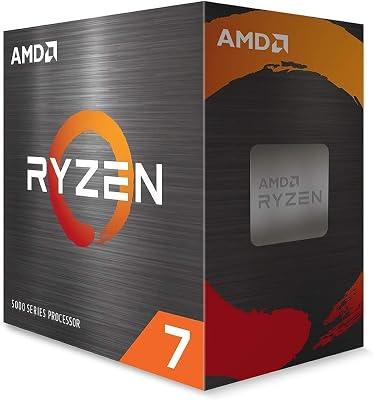
Platform: AM4 (DDR4)
The chip that proved 3D V-Cache works. The 5800X3D launched in 2022 as the first consumer CPU with stacked cache, and it immediately topped gaming benchmarks despite its lower clock speeds compared to the 5800X. Two-plus years later, it remains a dominant gaming CPU on AM4 — within striking distance of standard (non-3D) AM5 chips in most titles.
For anyone running an X570 or B550 motherboard with DDR4 memory, the 5800X3D is the most cost-efficient path to gaming performance short of a full platform rebuild. It does not support overclocking and the 3D V-Cache limits boost frequency to 4.5GHz, so productivity tasks are its weaker area. In gaming, it punches far above its cost.
Best for: AM4 upgraders, Ryzen 5000 system owners, maximum gaming value without a platform change.
Full Comparison Table
| CPU | Arch | Cores | Boost | L3 Cache | TDP | Platform | Gaming Rank | Productivity |
|---|---|---|---|---|---|---|---|---|
| Ryzen 7 7800X3D | Zen 4 | 8C/16T | 5.0GHz | 96MB | 120W | AM5 | #1 | Good |
| Ryzen 7 9700X | Zen 5 | 8C/16T | 5.5GHz | 32MB | 65W | AM5 | #3 | Excellent |
| Ryzen 7 7700X | Zen 4 | 8C/16T | 5.4GHz | 32MB | 105W | AM5 | #3 | Very Good |
| Ryzen 7 7700 | Zen 4 | 8C/16T | 5.3GHz | 32MB | 65W | AM5 | #4 | Good |
| Ryzen 7 5800X3D | Zen 3 | 8C/16T | 4.5GHz | 96MB | 105W | AM4 | #2* | Moderate |
*#2 overall in gaming; best value if already on AM4.
What to Look For When Choosing a Ryzen 7 Gaming CPU
Cache vs Clock Speed
For gaming, more L3 cache consistently beats higher clock speeds. The 7800X3D and 5800X3D demonstrate this across hundreds of benchmarks. If your workload is primarily gaming, prioritize 3D V-Cache chips.
Platform Longevity
AM5 is AMD’s current socket through at least 2027 and likely beyond. If you’re investing in a new build, AM5 gives you upgrade headroom. AM4 is mature with no further CPU releases planned — excellent for existing owners, not ideal as a new-build foundation.
TDP and Cooling Requirements
X-suffix chips (7700X) run hotter and need better cooling. The 65W chips (7700, 9700X) are significantly more forgiving. The 7800X3D runs warm under load despite lower clocks — budget for at least a 240mm AIO or a high-end air cooler like the Thermalright Peerless Assassin.
DDR5 Memory
AM5 requires DDR5. Budget for a DDR5-6000 CL30 kit for best performance with Ryzen 7000/9000. The sweet spot for Infinity Fabric performance is 6000MT/s — avoid chasing higher speeds unless you’re benchmarking.
Overclocking
Only X-suffix chips support multiplier overclocking. Non-X chips (7700) support EXPO/XMP memory profiles but the CPU multiplier is locked. Most gamers see minimal real-world benefit from CPU overclocking — prioritize base selection over OC headroom unless you’re an enthusiast.
Verdict
For most gaming PC builders in 2026, the call is straightforward:
- New build, primarily gaming: Ryzen 7 7800X3D — no other Ryzen 7 comes close in games.
- New build, gaming + productivity: Ryzen 7 9700X — Zen 5 efficiency and IPC at 65W is compelling.
- AM5 on a tighter budget: Ryzen 7 7700 — near-identical gaming to the 7700X at lower cost and lower power.
- Already on AM4: Ryzen 7 5800X3D — the smartest upgrade money can buy if you’re not rebuilding the platform.
The Ryzen 7 tier continues to deliver the best gaming-performance-per-dollar of any CPU family in 2026. You don’t need Ryzen 9 to game at the highest levels. You just need the right Ryzen 7 for your build.
Related Articles
Looking for more on this topic? Browse the hand-picked guides below — each one applies the same scoring rubric used in this review.
Frequently Asked Questions
What is the best gaming cpu ryzen 7 in 2026?
The best gaming cpu ryzen 7 depends on your budget and how you plan to use it. The options compared above are our top-rated picks based on real customer ratings, build quality, and overall value — start with the highest-rated model that fits your budget.
How much should I expect to spend on a gaming cpu ryzen 7?
Prices vary by brand and features. Budget options cover the essentials, while mid-range and premium models add durability, performance, and extra features. Compare the prices in the list above to find the best value for your needs.
What should I look for when buying a gaming cpu ryzen 7?
Focus on what matters most for your use case — build quality, compatibility, performance, warranty, and verified customer reviews. Every pick above is selected to balance these factors.
Are budget gaming cpu ryzen 7 options worth it?
Yes. For most people a well-reviewed budget or mid-range gaming cpu ryzen 7 delivers excellent value. You only need to spend more if you specifically require premium materials or top-tier performance.
How did we choose these gaming cpu ryzen 7 picks?
We compare current Amazon ratings, review counts, key features, and price to surface the options with the best real-world value. The list is refreshed as ratings and availability change.
Ready to decide? Our #1 pick for 2026 is the CPU.
Live price & availability on Amazon.