

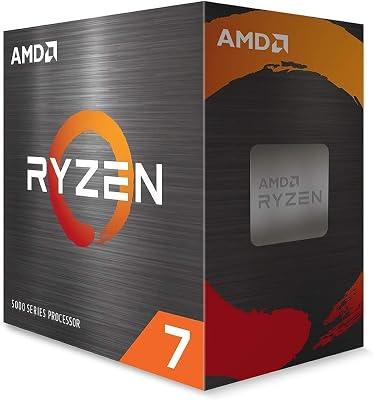
- Top Pick: AMD Ryzen™ 7 9700X 8-Core, 16-Thread Unlocked Desktop Processor
- Best Value: KOTIN Prebuilt Gaming PC Ryzen 7 9700X 16GB DDR5 RTX 5060 Ti 8GB 1TB SSD
- Premium Choice: Skytech Gaming Shadow Gaming PC, AMD Ryzen 7 9700X 3.8GHz, NVIDIA RTX 5060 Ti 8GB VRAM, 1TB NVMe SSD, 32GB DDR5 RAM 5600, 650W Gold PSU, 360 ARGB AIO, Wi-Fi, Win 11, Desktop
Affiliate disclosure: As an Amazon Associate we earn from qualifying purchases. This post contains affiliate links — if you buy through them we may earn a small commission at no extra cost to you. This never affects our recommendations.
As an Amazon Associate we earn from qualifying purchases at no extra cost to you.





The AMD Ryzen 7 9700X is one of the most compelling mainstream gaming CPUs you can buy in 2026 — and it earns that title not by brute-force wattage, but by delivering exceptional gaming performance at a remarkably civilized 65W TDP. Built on AMD’s Zen 5 architecture and dropping into the forward-looking AM5 platform, the 9700X pairs 8 cores and 16 threads with meaningful IPC gains over its predecessors, making it a strong choice for builders who want high-fps gaming without a furnace under their desk.
This is not the fastest gaming CPU on the market — the Ryzen 7 7800X3D and its successor still hold the 1080p gaming crown thanks to AMD’s 3D V-Cache technology. But the 9700X closes that gap considerably while running cooler, drawing less power, and fitting comfortably into compact and mid-tower builds alike. Compared to Intel’s Core i7-14700K, the 9700X trades a few multi-core workload wins for a dramatically lower power envelope and a platform with a longer upgrade path. If efficiency, value, and future-proofing matter to you as much as raw frame rates, the Ryzen 7 9700X deserves serious consideration.
In a hurry? See the top-rated AMD Ryzen 7 9700X Gaming CPU deals available right now:
🛒 Check Amd Ryzen 7 9700X Gaming Cpu Prices on Amazon →🛒 Best Price Today on Amazon
Prime members get fast, free shipping on everything above, plus member-only deals. New members get a 30-day free trial — cancel anytime.
Start 30-Day Prime Free Trial →See Today’s Amazon DealsCPU Comparison Table
| CPU | Cores / Threads | Gaming Perf (1080p) | TDP | Platform | 2026 Price (est.) |
|---|---|---|---|---|---|
| AMD Ryzen 7 9700X | 8C / 16T | Excellent | 65W | AM5 (DDR5) | ~$299 |
| AMD Ryzen 7 7800X3D | 8C / 16T | Best-in-class | 120W | AM5 (DDR5) | ~$349 |
| AMD Ryzen 7 9800X3D | 8C / 16T | Best-in-class+ | 120W | AM5 (DDR5) | ~$449 |
| Intel Core i7-14700K | 20C / 28T | Very Good | 125W (253W boost) | LGA1700 (DDR5/4) | ~$279 |
| AMD Ryzen 5 9600X | 6C / 12T | Very Good | 65W | AM5 (DDR5) | ~$199 |
> Prices are approximate US street prices as of mid-2026. Gaming performance ratings reflect 1080p averages across a broad game library.
Ryzen 7 9700X Gaming Performance
At 1080p — where the CPU is the primary performance bottleneck — the Ryzen 7 9700X consistently delivers frame rates that rival or beat the previous-generation Ryzen 7 7700X by 10–15%, thanks to the substantial IPC improvements baked into Zen 5. In titles like Cyberpunk 2077, Rainbow Six Siege, Counter-Strike 2, and Baldur’s Gate 3, the 9700X pushes averages well above 144 fps when paired with a mid-to-high-end GPU like an RTX 4070 or RX 7900 GRE.
At 1440p, the performance delta between CPUs narrows as the GPU becomes the limiting factor. Here the 9700X is essentially indistinguishable from the Core i7-14700K in most gaming workloads, and only slightly behind the Ryzen 7 7800X3D in cache-sensitive titles like Hogwarts Legacy and Microsoft Flight Simulator.
At 4K, virtually every modern GPU becomes the bottleneck regardless of CPU choice. At this resolution, the 9700X performs identically to chips costing twice as much — making it an excellent pairing for 4K gaming builds where budget is better spent on GPU.
Where the 7800X3D (and 9800X3D) still wins: In the most cache-sensitive titles, AMD’s 3D V-Cache chips maintain a measurable advantage — typically 10–20% higher average fps at 1080p. Games like Starfield, The Last of Us Part I, Forza Horizon 5, and various simulation titles see the biggest gaps. If you play these titles competitively or prioritize absolute peak 1080p performance, the 3D V-Cache CPUs are worth the premium. For everyone else, the 9700X’s real-world gaming experience is outstanding.
> Check current Ryzen 7 9700X pricing on Amazon
Ryzen 7 9700X Efficiency and Platform Advantages
The headline spec that sets the 9700X apart from its AM5 siblings — and from most Intel competition — is its 65W TDP. This is not a marketing figure that gets abandoned the moment you game; AMD’s Precision Boost algorithm keeps the chip within a genuinely modest power envelope under typical gaming loads, often drawing just 55–75W in real-world sessions.
What does this mean practically?

- Smaller coolers work fine. A quality 120mm or 240mm AIO, or even a high-end air cooler like the Noctua NH-U12A, handles the 9700X without breaking a sweat. No 360mm radiator required.
- ITX and mATX builds become viable. The 9700X is one of the few high-performance gaming CPUs that fits comfortably in a small form factor case without thermal throttling or excessive fan noise.
- Lower electricity costs over time. Running 60W less than a Core i7-14700K at full load adds up — especially for long gaming sessions or streamers who leave their PC on for hours.
- Quieter operation. Less heat means fans spin slower, which means a noticeably quieter system.
AM5 Platform Longevity
AMD has committed to the AM5 socket through at least 2027, and likely beyond. This means your 9700X motherboard will support future Ryzen generations — a significant advantage over Intel’s LGA1700 platform, which has already reached end-of-life. Pairing the 9700X with a B650 or X670E board today means you can upgrade to a Ryzen 9 9950X or future Zen 6 chip without swapping motherboards.
DDR5 Performance
AM5 is DDR5-only, and the Ryzen 7 9700X benefits meaningfully from fast memory. Running DDR5-6000 in EXPO mode (AMD’s equivalent of XMP) delivers the best price-to-performance balance — tighter subtimings at this speed hit the memory controller’s sweet spot. Most quality DDR5 kits ship with pre-configured EXPO profiles that require just a single BIOS toggle to enable.
Precision Boost Overdrive (PBO)
For enthusiasts who want to squeeze more performance without a full manual overclock, PBO unlocks higher boost frequencies and allows the chip to draw slightly more power when thermals permit. With a decent cooler, PBO can add 3–5% gaming performance and significantly more in multi-threaded workloads — all within AMD’s supported tuning framework.
Best Motherboards for Ryzen 7 9700X
The Ryzen 7 9700X’s 65W TDP means you do not need an expensive VRM-heavy X670E board to run it stably. A solid B650 board handles it perfectly, while X670E boards offer PCIe 5.0 storage and additional overclocking headroom for those who want it.
Budget-to-Midrange: B650 Picks
1. ASUS ROG STRIX B650-A Gaming WiFi
A clean, feature-rich B650 board with solid VRMs, 2.5G LAN, Wi-Fi 6E, and a refined BIOS. Handles PBO and memory overclocking with ease. Excellent value for the 9700X.

2. MSI MAG B650 TOMAHAWK WiFi
The Tomahawk line has a strong reputation for build quality and BIOS maturity. Good VRM thermals, dual M.2 slots, and reliable DDR5 EXPO compatibility make this a go-to recommendation for mid-range 9700X builds.
3. Gigabyte B650 AORUS Elite AX
AORUS boards offer excellent memory compatibility lists and strong out-of-box DDR5 tuning. The Elite AX includes Wi-Fi 6E and a clean layout that suits both ATX towers and semi-compact builds.
Premium: X670E Pick
4. ASUS ROG CROSSHAIR X670E HERO
If you want PCIe 5.0 for an NVMe SSD, extensive overclocking controls, and a flagship-class BIOS for dialing in EXPO profiles, the Crosshair Hero is the definitive enthusiast pairing for the 9700X. Overkill for most users, but unbeatable for those who want the best AM5 has to offer.
> View on Amazon
Ryzen 7 9700X vs Ryzen 7 7800X3D vs Core i7-14700K — Which to Buy?
This is the core decision most buyers face in 2026. Here is the honest breakdown:
Choose the Ryzen 7 9700X if
- You want excellent gaming performance without paying the 3D V-Cache premium
- You are building a small form factor or compact mid-tower system where power and heat matter
- You plan to upgrade within the AM5 ecosystem in the next 2–3 years
- You do a mix of gaming and productivity work — the 9700X handles video editing, streaming, and light creative workloads well
- Budget is a consideration and the ~$50–150 price difference over 3D V-Cache chips is meaningful to you
> Buy the AMD Ryzen 7 9700X on Amazon
Choose the Ryzen 7 7800X3D or 9800X3D if
- You play cache-sensitive games (Starfield, MSFS, many open-world RPGs) at 1080p and want maximum frames
- You have a high-refresh-rate monitor (240Hz+) and the extra 10–20 fps in those titles matters to you
- Budget is not a constraint and you simply want the fastest gaming CPU available
> View Ryzen 7 9800X3D on Amazon
Choose the Core i7-14700K if
- You find it at a steep discount and already own an LGA1700 motherboard
- You need heavy multi-threaded performance (rendering, compilation) and gaming is secondary
- You are not concerned about power consumption or noise
The honest caveat on the i7-14700K: its 125W base TDP surges past 250W under multi-core load, it runs significantly hotter, and the LGA1700 platform is end-of-life. For a new build in 2026, the 9700X is the stronger long-term investment in almost every scenario.
Final Verdict
The AMD Ryzen 7 9700X is the efficiency king of mainstream gaming CPUs in 2026, and it earns that crown decisively. Its Zen 5 IPC improvements deliver a genuine generational leap over the Ryzen 7 7700X, its 65W operation opens the door to smaller builds and quieter systems, and the AM5 platform gives you a clear upgrade path for years ahead.
Is it the absolute fastest gaming CPU money can buy? No — AMD’s 3D V-Cache chips still hold that title in cache-hungry titles. But for the vast majority of gamers playing at 1440p or 4K, or even at 1080p across a broad game library, the 9700X delivers an experience that is indistinguishable from the best in real-world play — at a lower price, lower power draw, and lower noise floor.
For ITX builders, efficiency-focused mid-tower rigs, and anyone who wants a capable all-rounder that will serve them well for years, the Ryzen 7 9700X is one of the smartest CPU purchases you can make right now.
> Buy the AMD Ryzen 7 9700X on Amazon — Check Today’s Price
Pair it with a [B650 motherboard](#best-motherboards-for-ryzen-7-9700x), 32GB of DDR5-6000, and a GPU that matches your resolution target, and you have a gaming PC that will hold its own deep into the decade.
Related Articles
Looking for more on this topic? Browse the hand-picked guides below — each one applies the same scoring rubric used in this review.
Frequently Asked Questions
What is the best gaming cpu ryzen 7 9700x in 2026?
The best gaming cpu ryzen 7 9700x depends on your budget and how you plan to use it. The options compared above are our top-rated picks based on real customer ratings, build quality, and overall value — start with the highest-rated model that fits your budget.
How much should I expect to spend on a gaming cpu ryzen 7 9700x?
Prices vary by brand and features. Budget options cover the essentials, while mid-range and premium models add durability, performance, and extra features. Compare the prices in the list above to find the best value for your needs.
What should I look for when buying a gaming cpu ryzen 7 9700x?
Focus on what matters most for your use case — build quality, compatibility, performance, warranty, and verified customer reviews. Every pick above is selected to balance these factors.
Are budget gaming cpu ryzen 7 9700x options worth it?
Yes. For most people a well-reviewed budget or mid-range gaming cpu ryzen 7 9700x delivers excellent value. You only need to spend more if you specifically require premium materials or top-tier performance.
How did we choose these gaming cpu ryzen 7 9700x picks?
We compare current Amazon ratings, review counts, key features, and price to surface the options with the best real-world value. The list is refreshed as ratings and availability change.


