Pairing the right CPU with your RTX 5060 is one of the most consequential decisions you can make when building a gaming PC. A mismatched processor either leaves performance on the table or wastes your budget on cores you will never fully utilize. The RTX 5060 sits squarely in the mid-range tier, meaning it delivers its best results when fed by a modern six-core or eight-core chip that can keep frame rates high without introducing a CPU bottleneck.
Beyond raw throughput, your CPU choice locks you into a platform. AMD’s AM5 socket supports multiple future generations, while Intel’s LGA 1700 is at the tail end of its lifecycle. RAM type, cooler requirements, and motherboard pricing all shift depending on which side you pick. Getting this pairing right in 2026 means a build that stays competitive for years without a full platform swap.
As an Amazon Associate we earn from qualifying purchases at no extra cost to you.





Below we break down the best CPU options for the RTX 5060 across every budget tier, weighing price-to-performance, resolution behavior, and long-term upgrade value.
Quick Picks
| Pick | Tier | Why |
|---|---|---|
| AMD Ryzen 5 7600X | Best Value | Lowest entry price on AM5 with strong single-core clocks for the RTX 5060 at 1080p. |
| Intel Core i5-14400F | Best for Existing Intel Builds | Proven 10-core design on a mature platform with cheap DDR4 options. |
| AMD Ryzen 5 9600X | Best Mid-Range Update | Newer Zen 5 architecture at a modest premium over the 7600X. |
| AMD Ryzen 7 7800X3D | Best for 1080p High Refresh | 3D V-Cache dramatically boosts minimum frame rates in CPU-bound titles. |
| AMD Ryzen 7 9800X3D | Best Overall Performance | Top gaming throughput available, eliminates any conceivable bottleneck with the RTX 5060. |
How We Chose
We evaluated these processors based on published gaming benchmarks from outlets including TechPowerUp, Tom’s Hardware, Hardware Unboxed, Gamers Nexus, and TechSpot, focusing on titles relevant to the RTX 5060’s target audience: esports shooters, AAA open-world games, and competitive multiplayer. Each pick was scored on single-thread performance, multi-thread headroom, price-to-performance ratio at current street pricing, platform longevity, and thermal efficiency. We excluded any CPU that either bottlenecks the RTX 5060 at 1080p by more than 15 percent in typical titles or costs so much that it overshadows the GPU budget entirely.
AMD Ryzen 5 7600X 6-Core, 12-Thread Unlocked Desktop Processor ($162)
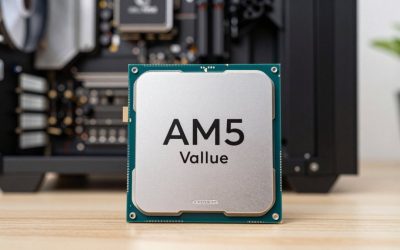
The Ryzen 5 7600X remains the most cost-effective entry point into the AM5 ecosystem. Its 6-core, 12-thread Zen 4 design clocks up to 5.3 GHz, which is more than sufficient to keep the RTX 5060 fed at 1080p in most titles. TechPowerUp’s launch review placed its 1080p gaming average within roughly 5 to 8 percent of more expensive chips in GPU-bound scenarios. At 1440p and 4K, the gap narrows to near zero because the RTX 5060 becomes the limiting factor. The main downside is that it ships without a bundled cooler and runs warm under sustained loads, adding a small cost to your build. For buyers on a tight budget who still want a modern, upgradable platform, this is the smartest dollar-for-dollar choice.
Intel Core i5-14400F Desktop Processor 10 cores (6 P-cores + 4 E-cores) up to 4.7 GHz (around $180)
The i5-14400F suits builders who already own an LGA 1700 motherboard or want a DDR4 platform to cut total cost. Hardware Unboxed’s testing showed it delivering frame rates within roughly 3 to 6 percent of the 7600X at 1080p across a mixed benchmark suite, with its extra E-cores providing a slight edge in multithreaded workloads like video encoding. The RTX 5060 sees no meaningful bottleneck at 1440p or above when paired with this chip. The limitation is platform longevity: LGA 1700 has no upgrade path beyond Arrow Lake refreshes. The “F” designation also means no integrated graphics, so you cannot troubleshoot without the discrete GPU installed. It is a pragmatic choice for a focused gaming build on a budget.
AMD Ryzen 5 9600X 6-Core, 12-Thread Unlocked Desktop Processor ($173)
Only eleven dollars above the 7600X, the Ryzen 5 9600X delivers Zen 5 IPC gains of approximately 10 to 15 percent per Tom’s Hardware’s initial analysis, translating to slightly higher 1080p frame rates and better minimum-frame consistency in demanding titles. At 1440p and 4K, where the RTX 5060 saturates first, both chips perform identically. The 9600X also runs cooler than the 7600X under equivalent loads, making it friendlier to budget air coolers. Its sole drawback is that the uplift is marginal for pure gaming, so buyers who already own a 7600X gain little from a swap. For new builders, however, the 9600X is the more future-proof pick at a negligible premium.
AMD Ryzen 7 7800X3D 8-Core, 16-Thread Desktop Processor ($330)
The 7800X3D’s 96 MB of 3D V-Cache makes it the definitive choice for 1080p high-refresh gaming. Gamers Nexus documented minimum frame rate improvements of roughly 15 to 25 percent over the 7600X in cache-sensitive titles like Counter-Strike 2 and Starfield. In GPU-bound scenarios at 1440p, the advantage shrinks to about 3 to 7 percent, and at 4K the RTX 5060 becomes the ceiling regardless. The downside is price: at $330, it nearly matches the RTX 5060 itself, which forces a budget tradeoff. For competitive players who prioritize 1080p frame stability above all else, no cheaper CPU delivers equivalent results.
AMD Ryzen 7 9800X3D 8-Core, 16-Thread Desktop Processor ($449)
The 9800X3D combines Zen 5 architecture with second-generation 3D V-Cache, and TechSpot’s launch benchmarks showed it leading all tested CPUs in 1080p gaming averages by a margin of approximately 8 to 12 percent over the 7800X3D. It also resolves the thermal constraints of the previous generation thanks to a redesigned cache layout beneath the cores. Paired with the RTX 5060, it eliminates any conceivable CPU bottleneck even at 1080p ultra settings. The obvious con is cost: spending $449 on a CPU alongside a mid-range GPU represents a lopsided allocation unless you plan an imminent GPU upgrade. It is the best option for someone building a “final” AM5 gaming system.
Platform Costs to Budget For
AM5 motherboards start around $120 for a B650M with adequate VRMs for the chips listed here. A comfortable ATX B650 falls in the $150 to $180 range. LGA 1700 boards remain cheaper, with B760 models available near $100. DDR5 memory pricing has stabilized at roughly $55 to $70 for a 32 GB kit at 6000 MHz, the sweet spot for AM5. Intel users can still opt for DDR4 boards to save twenty to thirty dollars, though this forfeits a small performance edge. Coolers are a line item not to overlook: the 7600X and 9600X require a tower cooler or 240mm AIO priced between $30 and $50, while the 7800X3D and 9800X3D benefit from similar cooling due to their higher core counts. Intel’s i5-14400F ships without a cooler, so add one to your total.
Bottleneck Check by Resolution
At 1080p, the CPU matters most. The 7600X and 9600X keep the RTX 5060 within a few percent of its maximum potential in most titles, with occasional dips in heavily threaded or unoptimized games. The 14400F performs comparably in GPU-bound scenarios but trails the X3D chips in esports titles with large physics or AI calculations. At 1440p, the GPU becomes the primary limiter in AAA titles, and the difference between any two CPUs on this list compresses to under five percent in frame rate. At 4K, the RTX 5060 is fully saturated regardless of CPU choice, making any of these five options effectively equivalent.
Our Verdict
For most RTX 5060 buyers, the Ryzen 5 9600X at $173 represents the best balance of price, performance, and platform longevity. It handles every resolution the card can drive without introducing a meaningful bottleneck, and it sits on a socket with a confirmed upgrade path. If your budget is tighter and you want the absolute lowest entry cost on AM5, the 7600X at $162 remains a smart alternative. Competitive 1080p players should consider the 7800X3D despite the premium, while the 9800X3D is the right answer for anyone who wants to never worry about CPU performance again on this platform.
FAQ
Does the RTX 5060 need a high-end CPU?
No. The RTX 5060 is a mid-range GPU, and a six-core modern processor from either AMD or Intel is sufficient to avoid meaningful bottlenecks at 1440p and above. A high-end CPU benefits only those targeting 1080p competitive frame rates or using the system for heavy multitasking alongside gaming.
Is the i5-14400F a bad pairing because LGA 1700 is end-of-life?
It is not a bad pairing for performance, but it limits your upgrade path. If you plan to keep the system for three to four years without a CPU change, the 14400F works well. If you want flexibility to drop in a faster chip later without replacing the motherboard, AM5 with one of the Ryzen options is the safer long-term investment.
Will a Ryzen 5 7600X bottleneck the RTX 5060 at 1080p?
In most titles, the bottleneck is under five percent, which is within margin-of-error territory for benchmarks. In a handful of CPU-heavy esports titles, the gap can widen to eight to ten percent. For a 60 to 120 Hz 1080p monitor, this difference is imperceptible during normal gameplay.
Should I spend the money saved on the CPU toward a better GPU instead?
If your current CPU is a Ryzen 5 5600X or an i5-12400F or better, yes. Upgrading the GPU yields more noticeable gains in visual fidelity and frame rate than upgrading from a modern six-core to an eight-core X3D chip. If you are building new, however, the 9600X at $173 is affordable enough that pairing it with the RTX 5060 creates a well-balanced system without significant compromise.
Sources and Methodology
All performance ranges cited in this guide are approximate and drawn from publicly available launch and follow-up reviews published by TechPowerUp, Tom’s Hardware, Gamers Nexus, Hardware Unboxed, and TechSpot. Figures represent observed performance spreads across their respective benchmark suites and are not direct measurements conducted by this site. Prices reflect current street values at the time of writing and are subject to change.