Forensic photography is documentation work before it is anything else. An investigator’s camera has to record a scene exactly as found, capture small evidence such as tool marks, fibres, and latent-print lifts at true macro distances, and produce files that hold up when they are enlarged, printed, and questioned later. That means RAW capture, honest colour, controllable flash, and a repeatable scale workflow matter far more than video features or burst speed.

The cameras below are all current models sold on Amazon US, chosen against manufacturer specifications for the jobs investigators actually do: overall scene documentation, mid-range orientation shots, close-up evidence work with a scale in frame, and low-light scenes where flash technique decides what the file shows. If your documentation work leans toward moving images as well, our guide to the best 4K cameras covers the video-first side of the current market.
As an Amazon Associate, we earn from qualifying purchases.
What Forensic Work Demands From a Camera
Three capture purposes drive the shortlist. Scene documentation needs a wide-to-normal zoom, reliable autofocus in mixed light, and files with enough resolution for large prints. Macro evidence work needs genuine close focusing, ideally true 1:1 reproduction or a dedicated microscope mode, plus even lighting from a ring flash or diffused twin light so texture reads without harsh shadows. Low-light scenes need clean high-ISO output and full manual control of flash, because automatic exposure will happily brighten a dark room into something that no longer matches what witnesses saw.
File format is non-negotiable: every camera here records RAW alongside JPEG, so the original capture can be archived untouched while working copies are enhanced. The scale workflow matters just as much. Close-up frames should include an L-shaped forensic scale or ruler in the same plane as the evidence, shot perpendicular to the subject, and each camera below either focuses close enough to make that practical or accepts a proper macro lens that does.
OM System Tough TG-7
The TG-7 is the camera many investigators reach for first, because it is built to survive the scene itself. The sealed body is waterproof, shockproof, crushproof, and freezeproof to manufacturer ratings, so rain, dust, drops onto concrete, and cold storage rooms are working conditions rather than risks. Its Variable Macro System is the standout feature: the Microscope mode focuses as close as one centimetre from the front of the lens and magnifies tiny subjects far beyond what a normal compact can reach, which suits fibres, hairs, small fragments, and serial-number stamps. Focus stacking and focus bracketing are built in for depth in close-up records.
The 12-megapixel sensor is modest next to the mirrorless bodies here, and that is the honest trade: this is a close-range and scene-context tool, not a large-print camera. RAW recording is supported, the built-in field sensor system logs GPS position, temperature, and pressure data alongside images, and the optional LED light guide and flash diffuser accessories turn the built-in flash into usable macro lighting. For gloved, wet, or contaminated environments where a system camera is a liability, the TG-7 is the practical primary camera.
Specs
- Sensor: 12MP back-illuminated CMOS, 1/2.33-inch format
- Lens: fixed 4x optical zoom, 25 to 100mm equivalent, f/2.0 to f/4.9
- Macro: Variable Macro System, Microscope mode focusing to 1cm, focus stacking and bracketing
- File formats: RAW plus JPEG, 4K video
- Rugged ratings: waterproof to 15m, shockproof to 2.1m, crushproof to 100kgf, freezeproof to minus 10 degrees Celsius
- Data logging: built-in GPS, thermometer, manometer, and compass sensors
- Lighting: built-in flash, supports LED light guide and flash diffuser accessories
Tier: mid-range
Canon EOS R50 With RF-S 18-45mm Kit Lens
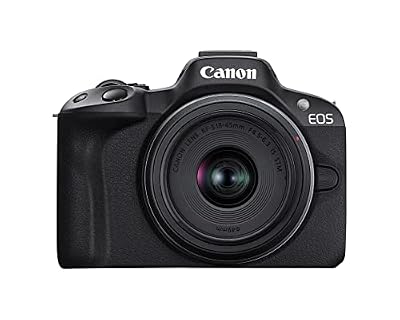
The R50 is the budget entry point into a proper interchangeable-lens evidence kit. Its 24.2-megapixel APS-C sensor records Canon CR3 RAW files with the resolution needed for courtroom prints of room-scale scenes, and the included RF-S 18-45mm zoom covers the overall-to-close-up sequence every scene protocol starts with. Dual Pixel CMOS AF II is dependable in the dim interiors where investigators often work, and the vari-angle screen helps when the only clean angle on a piece of evidence is low or overhead.
Close-up work is handled by lens choice rather than the kit zoom: Canon’s RF 35mm f/1.8 Macro IS STM and RF 85mm f/2 Macro IS STM both focus to half life-size and are natural pairings, and the multi-function shoe accepts Canon’s ring and twin macro lights as well as standard Speedlites. The single SD card slot and the absence of in-body stabilisation are the compromises at this tier, and the body is not weather sealed, so it belongs in a case between scenes rather than hanging in the rain. As a first system camera for a small department or a private investigator building a kit, it covers the fundamentals without wasted features.
Specs
- Sensor: 24.2MP APS-C CMOS with DIGIC X processor
- Lens included: RF-S 18-45mm f/4.5-6.3 IS STM kit zoom, Canon RF mount
- File formats: RAW (CR3) plus JPEG, 4K video
- ISO range: 100 to 32000 for stills
- Autofocus: Dual Pixel CMOS AF II with subject detection
- Storage: single SD card slot, UHS-I
- Lighting: built-in pop-up flash, multi-function accessory shoe for external flash and macro lights
Tier: budget
Sony Alpha a6700 With E PZ 16-50mm Lens
The a6700 brings the strongest imaging pipeline of the APS-C bodies here. Its 26-megapixel back-illuminated sensor and BIONZ XR processor deliver clean high-ISO files for available-light documentation, and the dedicated AI processing unit keeps autofocus locked on subjects in cluttered scenes. Five-axis in-body stabilisation steadies handheld orientation shots, and the body records full RAW files to a UHS-II SD slot.
For evidence close-ups, the E-mount macro range is deep: Sony’s E 30mm f/3.5 Macro reaches true 1:1 reproduction, and the FE 90mm f/2.8 Macro G OSS adds working distance for subjects that should not be approached too closely. There is no built-in flash, which investigators should read as a prompt rather than a flaw: the standard hot shoe takes Sony’s ring light and twin flash systems, and forensic close-up work is better served by controlled macro lighting than by an on-axis pop-up. The magnesium body is dust- and moisture-resistant, and the deep grip and clear menu structure make it easy to standardise settings across a team so every operator produces consistent files.
Specs
- Sensor: 26MP APS-C Exmor R back-illuminated CMOS with BIONZ XR processor
- Lens included: E PZ 16-50mm f/3.5-5.6 OSS II kit zoom, Sony E mount
- File formats: RAW plus JPEG, 4K video
- ISO range: 100 to 32000 for stills
- Stabilisation: 5-axis in-body image stabilisation
- Storage: single SD card slot, UHS-II
- Lighting: standard hot shoe for external flash, ring light, and macro twin flash systems
Tier: mid-range
Nikon Z5 II
The Z5 II is the premium pick, built around a 24.5-megapixel full-frame sensor that gives investigators the cleanest low-light files in this roundup. Nikon’s published autofocus sensitivity reaches minus 10EV with the right lens, which translates to reliable focusing in the dark interiors, vehicles, and night scenes where flash-only documentation loses context. Dual SD card slots are the professional feature that matters most here: set the second slot to backup and every frame exists twice before the card ever leaves the scene, a simple safeguard for evidence integrity.
Weather sealing, in-body stabilisation rated up to 7.5 stops at the centre, and full NEF RAW recording complete a body designed for methodical work. Macro duty is covered by the NIKKOR Z MC 50mm f/2.8 and the NIKKOR Z MC 105mm f/2.8 VR S, both true 1:1 lenses, and the hot shoe supports Nikon’s close-up speedlight systems and third-party ring flashes. The body-only configuration means a standard zoom such as the Z 24-70mm f/4 S or Z 24-120mm f/4 S must be budgeted alongside it. For agencies standardising one body across investigators, this is the one that removes the most limitations.
Specs
- Sensor: 24.5MP full-frame back-illuminated CMOS with EXPEED 7 processor
- Lens included: none, body only, Nikon Z mount
- File formats: RAW (NEF) plus JPEG, 4K video
- ISO range: 100 to 64000 for stills
- Stabilisation: 5-axis in-body stabilisation, up to 7.5 stops at frame centre
- Storage: dual SD card slots, UHS-II, with backup and overflow modes
- Build: magnesium alloy body with dust and drip resistance
Tier: premium
Accessories That Complete an Evidence Kit
The camera is only half of the workflow. A forensic kit needs an L-shaped scale and adhesive photo scales placed in the plane of the evidence for every close-up, a grey card or colour reference for verifiable colour, and a ring flash or diffused macro light so small subjects are lit evenly without specular glare. A sturdy tripod with a geared or ball head keeps the sensor plane parallel to flat evidence, spare batteries and cards keep a long scene from ending early, and a write-once archiving routine for the original RAW files protects the chain of documentation after the shoot. None of these items is glamorous, and all of them show up in the quality of the final file.
Frequently Asked Questions
Do forensic investigators need a full-frame camera?
No. Full-frame bodies such as the Z5 II give cleaner low-light files and more cropping headroom, but APS-C cameras like the R50 and a6700 meet the resolution and RAW requirements of evidence work, and a rugged compact like the TG-7 covers macro and hostile-environment jobs that no system camera should attempt.
Why is RAW capture so important for evidence photography?
A RAW file preserves the sensor data before in-camera processing alters contrast, sharpening, and colour. Archiving the untouched RAW original and working only on copies keeps the documentation defensible, because any enhancement can be shown to start from an unmodified capture.
What lighting works best for close-up evidence photos?
A ring flash or diffused macro twin light gives even, shadow-controlled illumination at close distances, which keeps texture and edges readable. Whatever the source, include a scale in the same plane as the subject and shoot perpendicular to it so measurements taken from the image stay accurate.
Can one camera handle both scene documentation and macro evidence?
A mirrorless body with a standard zoom and a true macro lens covers both jobs well. Many investigators still add a rugged compact with a microscope mode for extreme close-ups and contaminated or wet scenes, keeping the system camera clean and reserved for the main record.
Final Verdict
Choose the OM System Tough TG-7 if your scenes are wet, dirty, or physically risky and your close-up work involves very small items. Choose the Canon EOS R50 kit as the budget foundation of a lens-based kit, the Sony a6700 for the strongest APS-C low-light and autofocus performance, and the Nikon Z5 II when dual-card backup, full-frame low-light quality, and weather sealing justify the premium. Match any of them with a true macro lens, controlled macro lighting, and a disciplined scale routine, and the files will do the job evidence photography exists to do.
Product and ASIN Reference
| Product | ASIN |
|---|---|
| OM System Tough TG-7 (Black) | B0CGM17K5R |
| Canon EOS R50 Mirrorless Camera with RF-S 18-45mm f/4.5-6.3 IS STM Lens Kit (Black) | B0BTTV6CT1 |
| Sony Alpha a6700 Mirrorless Camera with E PZ 16-50mm f/3.5-5.6 OSS II Lens | B0CBND8G4P |
| Nikon Z5 II Full-Frame Mirrorless Camera (Body Only) | B0F3HJD64Y |