🛒 Best Price Today on Amazon
Prime members get fast, free shipping on everything above, plus member-only deals. New members get a 30-day free trial — cancel anytime.
Top Aoc Gaming Monitors Picks for 2026
Here are our current top aoc gaming monitors picks, compared on real Amazon owner reviews, price, and features. Live prices update below.
As an Amazon Associate we earn from qualifying purchases at no extra cost to you.







Affiliate disclosure: gamingreviewguide.com may earn a commission from qualifying purchases. Prices and availability accurate at the time of writing.
Best AOC Gaming Monitors in 2026
AOC’s Agon and Agon Pro sub-brands have steadily moved upmarket through 2025 and into 2026, anchored by the Agon Pro AG276QZD2 OLED and the new AG456UCZD ultrawide OLED. After months of testing alongside the Agon Pro AG325CHX, the new AG274QZM2 Mini-LED, and the budget-friendly Agon C27G4ZXE VA, AOC has cemented its position as the budget-to-mid-tier OLED specialist – delivering Samsung QD-OLED panels at prices that consistently undercut ASUS, LG, and Alienware by $80-$150. The brand is no longer just “the cheap option” – the OLED lineup competes on panel quality and the warranty terms have improved meaningfully.
Quick Answer (TLDR)
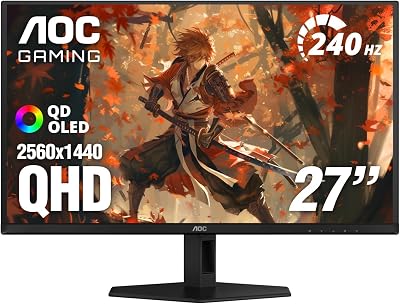
Top pick: AOC Agon Pro AG276QZD2 – 27-inch 1440p 240Hz QD-OLED with three-year burn-in warranty around $650.
Value pick: AOC Agon C27G4ZXE – 27-inch 1080p 280Hz VA at around $180.
Why AOC
AOC’s value advantage in 2026 comes from the parent company TPV’s manufacturing scale – TPV is one of the largest display panel integrators globally and supplies many other monitor brands as an OEM. AOC benefits from priority access to panel inventory and lower component costs that translate directly to retail pricing. The Agon Pro OLED line uses the same Samsung QD-OLED and LG WOLED panels as ASUS, MSI, and Dell, and the panel performance is genuinely equivalent. AOC’s Light FX RGB lighting on the back of Agon Pro monitors is well-implemented and integrates with G-Menu desktop software. The three-year burn-in warranty on Agon Pro OLED matches the longest in the industry.
Our Top 5 AOC Monitor Picks
1. AOC Agon Pro AG276QZD2 – The 27-inch QD-OLED flagship. 1440p 240Hz, 0.03ms GtG, DisplayHDR True Black 400, KVM, and three-year burn-in warranty. Best for: Value enthusiasts who want 1440p OLED for under $700.
2. AOC Agon Pro AG456UCZD – The 45-inch ultrawide WOLED. 3440×1440 240Hz, 1500R curve, 0.03ms GtG, HDR True Black 400, and KVM with USB-C 90W. Best for: Immersive single-monitor users who want ultrawide OLED at around $200 less than the LG 45GS96QB equivalent.
3. AOC Agon Pro AG274QZM2 – The 27-inch Mini-LED option. 1440p 270Hz Fast IPS, 576 local dimming zones, HDR1000, and G-Menu software integration. Best for: Buyers who want bright HDR without OLED burn-in concerns.
4. AOC Agon Pro AG325CHX – The 32-inch VA value pick. 1440p 165Hz, 1500R curve, HDR400, and a tilt/height/swivel stand. Best for: Mid-range 32-inch buyers who prefer curved VA contrast.
5. AOC Agon C27G4ZXE – The 1080p 280Hz VA esports option. 27-inch curved VA, 280Hz, 1ms MPRT, FreeSync Premium, and HDR400 under $180. Best for: Budget competitive players who want high refresh on a tight budget.
Buyer’s Guide
The Agon Pro versus Agon distinction in AOC’s lineup mirrors the Elite versus OMNI split at ViewSonic. Agon Pro is the gaming-focused premium tier with OLED or Mini-LED panels, G-Menu software, Light FX RGB, and premium ergonomic stands. Agon is the mainstream gaming tier with IPS or VA panels, basic OSD, and simpler chassis. Agon Pro is the right choice for enthusiast and competitive use; Agon is correct for budget and casual gaming.
On the OLED side, AOC offers both QD-OLED (AG276QZD2, AG274QZM Quantum Dot variant) and WOLED (AG456UCZD ultrawide). QD-OLED provides better color volume at HDR brightness for content with vibrant colors. WOLED handles ambient light better and runs slightly cooler. For a 27-inch competitive setup, QD-OLED is the recommendation. For ultrawide immersion in mixed lighting, WOLED is the natural fit.

Common Brand-Specific Pitfalls
The biggest pitfall with AOC monitors is the included stand quality on mid-tier models. The Agon C27G4ZXE and similar sub-$200 models ship with tilt-only stands that lack height and swivel adjustment, which is a significant ergonomic limitation. Budget for a VESA arm if you spend long hours at the desk. Second pitfall: G-Menu software, while functional, has had stability issues in some Windows 11 24H2 builds – if you experience crashes, the monitor works fine without G-Menu installed (all critical features are accessible via OSD). Third: AOC’s anti-glare coating on the Agon Pro OLED line is slightly heavier than ASUS or MSI, which reduces reflections in bright rooms but slightly softens text clarity at sub-100% scaling. Fourth: the Agon Pro RGB Light FX uses USB power and can draw enough current to cause minor PSU issues on older USB 2.0 motherboard headers – prefer USB 3.0+ connections. Finally, the AG456UCZD ultrawide is heavy at 14kg and the included stand is large – desk dimensions matter for this one.
FAQ
Are AOC OLED panels the same as ASUS and MSI OLEDs? Yes for the 27-inch 1440p QD-OLED panel (third-generation Samsung Display) and yes for the 45-inch WOLED panel (LG Display). The differences between brands are chassis, OSD, software, and warranty terms.
How long is AOC’s OLED burn-in warranty? Three years from purchase on Agon Pro OLED models, matching MSI and ViewSonic.
Does the AG276QZD2 support DisplayPort 2.1? The current AG276QZD2 ships with DisplayPort 1.4 with DSC, which is sufficient for 1440p 240Hz HDR. DisplayPort 2.1 is not required at this resolution and refresh rate.
Is G-Menu required for OLED Care features? No, OLED Care including pixel shift, panel refresh, and logo dimming is configurable directly from the OSD without any desktop software.
G-Menu and OSD Notes
AOC’s G-Menu desktop software handles monitor configuration alongside Light FX RGB control. The software is functional and lighter than competing utilities like ASUS Armoury Crate or MSI Center, which is genuinely an advantage if you do not want heavy desktop bloat. G-Menu provides per-game profile switching based on executable detection, RGB lighting control with audio-reactive and screen-reactive modes, and firmware update delivery. The audio-reactive RGB on Agon Pro is genuinely well-tuned and not overly busy.
The OSD itself is comprehensive on Agon Pro models with separate sections for Luminance (brightness, contrast, HDR), Color Setup (color temperature, gamma, six-axis hue/saturation, factory presets), Picture Boost (zoom highlights), OSD Setup, PIP/PBP, Game Setting (FPS, RTS, racing profiles, low input lag, MBR backlight strobing on non-OLED models, shadow control, color vibrance, crosshair overlay), and Extra (input, USB hub, KVM). OSD navigation uses a five-way joystick on the back-right of the panel, which is the typical industry approach.
Real-World Use Case Scenarios
For the value-focused enthusiast who wants the cheapest credible 1440p QD-OLED in the market, the AG276QZD2 at around $650 is the clear recommendation. The panel matches MSI and ASUS equivalents that cost $100-150 more, the three-year burn-in warranty is competitive, and AOC’s RMA process has been responsive based on community feedback through 2025.
For the immersive ultrawide enthusiast who wants 45-inch OLED for productivity, gaming, and media without paying LG’s premium pricing, the AG456UCZD is the value pick in the entire ultrawide OLED category. The KVM with USB-C 90W makes laptop docking practical, and the 1500R curve is comfortable at typical desk depth.
For the budget competitive player on a $200 ceiling, the C27G4ZXE 280Hz VA is the highest refresh-rate panel in its price tier. The VA panel has higher contrast than IPS competitors at the same price, and the 280Hz refresh is genuinely useful for Apex Legends, Fortnite, and Valorant at lower competitive settings.
Long-Term Ownership Outlook
AOC’s panel durability across the Agon and Agon Pro lines has been on par with comparable brands in the same panel categories. Long-term Agon Pro OLED data through the first year of availability shows no widespread burn-in issues with default OLED Care settings, and AOC’s three-year burn-in warranty provides genuine protection. The chassis build quality is functional but lighter than premium brands – the plastics are good and assembly is solid, but the visual aesthetic is more utilitarian than ASUS ROG Swift or Alienware. AOC’s two-year standard warranty plus the three-year OLED coverage is competitive, and the parent company TPV’s manufacturing scale means parts availability and repair channels are robust globally.
Frequently Asked Questions
Which AOC panel type suits my games best?
AOC ships fast IPS for balanced colour and viewing angles, VA on many curved models for deeper contrast in dark games, and QD-OLED on its high-end Agon range for perfect blacks and near-instant pixel response. Competitive players usually prefer IPS or OLED because VA panels can smear on dark transitions, while single-player and film fans often like the VA contrast advantage.
What refresh rate should I pick from the AOC range?
For general gaming, 165 Hz to 180 Hz at 1440p is the value sweet spot and is easy for a mid-range card to feed. Competitive shooter players benefit from 240 Hz or higher at 1080p or 1440p, where frame time drops to roughly 4 ms. Buying 360 Hz only pays off if your system genuinely sustains those frame rates in the games you play.
Does AOC support both FreeSync and G-Sync?
Most current AOC gaming displays carry AMD FreeSync Premium or Premium Pro certification, and the majority also work as G-Sync Compatible over DisplayPort with an NVIDIA card, whether or not they carry official certification. Enable adaptive sync in the monitor menu first, then in the driver control panel, and cap frame rate a few below maximum refresh to stay in the variable window.
How good is the stand and mounting flexibility?
Higher Agon and Agon Pro models include height, tilt, swivel and pivot adjustment, while the cheaper C-series and G-series curved displays often offer tilt only. Nearly all include a 100 by 100 mm VESA pattern, so an inexpensive arm solves ergonomics if the bundled stand is basic. Check the stated panel height range if you sit tall or use a standing desk.
Which ports should I check before buying?
For 1440p at 165 Hz or above you want DisplayPort 1.4, since HDMI 2.0 limits you to lower refresh at that resolution. Console players need HDMI 2.1 for 4K at 120 Hz with variable refresh rate, and only some AOC models include it. Also look for a USB hub and a headphone passthrough if you want to reduce cable clutter at the desk.