Shadows of Doubt is a private-eye simulator set in a procedurally generated city where every citizen keeps a schedule, a home and a paper trail, and a killer works through that population until somebody connects the evidence. It comes from ColePowered Games, published by Fireshine Games, and Steam’s record lists it as released on 26 September 2024, after an Early Access period dated to April 2023. The question here is narrower: what does a Linux player get for that purchase?
The short version is a familiar shape with one loud contradiction. Every delivery layer on Steam says Windows only, and GOG’s edition agrees, yet the game’s own soundtrack flags Linux as supported and ProtonDB’s page heads its requirements block with a native-support label. Both signals are false, over a strong underlying story: the Windows build is Steam Deck Verified with a Platinum tier.
As an Amazon Associate, we earn from qualifying purchases.
Quick answer
No. Shadows of Doubt has no native Linux build: Steam flags the game Windows-only, publishes an empty Linux requirements list, and ships one content depot with no Linux variant, and GOG’s edition is Windows-only too. The Windows version runs through Proton instead, where it is Steam Deck Verified and holds a Platinum tier from 84 ProtonDB reports at strong confidence.
The Steam record, layer by layer
Start with the flags. The store record for app 986130 reads windows true, mac false and linux false, and the fields behind those flags match them. The Windows requirements are genuinely populated at both tiers, asking for Windows 10 or newer, a 6th-generation Core i5 or Ryzen 5 1600, and 8 GB of RAM. The Linux requirements field is an empty list outright: no hardware lines, nothing a port would need to publish. The Mac field is the same empty list behind its own false flag.
The depot table tells the same story in Valve’s own plumbing. SteamDB lists exactly one content depot, depot 986131 at about 1.27 GiB, plus the artbook depot belonging to the separate DLC app. There is no Linux depot and no Mac depot, and the size a Windows-filtered download reports is the whole download, so that single depot is the Windows build. A purchase delivers it through the store package; no second package holds another platform’s files.
SteamDB’s asset list also carries a LinuxClientIcon entry, but it shares its file hash with the Mac client icon, making it a leftover library asset rather than a build. The record carries no DRM notice and no external-account notice either: gaps in the paperwork, stated as gaps, which matter again in the anti-cheat section.
The family sweep: the soundtrack flags Linux, the game does not
The game’s record lists a DLC array of two apps, both read individually here, because add-on apps keep their own platform flags and those flags are the most reliable source of false Linux claims in this series.
The Shadows of Doubt Soundtrack, app 2497620, is the trap in its purest form. Its record flags all three platforms true, Windows, Mac and Linux alike, while its Linux and Mac requirements fields are both empty lists. It is a music product: the flag describes where Steam will sell and stream audio files, and says nothing about any executable. Anyone who saw that Linux tick and stopped reading would walk away believing a port exists. It does not; the flag belongs to the soundtrack alone.
The second app behaves itself. The Digital Artbook, app 3229880, flags Windows only, Mac and Linux both false. So the family verdict is simple: the only Linux flag in this game’s orbit sits on an audio product, and the apps containing the game and its artwork are unanimous for Windows.
Steam Deck: Verified, on paperwork older than the current build
Valve’s compatibility record, read here through SteamDB’s republication of Valve’s compatibility data, gives the game a Verified rating, with SteamOS separately marked Compatible. All four Verified checks pass: full functionality on the default controller configuration, Deck controller icons shown, interface text legible, and the default graphics configuration performing well. The recommended runtime on the sheet is proton-9.0-4RC, which settles what the badge certifies: the Windows build under Proton, not a native port wearing a badge.
The paperwork has one wrinkle. Valve’s test was recorded on 12 June 2025 against build 18191560, while the public branch now serves build 24616330, built in August 2026, so the verdict certifies an older build than the one a buyer downloads today. That does not overturn the rating, but it makes this file a candidate for the factual Deck-paperwork supplement list we keep: games whose test sheet predates the branch it vouches for.
ProtonDB: Platinum, and a heading that contradicts Steam
ProtonDB’s summary reads Platinum at the headline, Platinum as the best-reported tier and Gold on the trending line, drawn from 84 reports with confidence rated strong. The reports underneath were filed under named Proton versions, current ones like Proton 10.0-3 alongside 9.0-4, Experimental and GE builds. Report-level texture, kept at report weight: several players note frame-rate drops in the open city and audio crackling in long sessions, and more than one points out the same roughness shows up on Windows, which points to an unoptimised simulation rather than a compatibility fault.
One part of that page needs correcting in print. Its classification heading reads “Natively Supports”, the stray-tag pattern this series keeps meeting: a heading claiming native support while every report beneath it was filed under a compatibility layer and Steam’s record contradicts the label on every layer above. The article follows Steam, as always. The heading is a labelling quirk; the tier, report count and confidence are the parts worth trusting, and all three say the Windows build runs very well under Proton.
Anti-cheat, from three separate sources
The game is single-player, and the three sources this series checks separately all come back quiet. Steam’s record names no anti-cheat and carries neither a DRM notice nor an external-account notice. SteamDB’s detected technology list is engine and middleware plumbing only: Unity, FMOD audio, a DLSS library, Resonance Audio, UnityBurst, UnityIL2CPP and cURL, none of which inspects a player’s system. The Are We Anti-Cheat Yet dataset carries no entry for the game across its catalogue, searched by name and by app number.
GOG: an edition exists, and it is Windows only
GOG does sell this game, worth establishing properly because GOG’s own embed search returned no results for the title, the known blind spot in that route. The ruling rests on GOG’s catalogue and product records instead: the product, titled Shadows of Doubt with a release date matching Steam’s 26 September 2024, lists its compatibility as Windows true, Mac false and Linux false. The storefront split some players hope for does not exist; both shops sell the same Windows build.
The hardware that fits a Proton detective
Valve Steam Deck OLED 512GB

The handheld the Verified badge was written for, with legible text and a well-performing default configuration on Valve’s sheet.
Specs
- Display: 7.4-inch HDR OLED, 1280 by 800, up to 90 Hz
- Processor: AMD Zen 2 and RDNA 2 custom APU
- Memory: 16 GB LPDDR5
- Storage: 512 GB NVMe, plus a microSD slot
- Wireless: Wi-Fi 6E and Bluetooth
- Channel note: Valve sells the Deck mainly through its own store, so Amazon listings are third-party sellers
8BitDo Ultimate 2 Bluetooth Controller

The docked and desktop pad pick: full controller support is listed, and modern sticks plus back buttons suit long evidence-board sessions.
Specs
- Connectivity: Bluetooth wireless and USB-C wired
- Joysticks: TMR electromagnetic, anti-drift design
- Triggers: Hall effect, with mode switching
- Extras: two remappable back buttons, motion control
- In the box: charging dock included
Xbox Wireless Controller, Carbon Black

The safest guest pad in PC gaming: universal Steam Input support, matching glyphs, and Bluetooth or wireless pairing.
- Connectivity: Xbox Wireless and Bluetooth
- Port: USB-C for wired play
- Controls: hybrid D-pad, dedicated Share button
- Power: AA batteries or optional rechargeable pack
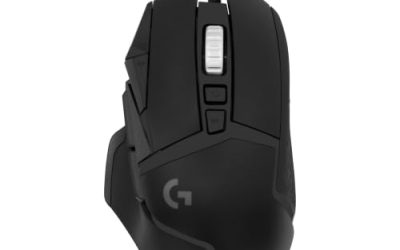
Logitech G502 HERO

A detective game lives in its menus, and a wired mouse with eleven programmable buttons turns case-file paperwork into single clicks.
Specs
- HERO optical sensor, up to 25,600 DPI
- 11 programmable buttons
- Adjustable weight system
- Wired USB connection
- On-board memory profiles
Samsung T9 Portable SSD 2TB

For moving a Linux game library between machines, a fast USB-C drive is the simple answer. The headline figure needs a Gen 2×2 host port; on a lesser port the drive runs at that ceiling.
Specs
- Capacity: 2 TB portable SSD
- Interface: USB 3.2 Gen 2×2, USB-C connector
- Maker-rated speeds: up to 2,000 MB per second read, 1,950 MB per second write
- Features: Dynamic Thermal Guard, maker-rated drop resistance
How to choose
Choose your route first, because there is only one: the Windows build under Proton, from whichever storefront you prefer, since the Steam and GOG editions are the same build with the same flags. On a desktop, leave Steam’s default Proton selection alone to start; the report pool’s centre of gravity sits on recent numbered releases, and Valve’s Deck sheet was written against a 9.0-series release candidate, so anything current is inside the tested envelope. If a build misbehaves, reports show Experimental and GE builds in successful use as fallbacks, not requirements.
Choose your input second. The game supports a controller fully, but the investigation layer is dense with text and linked records, so mouse-and-keyboard players gain precision on the evidence board. Deck players should know the one caveat in this file: Valve’s Verified test predates the current public build, so treat the badge as historical evidence backed by recent Platinum reports.
Who should skip
Skip the purchase if you buy native Linux ports only: there is no port here, the soundtrack’s Linux flag is an audio-product artefact, and no record suggests one is coming. Skip it, too, if you want a frictionless simulation: the reports are Platinum-tier for compatibility while describing a game whose city simulation stutters on every platform, Windows included. And if your plan was to buy the GOG copy to escape Proton, skip that plan rather than the game.
FAQ
Is Shadows of Doubt native on Linux?
No. Steam flags the game Windows-only with an empty Linux requirements list and a single Windows content depot, and GOG’s edition is Windows-only too. Linux play happens through Proton, where the game is Deck Verified with a Platinum headline tier.
Why does the Shadows of Doubt soundtrack show Linux support?
Because the soundtrack is a separate store app with its own platform flags, and its record flags all three platforms while publishing empty requirements fields. It is a music product; the flag covers selling audio files, not running the game, and the base game flags Linux false on every layer.
Does Shadows of Doubt work on Steam Deck?
Yes, with a paperwork caveat. Valve rates it Verified and SteamOS Compatible, all four checks passing under a Proton runtime. The test behind that rating was recorded in June 2025 against an older build than the public branch now serves, so the badge certifies the Windows build as tested then, backed by more recent community reports.
Is the GOG version any different for Linux players?
No. GOG’s edition is an alternative storefront, but its compatibility data lists Windows only, the same as Steam. A GOG copy on Linux runs through Proton exactly like a Steam copy, so choose on library preference, not platform support.
Final verdict
Shadows of Doubt is not a native Linux game, and its record is a small museum of the ways a store page can pretend otherwise: a soundtrack that flags Linux true, a leftover client icon, and a database heading claiming native support over a stack of Proton reports. Strip those away and the honest picture is unusually good: one Windows build, sold identically on Steam and GOG, Deck Verified, Platinum across 84 reports at strong confidence, and no anti-cheat anywhere in the file. Linux players get no port, but one of the best-documented Proton routes in this series.
Product and ASIN Reference
| Product | ASIN |
|---|---|
| Valve Steam Deck OLED 512GB | B0CQ3RWQQZ |
| 8BitDo Ultimate 2 Bluetooth Controller | B0F194QFT2 |
| Xbox Wireless Controller, Carbon Black | B08DF248LD |
| Logitech G502 HERO | B07GBZ4Q68 |
| Samsung T9 Portable SSD 2TB | B0CHFS9K14 |