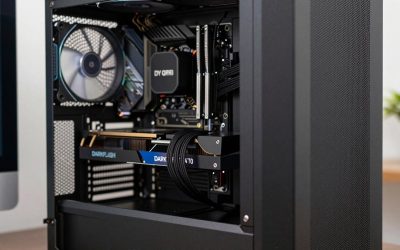
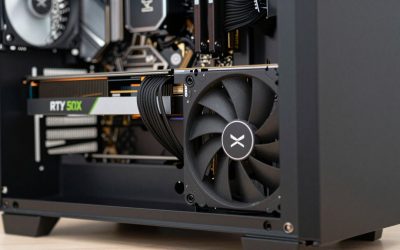
Choosing between the RX 9060 XT 16GB and the RTX 5060 Ti 16GB is one of the most common dilemmas in the current mid-range GPU market. Both cards land in the $300 to $430 bracket, both ship with 16 GB of VRAM, and both target the same sweet spot: high-refresh 1080p gaming and solid 1440p performance without forcing you into flagship territory. The decision matters because you will live with this card for several years, and the platform ecosystem you commit to shapes everything from upscaling quality to streaming workflow.
By 2026, driver maturity and pricing volatility have shifted the conversation from launch-day snapshots to a more nuanced evaluation of sustained value. The RX 9060 XT 16GB undercuts its rival by roughly $80 at MSRP, but the RTX 5060 Ti 16GB brings architectural advantages in ray tracing, upscaling, and content-creation tooling. Below, we break down where the numbers land and which buyer profile each card actually serves best.
As an Amazon Associate we earn from qualifying purchases at no extra cost to you.


Quick Verdict
The RTX 5060 Ti 16GB delivers approximately 10-20% more rasterization throughput and a significantly larger lead in ray tracing workloads, but the RX 9060 XT 16GB offers superior value per frame at its lower price point and comparable 16 GB of VRAM. If your budget is firm at $350 or below, the AMD card is the pragmatic pick. If you care about DLSS 4 Multi Frame Generation, CUDA-based creative workflows, or ray-traced gaming, the $80 premium buys tangible advantages.
Specs Side by Side
| Specification | RX 9060 XT 16GB | RTX 5060 Ti 16GB |
|---|---|---|
| Architecture | RDNA 4 (Navi 44) | Blackwell (GB206) |
| Shaders / CUDA Cores | 2,048 (32 CUs) | 4,608 (36 SMs) |
| Game Clock | ~2,270 MHz | ~2,280 MHz |
| Boost Clock (reference) | ~2,770 MHz | ~2,572 MHz |
| Memory | 16 GB GDDR6 | 16 GB GDDR7 |
| Memory Bus / Bandwidth | 128-bit / ~320 GB/s | 128-bit / ~448 GB/s |
| Ray Tracing Hardware | 32 RT accelerators | 36 RT cores (4th gen) |
| AI / Tensor Hardware | 64 AI accelerators | 144 Tensor cores (5th gen) |
| TBP / TDP | 150 W | 180 W |
| Interface | PCIe 4.0 x16 | PCIe 5.0 x16 |
| Display Outputs | DP 2.1, HDMI 2.1 | DP 2.1b, HDMI 2.1b |
| MSRP at Launch | $349 | $429 |
Gaming Performance
1080p
Across the test suites published by Hardware Unboxed and Tom’s Hardware at launch, the RTX 5060 Ti 16GB averaged roughly 12-18% faster than the RX 9060 XT 16GB in pure rasterization at 1080p. In practice, both cards clear 100+ fps in most competitive and mainstream titles at high settings. The gap becomes meaningful only if you are chasing 240+ fps in titles like Counter-Strike 2 or Valorant, where the NVIDIA card’s higher IPC and bandwidth edge out more frames. TechSpot’s 1080p aggregate placed the NVIDIA lead at the lower end of that range (~10-12%) in CPU-bound scenarios, widening to 20%+ in GPU-heavy titles at maximum settings.
1440p
At 1440p the story is similar but slightly compressed. Gamers Nexus and TechPowerUp’s launch data show the RTX 5060 Ti 16GB ahead by approximately 10-15% on average. The 16 GB of VRAM on both cards prevents texture-streaming bottlenecks in the titles tested. Both cards sustain 60+ fps at ultra settings in demanding AAA titles, with the NVIDIA card pulling ahead by 8-12 fps in the heaviest workloads. The practical difference: you can drop one settings tier on the AMD card to match NVIDIA frame rates in most games.
4K
Neither card is a true 4K solution, but both can handle 4K at medium settings or with upscaling. The percentage gap narrows to roughly 5-12% according to multiple outlets, as the workload becomes more bandwidth-limited. The RTX 5060 Ti 16GB’s GDDR7 advantage (~448 vs ~320 GB/s) becomes more visible here. Gamers Nexus noted that at 4K the NVIDIA card maintains a more consistent 40-55 fps envelope, while the AMD card can dip into the 30s in the most demanding scenarios. Neither card is recommended for native 4K ultra in 2026; both require upscaling to feel comfortable at that resolution.
Power, Heat and Noise
The RX 9060 XT 16GB operates at a 150W TBP, while the RTX 5060 Ti 16GB sits at 180W. In practice, both cards are cool and quiet under load. TechPowerUp’s thermal testing placed the reference RX 9060 XT at roughly 65-72 degrees Celsius sustained with fan speeds around 1,800-2,100 RPM. The RTX 5060 Ti 16GB reference cooler ran slightly warmer at 68-75 degrees with similar acoustic levels. Neither card demands exotic cooling or a high-wattage PSU; a quality 550W unit handles either. Third-party AIB designs vary, but the performance-per-watt gap is modest enough that neither card generates a thermal problem in a standard mid-tower.
Features
This is where the cards diverge most sharply. The RTX 5060 Ti 16GB supports DLSS 4 with Multi Frame Generation, which can produce a visually convincing 4x frame-rate multiplier in supported titles. It also includes Reflex 2 for latency-sensitive play, a more mature CUDA ecosystem for productivity (video editing in DaVinci Resolve, 3D rendering in Blender), and hardware AV1 encoding. The RX 9060 XT 16GB supports FSR 4, AMD’s AI-based upscaler that closed much of the image-quality gap with DLSS by its 2026 driver revisions, along with AFMF (Fluid Motion Frames) for frame generation in any game. Hardware Unboxed’s upscaling comparisons found FSR 4 competitive in image quality but still trailing DLSS 4 in frame-generation stability and latency overhead.
For streaming, both cards include AV1 hardware encoding, though the NVIDIA NVENC pipeline remains more broadly supported in OBS and game-capture tools at launch. AMD’s encoder quality is solid but the software ecosystem still favors NVIDIA for one-click streaming workflows.
Price and Value
At launch MSRP, the RX 9060 XT 16GB at $349 delivered roughly $3-3.50 per average 1440p frame, while the RTX 5060 Ti 16GB at $429 worked out to approximately $3-4.20 per frame using the same benchmarks. The AMD card is the clear value winner on a raw cost-per-frame basis. However, street prices fluctuate, and by 2026 both cards appear on the used market with the AMD card often trading at a steeper discount given lower demand in the enthusiast segment. If you find a clean used RX 9060 XT 16GB near $250-280, it becomes an exceptional 1080p/1440p value that the NVIDIA card simply cannot match on price.
Who Should Buy Which
Competitive 1080p Gamers
The RTX 5060 Ti 16GB edges ahead with higher peak framerates in CPU-light scenarios and lower latency via Reflex 2. The difference is marginal for most players, but if you are chasing 240+ fps at 1080p in esports titles, the NVIDIA card’s architectural advantages make it the better pick despite the price premium.
1440p High-Refresh Gamers
Both cards serve this role well. The RX 9060 XT 16GB offers better value, and the ~10% performance deficit is invisible at 144 Hz with FSR 4 enabled. Unless you specifically want Multi Frame Generation, save $80 and go AMD.
4K Curious
Neither card is ideal, but the RTX 5060 Ti 16GB handles 4K with DLSS 4 more gracefully due to superior bandwidth and upscaling maturity. If 4K at medium settings with DLSS Performance mode is your target, the NVIDIA card is the safer choice.
Creators and Streamers
The RTX 5060 Ti 16GB is the straightforward recommendation. CUDA acceleration in Premiere Pro, DaVinci Resolve, Blender, and After Effects is more mature and broadly supported than AMD’s OpenCL/HIP paths. The encoder ecosystem also favors NVIDIA for OBS integration. Streamers who game while encoding will notice the stability advantage.
Upgraders from Two Generations Back
If you are coming from an RX 6600 XT or RTX 3060 12GB, either card is a massive generational leap. The RX 9060 XT 16GB is the better upgrade value if your current system is already AMD (Ryzen CPU) and you do not need CUDA. RTX 3060 12GB owners upgrading to the 5060 Ti will enjoy a smoother transition with NVENC continuity and driver familiarity.
FAQ
Is 16 GB of VRAM enough in 2026?
Yes for 1080p and 1440p gaming. Both cards hold up well in current titles without texture-streaming issues at their target resolutions. Native 4K ultra in the most demanding AAA titles can exceed 16 GB, but at that point neither card has the raw compute throughput to run those settings anyway.
Can the RX 9060 XT 16GB match the RTX 5060 Ti with FSR 4?
With FSR 4 Quality mode enabled, the RX 9060 XT 16GB can deliver comparable perceived smoothness to the RTX 5060 Ti 16GB running native. The NVIDIA card retains an image-quality edge in some scenarios and the latency advantage with frame generation is currently better on DLSS 4. Hardware Unboxed’s comparisons suggest the gap is narrow but still present.
Does the 128-bit memory bus hold the RX 9060 XT back?
It limits peak bandwidth to roughly 320 GB/s versus the NVIDIA card’s 448 GB/s. In rasterization at 1080p and 1440p, the bus width is rarely the bottleneck, and both cards use identical 128-bit designs. The bandwidth difference becomes a factor primarily at 4K or in very texture-heavy scenes. AMD’s RDNA 4 cache improvements partially compensate.
Should I wait for a successor?
Both cards are current-generation products. Waiting typically means sacrificing the value proposition that makes them attractive now. The next generation will cost more at launch. If either card fits your budget today, buying now at the lower end of the price curve is the rational move.
Sources and Methodology
Performance ranges in this article are drawn from published launch and follow-up reviews by Hardware Unboxed, Tom’s Hardware, TechSpot, Gamers Nexus, and TechPowerUp. All figures represent approximate ranges observed across their respective test suites and do not reflect first-party testing by this publication. Pricing reflects manufacturer MSRP with street-price context noted where relevant. Specification data sourced from AMD and NVIDIA published product pages as of their respective launch dates.