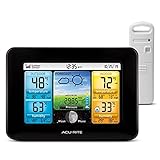
- Top Pick: AcuRite Wireless Home Weather Station with Color Display, Indoor Outdoor Thermometer and Temperature Sensor (02077M)
- Best Value: Digital Barometer Weather Forecast Clock, Thermometer Hygrometer
- Premium Choice: Weather Station Wireless Indoor Outdoor with 3 Sensor, Digital Outdoor Thermometer, Large Display Home Weather Stations with Weather Forecast, Atomic Clock, Barometric Pressure, Moon Phase
The best digital barometers for home weather monitoring are the Ambient Weather WS-5000 for detailed sensor data, the Davis Vantage Vue for dependable outdoor-station integration, the AcuRite Atlas for a large all-in-one display, and a Netatmo Weather Station for compact app-based monitoring.
- Best digital barometers at a glance
- Head-to-head: which barometer fits your home?
- Decision matrix: match the barometer to your situation
- What pressure accuracy actually matters at home?
- How to calibrate and place a home digital barometer
- Pressure trends and forecasting: use the rate of change
- Features worth paying for—and those that are less important
- Bottom line
A barometer can do more than show today’s air pressure: a steady pressure rise often indicates improving weather, while a rapid fall can warn of an approaching front. The useful differences between models are not just the advertised pressure range. Accuracy, update interval, pressure reference, display design, calibration controls, sensor placement, and the quality of the trend graph determine whether the reading helps you make decisions.
As an Amazon Associate we earn from qualifying purchases at no extra cost to you.


Best digital barometers at a glance
| Model | Best for | Pressure resolution | Display or app | Typical market range |
|---|---|---|---|---|
| Ambient Weather WS-5000 | Most complete home weather monitoring | 0.01 inHg / 0.1 hPa class | Console plus web and mobile dashboards | Usually $300–$450 |
| Davis Vantage Vue | Reliable integrated outdoor station | 0.01 inHg class | WeatherLink console or compatible display | Usually $400–$700 |
| AcuRite Atlas | Large, readable home display | 0.01 inHg class | Color console plus optional app connectivity | Usually $250–$450 |
| Netatmo Weather Station | Minimalist indoor and app monitoring | About 1 hPa class | Mobile app and web dashboard | Usually $150–$250 |
Specifications vary by package and regional version, so check the included console, connectivity hardware, and sensor set before buying. A barometer-only device may cost less than a full weather station, but many inexpensive units provide only a pressure number and a simple arrow rather than a useful history graph.
Head-to-head: which barometer fits your home?
Ambient Weather WS-5000: best for serious home monitoring
The WS-5000 is the strongest choice when pressure is only one part of your monitoring plan. Its outdoor sensor system can provide pressure, temperature, humidity, wind, rainfall, and other readings, while the console presents more information than a basic desk barometer. Online dashboards make it possible to inspect pressure changes over hours, days, or longer periods.
Its main advantage is information gain. A pressure reading of 30.05 inHg is not very informative by itself; a graph showing a 0.12 inHg drop over six hours is much more useful. The system is a good fit for a homeowner who wants alerts, historical comparisons, and a weather-station ecosystem rather than a single instrument.
Choose it if you are comfortable configuring Wi-Fi and adjusting station settings. It is less suitable if you want a completely self-contained device with large, glanceable text and no app setup.
Davis Vantage Vue: best for dependable integrated measurements
The Vantage Vue is a compact integrated weather station with a strong reputation for durable outdoor hardware and a dedicated console ecosystem. It is appropriate when you want pressure trends alongside wind, temperature, humidity, and rainfall without assembling separate sensors.
The important buying detail is the display and connectivity package. Some configurations emphasize the console, while others rely more heavily on WeatherLink connectivity. Confirm that the included display meets your needs before purchase. The Vantage Vue is also not the cheapest option, but its value is tied to sensor construction, long-term station support, and consistent operation rather than a flashy screen.
AcuRite Atlas: best for an easy-to-read console
The AcuRite Atlas is a sensible choice for a kitchen, office, or family room where several people need to read the weather from across the room. Its console-oriented design makes it easier to see current pressure and trend information without opening a phone.
It suits buyers who value a colorful, information-dense screen and a broad set of outdoor readings. Before purchasing, check whether the particular package includes the connectivity features you want. Some buyers need only local readings; others expect remote access and historical records.
Netatmo Weather Station: best for compact app monitoring
Netatmo’s Weather Station is better understood as an indoor-air and outdoor-weather monitoring system with barometric pressure included, rather than as a traditional standalone barometer. Its compact modules and app interface work well in apartments, offices, and homes where a large console would be inconvenient.
The trade-off is readability at a distance. If you want to glance at pressure from across a room, a dedicated console is preferable. If you want indoor pressure, temperature, humidity, carbon dioxide information, and remote access in a restrained design, Netatmo is a more appropriate fit.
Decision matrix: match the barometer to your situation
| Your situation | Priority | Best direction | Why |
|---|---|---|---|
| You want a complete weather station | History, alerts, multiple sensors | Ambient Weather WS-5000 | Strong dashboard and broad sensor data |
| You want long-term outdoor reliability | Durable station hardware | Davis Vantage Vue | Integrated sensor design and established ecosystem |
| You read the screen from several feet away | Large, clear console | AcuRite Atlas | Console-first presentation |
| You live in an apartment or want minimal hardware | Small footprint and app access | Netatmo Weather Station | Compact modules and mobile history |
| You want pressure only | Low cost and simplicity | Barometer-only sensor class | Avoid paying for wind and rainfall sensors you will not use |
What pressure accuracy actually matters at home?
For home forecasting, repeatability and trend resolution are often more valuable than laboratory-level absolute accuracy. A device that is consistently 0.04 inHg high can still reveal an approaching pressure fall, provided it does not drift and its pressure reference is configured correctly.
Look for a resolution of at least 0.01 inHg, or roughly 0.1 hPa, if you want to observe gradual changes. Do not confuse resolution with accuracy: displaying pressure to two decimal places does not guarantee that the sensor is accurate to two decimal places.
Also check whether the device reports station pressure or sea-level-adjusted pressure. Station pressure reflects the pressure at the sensor’s actual elevation. Sea-level pressure is adjusted so readings from different locations can be compared. A wrong elevation setting can produce a perfectly stable but misleading number.
How to calibrate and place a home digital barometer
- Set the measurement unit. Choose hPa or inHg and keep it consistent when comparing readings with official weather sources.
- Enter elevation accurately. Use the elevation of the pressure sensor, not necessarily the height of the roof or the highest point of the property.
- Allow stabilization. Leave a new indoor console powered for several hours before judging its reading. Let an outdoor sensor operate through at least one normal day-night cycle.
- Compare with a nearby reference. Use a reliable local weather station at a similar elevation. Compare trends over several hours rather than forcing a one-time number to match.
- Apply only a measured offset. If your unit is consistently 0.03 inHg different after stabilization, use its calibration adjustment if available. Do not repeatedly change the offset because of every weather change.
Indoor placement matters more than many buyers expect. Keep the console away from direct sunlight, heating vents, air conditioners, exterior doors, kitchens, and vibrating appliances. Temperature changes can influence the pressure sensor and the enclosure around it. An indoor barometer should sit on a stable shelf about chest height, where air can circulate but drafts are limited.
For an outdoor sensor, avoid mounting it directly beside a roof exhaust, wall-mounted heat pump, or large reflective surface. The pressure sensor itself does not need wind exposure, but the complete weather-station assembly does need a representative location for temperature and humidity.
Pressure trends and forecasting: use the rate of change
A simple trend arrow is useful, but a numerical change is better. As a practical household rule, a change of about 0.06 inHg, or 2 hPa, over three hours is worth noticing; a faster or larger fall is a stronger signal of changing weather. This is not a storm guarantee, because local terrain, fronts, and seasonal weather patterns affect the result.
For example, suppose a barometer reads 30.12 inHg at 9 a.m. and 30.00 inHg at noon:
- Pressure change: 30.00 − 30.12 = −0.12 inHg.
- Elapsed time: 3 hours.
- Rate: −0.12 ÷ 3 = −0.04 inHg per hour.
That is a meaningful falling trend. A device that records readings every 30–60 minutes can show this pattern clearly; a barometer that updates only occasionally may hide it. For household use, a one-minute refresh is unnecessary unless you are monitoring rapid changes. A five- to fifteen-minute sensor update paired with a multi-hour graph is usually a better balance of useful detail and battery or network demand.
Features worth paying for—and those that are less important
- Worth paying for: adjustable elevation, pressure-history graphs, exportable records, reliable timekeeping, a readable display, and a stable outdoor sensor link.
- Useful in larger homes: Wi-Fi or internet access, phone alerts, and multiple indoor sensor support.
- Usually optional: forecast icons based only on pressure, decorative animations, and extreme pressure ranges unlikely to occur in your region.
- Important for battery systems: replaceable batteries, low-battery warnings, and a sensor update interval that can be adjusted.
Bottom line
For the most capable home weather monitoring, choose the Ambient Weather WS-5000. Choose the Davis Vantage Vue when durable integrated outdoor hardware matters most, the AcuRite Atlas when a large local display is the priority, and the Netatmo Weather Station when compact app-based monitoring is more important than a room-readable console.
Whichever model you select, configure elevation correctly, place the sensor away from heat and drafts, and judge pressure by its time-based trend rather than one isolated number. Those setup decisions often make a greater practical difference than a small advertised accuracy advantage.
Ready to decide? Our #1 pick for 2026 is the Ambient Weather WS-5000.
Live price & availability on Amazon.