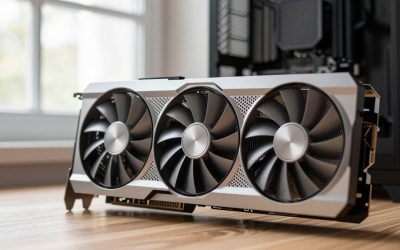
The RTX 5080 is the better gaming card by a wide margin, roughly 30-55% faster in raster at 4K and often close to twice as fast with heavy ray tracing, so it is the pick for high-refresh 4K and path-traced games if your budget stretches to around $1,000. The RX 7900 GRE is the smarter buy for 1440p players who mostly game without ray tracing, because it delivers far better value per dollar with the same 16 GB of VRAM at roughly half the price.
These two cards sit in different price classes. The RX 7900 GRE launched in July 2023 at $549 as an upper-midrange RDNA 3 card, while the RTX 5080 arrived in January 2025 at $999 as NVIDIA’s second-tier Blackwell flagship. Buyers still compare them because the GRE has become a popular used and clearance option, and because both carry 16 GB, which makes people wonder whether the extra $450 is justified. The answer depends entirely on resolution and whether ray tracing matters to you.
Quick answer: Our top pick in 2026 is the Architecture — our #1 rated choice. See the full ranked comparison, alternatives and buying advice below.
Specifications
| Spec | RX 7900 GRE | RTX 5080 |
|---|---|---|
| Architecture | RDNA 3.0 | Blackwell 2.0 |
| Release date | 27 July 2023 | 30 January 2025 |
| Launch MSRP | $549 | $999 |
| Shaders / CUDA cores | 5120 | 10752 |
| Boost clock | 2245 MHz | 2617 MHz |
| Process | 5 nm | 5 nm |
| TDP | 260 W | 360 W |
| Memory | 16 GB GDDR6 | 16 GB GDDR7 |
| Bus width | 256-bit | 256-bit |
| Bandwidth | 576.0 GB/s | 960.0 GB/s |
| Cache | 6 MB L2 + 64 MB L3 | 64 MB L2 |
| Interface | PCIe 4.0 x16 | PCIe 5.0 x16 |
| Power connectors | 2x 8-pin | 1x 16-pin |
| Length / width (reference) | 276 mm, 2-slot | 304 mm, 2-slot |
| Outputs | 1x HDMI 2.1a, 2x DP 2.1, 1x USB-C | 1x HDMI 2.1b, 3x DP 2.1b |
Same capacity, same bus width, but the RTX 5080’s GDDR7 delivers about 67% more bandwidth. That bandwidth, plus a much larger shader array and a far stronger ray tracing pipeline, explains why the gap grows at higher resolutions.
Raster Performance by Resolution
Gamers Nexus’s RTX 5080 review measured it around 10-12% ahead of the RX 7900 XTX at 4K in several titles, and the XTX itself runs roughly 25-30% ahead of the GRE at 4K on average. Chaining those figures gives a 4K gap of roughly 40-45%. Aggregated benchmark datasets broadly agree, with estimates ranging from about 30% to 55% at 4K depending on the game list, and individual heavy titles such as Cyberpunk 2077 showing larger gaps.
- 1080p: The gap often shrinks to 15-25% because the CPU caps frame rates. Neither card is a sensible purchase purely for 1080p unless you chase very high refresh rates.
- 1440p: Expect roughly 25-40% in favor of the 5080 in demanding games. The GRE already delivers high frame rates here, often around 80-110 fps in modern AAA titles at high settings, versus roughly 110-150 fps on the 5080.
- 4K: The 5080’s home turf. Many demanding games run around 60-90 fps natively on the 5080 versus roughly 45-65 fps on the GRE.
Frame rates vary considerably with game, settings, CPU and patch or driver version.
Ray Tracing and Path Tracing
This is where the RTX 5080 becomes a different class of card. Synthetic ray tracing tests such as 3DMark Speed Way show it more than twice as fast as the GRE, and in RT-heavy games the lead commonly lands in the 75-110% range. Path-traced modes in titles such as Cyberpunk 2077 and Alan Wake 2 are playable on the 5080 with DLSS, while the GRE is not built for them.
Upscaling and Frame Generation
- RTX 5080: DLSS 4 Super Resolution with the transformer model, DLSS Frame Generation and Multi Frame Generation, plus Reflex. With MFG, high-refresh 4K becomes achievable in demanding games, provided the base frame rate is already near 60 fps to keep latency acceptable.
- RX 7900 GRE: FSR 3.1 upscaling and frame generation plus driver-level AMD Fluid Motion Frames. The ML-based FSR 4 is officially aimed at RDNA 4 cards, not RDNA 3.
In practice, DLSS 4 at 4K Performance mode looks noticeably cleaner than FSR 3.1 at comparable settings, which effectively widens the usable performance gap beyond the native numbers.
VRAM: A Tie on Capacity
Both cards have 16 GB, which is comfortable at 1440p and adequate for most games at 4K with high or ultra textures. The 5080’s faster memory helps at 4K, but neither card has an edge in how many textures it can hold. If VRAM capacity is your main concern, the 5080 offers no improvement over the GRE.
Power, PSU and Physical Size
Using GPU TDP plus CPU (around 120-150 W for a high-end gaming CPU) plus about 150 W headroom:
- RX 7900 GRE: 260 + 120 + 150 = 530 W, so a quality 650 W unit is plenty.
- RTX 5080: 360 + 150 + 150 = 660 W, so 750 W is the minimum sensible size, and 850 W gives margin for overclocked partner cards.
The RTX 5080 uses a single 16-pin (12V-2×6) connector. An ATX 3.x PSU with a native cable is the cleanest setup; adapters are included, but the plug must be fully seated. The GRE uses two familiar 8-pin plugs. The 5080 Founders Edition is 304 mm long and dual-slot, while many partner models exceed 330 mm and occupy three or more slots, so case clearance matters more with the NVIDIA card.
Cost Per Frame
At launch MSRP, indexing the GRE at 100 and the 5080 at about 145 for 4K raster:
- RX 7900 GRE: $549 / 100 = about $5.49 per performance point.
- RTX 5080: $999 / 145 = about $6.89 per performance point.
That makes the 5080 roughly 25% more expensive per frame in raster at MSRP, and the gap widens further at 1440p where its lead is smaller. With ray tracing included, the 5080’s cost per frame becomes competitive or better. RTX 5080 street prices have frequently sat above MSRP, which tilts value further toward the GRE. Used RX 7900 GRE cards commonly trade around $350-$450, making it one of the stronger 1440p values on the secondhand market.
Which Card Fits Your Build
| Buyer profile | Pick | Reason |
|---|---|---|
| 1440p, raster, budget near $500 | RX 7900 GRE | Much better cost per frame |
| 1440p 240 Hz competitive | RTX 5080 (with fast CPU) | Higher ceiling, Reflex |
| 4K high refresh | RTX 5080 | About 30-55% faster plus DLSS 4 MFG |
| Path tracing and heavy RT | RTX 5080 | Often near twice as fast |
| 650 W PSU, mid-size case | RX 7900 GRE | Lower power, shorter card |
| AI, rendering, streaming | RTX 5080 | CUDA ecosystem, newer NVENC |
CPU and Monitor Considerations
The RTX 5080 only shows its full advantage when nothing else holds it back. At 1440p, a slower CPU can cap frame rates well before the 5080 runs out of headroom, so pairing it with an older six-core chip wastes much of the extra money. A modern high-end processor, ideally an X3D-class Ryzen or a recent Core chip, is the right partner. The GRE is more forgiving and pairs sensibly with mainstream CPUs.
Your monitor tells a similar story. On a 1440p 144 Hz display, the GRE already reaches or approaches the refresh ceiling in many games, which makes the 5080’s extra speed less visible. On a 4K 144 Hz or 1440p 240-360 Hz panel, the 5080’s headroom and DLSS 4 Multi Frame Generation become genuinely useful. Both cards offer DisplayPort 2.1-class outputs for high-refresh displays.
Frequently Asked Questions
How much faster is the RTX 5080 than the RX 7900 GRE?
Roughly 30-55% at 4K in raster games, based on review and aggregate data, with a smaller gap at 1440p and 1080p. With heavy ray tracing it can be about 75-110% faster.
Both have 16 GB, so is the RTX 5080 worth nearly double the price?
For 4K and ray tracing, yes, because the extra speed and DLSS 4 make a clear difference. For 1440p raster gaming, the GRE delivers most of the experience at a much lower cost.
What power supply does the RTX 5080 need?
A quality 750 W PSU is the minimum with a high-end CPU, and 850 W is a comfortable choice. An ATX 3.x unit with a native 16-pin cable is preferable to using an adapter.
Can the RX 7900 GRE handle 4K?
Yes, in many games at high settings, especially with FSR upscaling. Native 4K with ray tracing is generally beyond it, and it is best viewed as a strong 1440p card.
Is there an AMD card closer to the RTX 5080?
The RX 9070 XT is AMD’s current top RDNA 4 card and costs far less, but it sits below the RTX 5080 in performance. AMD does not currently offer a direct RDNA 4 rival at the 5080 level.
Ready to decide? Our #1 pick for 2026 is the Architecture.
Live price & availability on Amazon.