

- Top Pick: GIGABYTE AORUS Radeon RX 6800 Master 16G Graphics Card, MAX-Covered Cooling, 16GB 256-bit GDDR6, GV-R68AORUS M-16GD Video Card
- Best Value: PowerColor Red Dragon AMD Radeon RX 6800 Gaming Graphics Card with 16GB GDDR6 Memory, Powered by AMD RDNA 2, Raytracing, PCI Express 4.0, HDMI 2.1, AMD Infinity Cache (Renewed)
- Premium Choice: AMD Radeon™ RX 6950 XT gddr6 Graphics Card
Moving from an RX 6800 to an RX 6950 XT makes sense only for 1440p high-refresh or 4K players who can buy the 6950 XT used at a sensible price, because the gain is a solid but not transformative 25-35% in rasterized games with the same 16 GB of VRAM and the same feature set. If you play at 1080p or are happy at 60-90 FPS at 1440p, the RX 6800 is still a capable card, and the money is usually better saved toward a newer generation such as the Radeon RX 9070 series.
Both cards are RDNA 2 designs on the same 7 nm process, so this upgrade is about more of the same silicon rather than a new architecture. That shapes everything below: the performance gain is real, but you do not pick up new upscaling hardware, better ray tracing per core or more memory.
As an Amazon Associate we earn from qualifying purchases at no extra cost to you.

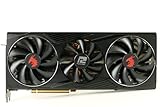

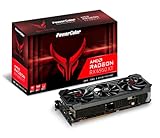
What Changes on Paper
The RX 6950 XT is the fully enabled Navi 21 chip with faster memory, while the RX 6800 is a cut-down version of the same die. The table below uses the official reference specifications.
| Specification | RX 6800 | RX 6950 XT |
|---|---|---|
| Architecture | RDNA 2.0 | RDNA 2.0 |
| Release date | 28 October 2020 | 10 May 2022 |
| Launch MSRP | $579 | $1,099 |
| Stream processors | 3840 | 5120 |
| Boost clock | 2105 MHz | 2324 MHz |
| Process | 7 nm | 7 nm |
| Board power (TDP) | 250 W | 335 W |
| Memory | 16 GB GDDR6 | 16 GB GDDR6 |
| Bus width | 256-bit | 256-bit |
| Bandwidth | 512.0 GB/s | 576.0 GB/s |
| Infinity Cache (L3) | 128 MB | 128 MB |
| L2 cache | 4 MB | 4 MB |
| Interface | PCIe 4.0 x16 | PCIe 4.0 x16 |
| Power connectors | 2x 8-pin | 2x 8-pin |
| Length / width (reference) | 267 mm / 2-slot | 267 mm / 3-slot |
| Display outputs | 1x HDMI, 2x DisplayPort, 1x USB Type-C | 1x HDMI 2.1, 2x DisplayPort 1.4a |
The headline number is the shader count: 5120 against 3840 is a 33% increase, and the 6950 XT also runs about 10% higher boost clocks and 12.5% more memory bandwidth thanks to faster GDDR6. Memory capacity, bus width and Infinity Cache are identical. In practice, the extra shaders do not scale perfectly, which is why real games show a smaller gain than the raw arithmetic suggests.
How Much Faster Is the RX 6950 XT in Games?
According to TechPowerUp’s RX 6950 XT reviews, the 6950 XT finishes roughly 12-15% ahead of the RX 6800 XT at 4K, and the RX 6800 typically trails the 6800 XT by a further 12-15% in the same outlet’s data. Chaining those figures puts the RX 6950 XT roughly 25-35% ahead of the RX 6800 in rasterized games, with the larger gap at 4K, where shader throughput and bandwidth matter most, and the smaller gap at 1080p, where the CPU often limits both cards.
In practical terms, and with the caveat that frame rates vary with settings, CPU and game patches:
- 1080p: both cards run most modern games at high frame rates, and many titles become CPU-bound. The visible gain may be 10-20% or less in esports and lighter titles.
- 1440p: this is where the upgrade is easiest to feel. A demanding game that runs at roughly 70-85 FPS on the RX 6800 at high settings will often land somewhere around 90-110 FPS on the 6950 XT.
- 4K: the 6950 XT is the more comfortable 4K card, often turning a 45-55 FPS experience into something closer to 60-70 FPS before upscaling.
Ray tracing
Both cards use first-generation AMD ray accelerators, one per compute unit. The 6950 XT has more compute units, so its ray tracing performance rises roughly in line with its raster lead, but neither card handles heavy path-traced or full ray-traced settings well. If ray tracing is your main reason for upgrading, an RDNA 2 to RDNA 2 jump is the wrong move; RDNA 4 cards such as the RX 9070 XT, or a current GeForce RTX 50 card, are far stronger in that area.
Upscaling and frame generation
Nothing changes here. Both cards support FSR 1, FSR 2 and FSR 3.1, including FSR 3 frame generation in supported games, plus AMD Fluid Motion Frames at the driver level. FSR 4, AMD’s machine-learning upscaler, is officially aimed at RDNA 4 Radeon RX 9000 cards, so neither the RX 6800 nor the 6950 XT gains it through this upgrade. Intel’s XeSS also runs on both cards through its DP4a path.
Worked Numbers: Cost per Performance and PSU Sizing
Using launch MSRP and taking the RX 6800 as 100 performance points with the 6950 XT at roughly 130 (the middle of the 25-35% range):
- RX 6800: $579 / 100 = about $5.79 per performance point.
- RX 6950 XT: $1,099 / 130 = about $8.45 per performance point.
At launch prices, the 6950 XT cost about 46% more per unit of performance. The used market changes the picture, so the useful test is simple: divide the net upgrade cost (6950 XT price minus what your RX 6800 sells for) by the 30-point gain. If that net cost is around $100-$150, you are paying roughly $3-$5 per extra point, which is reasonable. If it is $250 or more, a newer card is usually the better destination.
For power, a common sizing rule is GPU board power plus CPU power plus about 150 W of headroom:
- RX 6800 with a 125 W gaming CPU: 250 + 125 + 150 = about 525 W, so a quality 550-650 W unit is comfortable.
- RX 6950 XT with the same CPU: 335 + 125 + 150 = about 610 W, so a quality 750 W unit is the sensible floor, and 850 W gives more room for the transient spikes high-end RDNA 2 cards are known for, especially factory-overclocked models.
If your RX 6800 runs on a budget 550 W supply, plan for a PSU upgrade as part of the cost.
Case Fit and Connectors
The reference RX 6950 XT keeps the same 267 mm length as the RX 6800 but grows from a 2-slot to a 3-slot cooler, and many partner 6950 XT cards are longer and thicker than reference. Check three things before buying: the GPU clearance figure for your case, whether a 3-slot card blocks a second PCIe or M.2 heatsink you rely on, and whether your PSU has two separate 8-pin PCIe cables. Both cards use 2x 8-pin on reference designs, though some partner 6950 XT boards add a third 8-pin connector. Using separate cables rather than one daisy-chained cable is the safer choice at 335 W.
Display outputs also differ slightly. The RX 6800 reference card includes a USB Type-C port, while the reference 6950 XT drops it in favor of HDMI 2.1 and two DisplayPort 1.4a outputs. Anyone running a USB-C monitor directly from the GPU should check the specific partner card’s outputs.
Used-Market Reality in 2026
Both cards are previous-generation-plus products now, sold mostly used or as leftover stock. As a broad guide, RX 6800 cards usually sell for about $250-$320 used and RX 6950 XT cards for roughly $350-$450 used, depending on condition, model and region. When buying a used 6950 XT, ask whether it was used for mining, check that the fans spin without rattling, and run a stress test for 15-20 minutes to watch hotspot temperature; a hotspot well above the mid-90s Celsius at stock may point to dried thermal paste.
Also compare against current cards. An RX 9070 or RX 9070 XT costs more new, but brings much stronger ray tracing, FSR 4 support and better efficiency, and comes with a warranty.
Who Should Upgrade and Who Should Wait
| Your situation | Better choice | Why |
|---|---|---|
| 1080p, any refresh rate | Keep the RX 6800 | CPU limits shrink the gain; 16 GB is already plenty |
| 1440p at 60-100 FPS | Keep the RX 6800 | Already delivers this in most games with FSR as backup |
| 1440p at 120-165 Hz | RX 6950 XT if net cost is low | About 30% more frames pushes more games past 100 FPS |
| 4K at 60 FPS | RX 6950 XT, or skip to RX 9070 XT | 6950 XT gets closer to native 60; RDNA 4 adds FSR 4 |
| Ray tracing focus | Skip both, buy RDNA 4 or RTX 50 | Same first-gen RT hardware on both RDNA 2 cards |
| Small case or 650 W PSU | Keep the RX 6800 | 3-slot cooler and 335 W board power need more room |
The bottom line is that the RX 6950 XT is the best RDNA 2 card, but stepping up from an RX 6800 buys a tier of performance, not a new generation. It is worth it when the net cost is modest and your monitor can show the extra frames; otherwise, waiting for a larger jump delivers far more for the money.
Frequently Asked Questions
Is the RX 6950 XT worth it over the RX 6800 for 1440p?
It can be, if you play on a 144 Hz or faster monitor and the net upgrade cost is small. Review data places the 6950 XT roughly 25-35% ahead, which pushes many demanding games from the 70-85 FPS range toward 90-110 FPS. For 60-100 FPS play, the RX 6800 is already enough.
Do I need a new power supply to move from an RX 6800 to an RX 6950 XT?
Often yes. The 6950 XT is rated at 335 W versus 250 W, and a typical gaming system then needs about 610 W before accounting for transient spikes. A quality 750-850 W unit with two separate 8-pin PCIe cables is the safe target.
Does the RX 6950 XT have more VRAM than the RX 6800?
No. Both cards have 16 GB of GDDR6 on a 256-bit bus with 128 MB of Infinity Cache. The 6950 XT only gains bandwidth, 576 GB/s versus 512 GB/s, from faster memory chips.
Can either card use FSR 4?
FSR 4 is officially aimed at RDNA 4 Radeon RX 9000 cards, so neither RDNA 2 card is a target for it. Both support FSR 3.1 upscaling and frame generation in supported games, plus driver-level Fluid Motion Frames.
Is an RX 9070 a better upgrade than an RX 6950 XT?
For most buyers, yes, if the budget stretches that far. The RX 9070 series brings much stronger ray tracing, FSR 4 support and better efficiency, along with a new-card warranty. The RX 6950 XT only makes more sense when it is available used at a clearly lower price.
Ready to decide? Our #1 pick for 2026 is the Architecture.
Live price & availability on Amazon.












