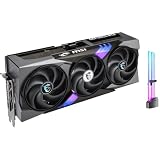
- Top Pick: msi GeForce RTX 5090 Gaming Trio OC Triple Fan Graphics Card, 32GB GDDR7, 3352 AI Tops, DLSS 4, AI Content Creation, Local LLM Inference, 28 Gbps, 512-bit, DP 2.1b x3, HDMI 2.1b, with GPU Holder
- Best Value: msi Gaming RTX 5090 32G Ventus 3X OC Graphics Card (32GB GDDR7, 512-bit, Extreme Performance: 2452 MHz, DisplayPort x3 2.1a, HDMI 2.1b, NVIDIA Blackwell Architecture)
- Premium Choice: msi Gaming RTX 5090 32G SUPRIM SOC Graphics Card (32GB GDDR7, 512-bit, Extreme Performance: 2580 MHz, DisplayPort x3 2.1a, HDMI 2.1b, NVIDIA Blackwell Architecture)
The MSI GeForce RTX 5090 Gaming Trio OC 32G is the flagship of NVIDIA’s current generation — a no-compromise card built for maxed 4K, 8K and serious creative or AI work. Based on the Blackwell architecture, it pairs a vast 32GB of fast GDDR7 memory with the current generation’s DLSS 4 toolkit, and MSI’s large Gaming Trio cooler keeps it composed. At around $4,000 it is a halo product. This MSI RTX 5090 review covers the specifications, performance, upscaling and value.
- MSI RTX 5090 at a Glance
- Architecture and Key Specifications
- Gaming Performance and Target Resolution
- Upscaling and Frame Generation
- Cooling, Power and Physical Fit
- Who Is the MSI RTX 5090 For?
- Pros and Cons
- Is the MSI RTX 5090 Worth It?
- Frequently Asked Questions
- More Graphics Card Reviews
- Related Articles
- Related Articles
- Related Guides

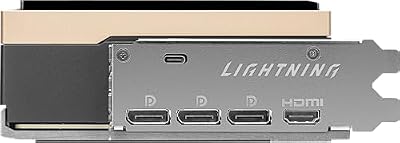
msi Gaming RTX 5090 32G Lightning Z Graphics Card (32GB GDDR7, 512-bit, Extreme Performance: 2775 MHz, DisplayPort x3 2.1a, HDMI 2.1b, NVIDIA Blackwell Architecture)


As an Amazon Associate we earn from qualifying purchases. Product prices and availability are accurate as of the date/time indicated.
🛒 Best Price Today on Amazon
Prime members get fast, free shipping on everything above, plus member-only deals. New members get a 30-day free trial — cancel anytime.
As an Amazon Associate we earn from qualifying purchases.




MSI RTX 5090 at a Glance
| Component | Specification |
|---|---|
| GPU | NVIDIA GeForce RTX 5090 |
| Architecture | NVIDIA Blackwell |
| Video memory | 32GB GDDR7 |
| Memory interface | 512-bit |
| Boost clock | Around 2497 MHz |
| Interface | PCIe 5.0 |
| Display outputs | 3x DisplayPort 2.1a, 1x HDMI 2.1b |
| Cooler | Large triple-fan Gaming Trio, around 14 inches long |
| Price | Around $4,000 |
Architecture and Key Specifications
The RTX 5090 is built on NVIDIA’s current Blackwell architecture, and it is the flagship of the latest GeForce line. Its specification sheet is in a class of its own: a vast 32GB of fast GDDR7 memory on a very wide 512-bit memory interface. That combination of an enormous 32GB buffer and an exceptionally wide interface gives the RTX 5090 capacity and bandwidth far beyond any other consumer card — a defining feature that matters for the most demanding gaming and, especially, for memory-hungry creative and AI workloads.
MSI’s Gaming Trio OC version is a large, premium implementation. It carries a factory overclock with a boost clock around 2497 MHz, uses a fast PCIe 5.0 interface, and is cooled by a large triple-fan Gaming Trio design roughly 14 inches long. The combination of a vast modern memory buffer, a current architecture and a substantial cooler makes the RTX 5090 a genuine no-compromise flagship for the most demanding users.
Gaming Performance and Target Resolution
The RTX 5090 is built for maxed 4K gaming and serious 8K capability, and that is how it should be judged. At 4K it is the most capable card of the current generation, delivering an outstanding experience in modern AAA titles with maxed settings and ray tracing enabled — there is no resolution-or-settings combination at 4K that genuinely troubles it.
It is also a card with real 8K ambitions, an extremely demanding resolution that only a flagship can sensibly approach. At 1440p it is far beyond what is needed, and in esports it is simply effortless. Beyond gaming, its vast 32GB memory buffer makes it a genuine workstation-class card for content creation and AI workloads, where memory capacity is often the limiting factor. As the flagship of the current generation, the RTX 5090 is built for the user who wants the very best, with no compromise.
Upscaling and Frame Generation
The RTX 5090 supports DLSS 4 with Multi Frame Generation. As a Blackwell-architecture card it belongs to the current GeForce generation, and DLSS 4 and its Multi Frame Generation feature are exclusive to that generation. For the flagship card, this current-generation upscaling toolkit complements raw performance that is already the strongest available.
DLSS Super Resolution reconstructs a lower internal resolution to your target resolution, recovering performance with little loss of image quality. DLSS 4 Multi Frame Generation goes further, generating multiple additional frames to lift on-screen smoothness substantially in supported titles. On the RTX 5090, this toolkit is the natural tool for the most extreme scenarios — pushing very high frame rates at 4K with everything maxed, or stretching towards 8K in supported games. Even on a card this powerful, access to the current generation’s flagship upscaling features extends what is possible at the very limits of high-resolution gaming.
Cooling, Power and Physical Fit
MSI has given the RTX 5090 a large cooler to match its flagship status. The triple-fan Gaming Trio design is roughly 14 inches long, and that substantial size provides the ample cooling capacity a flagship card requires, keeping temperatures and noise sensible during extended demanding sessions. The implication is unavoidable: at around 14 inches this is a very large card, and buyers must check it carefully against the clearance in their case, as it will not fit smaller builds.
Power is a serious consideration. As the flagship of the current generation, the RTX 5090 has a substantial power requirement, and buyers must plan for a capable, high-quality, high-wattage power supply with the connectors to suit. This is not a card to pair with a marginal PSU. For a suitably specified high-end system this presents no obstacle, and the large Gaming Trio cooler keeps the flagship composed under the heaviest loads.
Who Is the MSI RTX 5090 For?
The MSI RTX 5090 Gaming Trio OC is for the user who wants the very best, with no compromise. If you game at 4K and want maxed settings with ray tracing and no concessions, have ambitions towards 8K, or — just as importantly — run memory-hungry content creation or AI workloads that benefit from a vast 32GB buffer, the RTX 5090 is squarely your card. It is a genuine dual-purpose flagship: a no-compromise gaming card and a serious creative or AI workstation card.
It is not for buyers working to a budget, or for those whose needs are met by a high-end or top-tier card — the RTX 5090 is a halo product priced accordingly. But for the user who genuinely wants the most capable consumer graphics card available, for gaming and demanding professional work alike, the RTX 5090 is exactly that.
Pros and Cons
Pros: The most capable consumer graphics card of the current generation; vast 32GB of fast GDDR7 memory on a very wide 512-bit interface; maxed 4K and serious 8K capability; genuine creative and AI workstation card; supports DLSS 4 with Multi Frame Generation; large, substantial cooler.
Cons: A flagship price that puts it far beyond most budgets; a very large card, around 14 inches, that will not fit smaller builds; a substantial power requirement that demands a capable, high-wattage PSU.
Is the MSI RTX 5090 Worth It?
At around $4,000 the MSI GeForce RTX 5090 Gaming Trio OC 32G is worth it for the specific user it is built for: someone who genuinely wants the most capable consumer graphics card available, for no-compromise 4K and 8K gaming and for demanding creative or AI work. Its vast 32GB memory buffer, very wide interface and current-generation DLSS 4 toolkit make it a genuine dual-purpose flagship.
For most gamers, a high-end or top-tier card represents far better value, and the RTX 5090’s price places it well beyond mainstream budgets. But for the enthusiast or professional who wants the very best and can justify the cost — particularly one whose work benefits from 32GB of memory — the RTX 5090 delivers exactly that, and MSI’s large, well-cooled Gaming Trio is a fitting way to buy it.
Frequently Asked Questions
Is the MSI RTX 5090 good for 4K gaming?
Yes. The RTX 5090 is the flagship of the current generation and the most capable card for maxed 4K gaming with ray tracing enabled. It also has serious 8K capability.
Does the RTX 5090 support DLSS 4?
Yes. The RTX 5090 is built on NVIDIA’s Blackwell architecture, so it supports DLSS 4 with Multi Frame Generation, the current generation’s flagship upscaling feature.
Is the MSI RTX 5090 good for creative and AI work?
Yes. Its vast 32GB memory buffer makes it a genuine workstation-class card for content creation and AI workloads, where memory capacity is often the limiting factor.
How much memory does the RTX 5090 have?
The RTX 5090 has a vast 32GB of fast GDDR7 memory on a very wide 512-bit interface — capacity and bandwidth far beyond any other consumer graphics card.
More Graphics Card Reviews
- MSI GeForce RTX 3050 Ventus 2X 6G OC Review
- ASRock Intel Arc A580 Challenger 8GB OC Review
- ASUS Dual GeForce RTX 4060 V2 OC Edition Review
- GIGABYTE GeForce RTX 5050 WINDFORCE OC 8G Review
- GIGABYTE GeForce RTX 5060 Gaming OC 8G Review
- ASRock Radeon RX 7700 XT Challenger 12GB Review
- GIGABYTE Radeon RX 9060 XT Gaming OC 16G Review
- MSI GeForce RTX 5060 Ti 16G Shadow 2X OC Review
Affiliate Disclosure: As an Amazon Associate, we earn from qualifying purchases. If you click a link and make a purchase, we may earn a small commission at no extra cost to you. Prices and availability are accurate as of publication and may change.
Related Articles
Looking for more on this topic? Browse the hand-picked guides below — each one applies the same scoring rubric used in this review.