Moving Out, the furniture-hauling co-op game from SMG Studio and Devm Games, published by Team17 and released on 28 April 2020, never received a Linux build. Steam’s record is plain about it: the platform flags read Windows true, Mac false, Linux false, and the Linux requirements tab is an empty shell, Minimum and Recommended headings standing over empty lists.
The record’s one oddity sits on the other axis. The Mac flag also reads false, yet the Mac requirements field is fully written out, a complete Mavericks-era specification sitting behind a withdrawn flag: the mirror image of the usual trap, text describing a build the flag disowns instead of a flag promising a build that does not exist. It changes nothing for Linux players, whose route is Proton, but it proves paperwork and delivery are different records, and only one of them installs anything.
As an Amazon Associate, we earn from qualifying purchases.
Quick answer
Moving Out is not native on Linux. Steam flags the game Windows only, its Linux requirements tab is an empty shell, and its single content depot ships one Windows build. The working route is Proton: ProtonDB rates the game Platinum across 31 reports with strong confidence, and Valve rates it Verified on Steam Deck, tested on the build the public branch still serves.
The status at a glance
| Question | Answer from the record |
|---|---|
| Native Linux build | No — Steam flags read Windows only |
| Mac requirements field | Fully written, behind a false flag |
| Steam Deck verdict | Verified, paperwork current on the branch build |
What Steam’s record says
The appdetails record for Moving Out (app 996770) lists two developers, SMG Studio and Devm Games, and Team17 as publisher. The category list is a local-multiplayer set: single-player, multi-player, co-op, shared and split screen play, Remote Play Together, full controller support, Steam Cloud and Family Sharing. No anti-cheat is named, no third-party DRM notice appears, and no external account or launcher is required.
The Linux requirements field is the empty shell: both tiers exist as headings, and both lists under them are empty. The Windows minimum, by contrast, is genuinely written: Windows 7 SP1 or Windows 10 in 64-bit, a Core2 Duo E8400 or Phenom II X2 550 class processor, a modest 2020 specification any current Linux machine clears without effort.
The Mac field is where the record contradicts itself in the harmless direction. Mac reads false in the flags and no Mac build is delivered, yet the field carries a complete written minimum: OS X Mavericks 10.10, a dual-core Intel processor, 2 GB of RAM and a 1.5 GB video card. Leftover text, and proof of the rule this series runs on: a populated field is paperwork, not delivery.
The delivery layers agree completely. SteamDB’s depot table lists exactly one content depot, 996771, Moving Out Content, at 697.20 MiB, with no operating-system split and no companion depot beside it. The public branch serves build 6393794. The packages tell the same story on Steam’s own package records: the base package (sub 328868), the Commercial License package (sub 597152) and the Deluxe Edition package (sub 1536764) each read Windows true, Mac false, Linux false. A purchase, in any edition, delivers the one Windows build and nothing else.
The family sweep: three add-ons, zero extra flags
The game’s record carries a DLC array of exactly three apps, each read individually. Movers in Paradise (1464740), the expansion released in February 2021, flags Windows true, Mac false, Linux false, with the same empty-shell Linux field as the base game. The Employees of the Month Pack (1249280), a launch-day add-on, repeats that paperwork exactly. Neither adds a platform the base record does not claim.
The third app is the one this series watches most closely. The Original Soundtrack (1289400) is a music product, and soundtrack apps are the classic source of false Linux flags that a family-level scan then credits to the game. This one does not. The soundtrack flags Windows only, and its Linux field is not even a shell; it is an empty list outright. Between the game and its whole family there is not a single Linux flag anywhere to misread.
Anti-cheat and launchers: three empty chairs
Steam’s record names no anti-cheat, carries no DRM notice and requires no external account. SteamDB’s detected-technology list names engine plumbing only: the Unity Engine and the UnityIL2CPP SDK. The Are We Anti-Cheat Yet dataset, all 1,167 games on its master branch, searched by name and by app id, carries no entry for Moving Out at all. Three sources, kept separate, three negatives. The multiplayer is local and Remote Play based, not server-based.
The Proton file
ProtonDB’s summary record for app 996770 was read in full this session: a Platinum headline tier, a Platinum best-reported tier and a Platinum trending tier, across 31 reports, with strong confidence at 0.79. One limit is disclosed plainly: the classification heading on the game’s ProtonDB page could not be extracted this session, so no claim is made about whether the page heads its block with a native-support label, and nothing here rests on it.
The report texture, kept at report weight, matches the tiers. Recent filings describe local multiplayer rated Excellent and clean out-of-the-box runs. The older filings carry the early Proton-era faults: Media Foundation cutscenes that arrived as black screens and had to be skipped with a button press, and a hang on exit, both concentrated in reports from the Proton 4 and 5 years. Two single-report notes sit in the current file: a level-select map glitch under the stock build, clean under GE-Proton, and a PipeWire launch note for Remote Play on Wayland. Neither is a property of the game.
The Steam Deck sheet
Valve rates Moving Out Verified on Steam Deck, and SteamOS separately Compatible. One evidence note: the verdict and paperwork were read through SteamDB’s republication of Valve’s compatibility record, disclosed here as the route used.
All four Verified items pass: all functionality is accessible with the default controller configuration, in-game interface text is legible, and the default graphics configuration performs well. The configuration block is clean where it matters for a couch co-op game: gamepad input, no small-text flag, no manual keyboard invocation, and no internet required for setup or single-player. The recommended runtime is proton-7.0-1, the honest line for a Windows-only game: the badge certifies the Windows build under Proton, because Proton is the only route there is.
The paperwork has one property most games in this cluster cannot claim. Valve’s test is dated 26 March 2022 and was run on build 6393794, and the public branch still serves that build today, untouched since March 2021. The test therefore covers the exact build a buyer installs now: this is not a supplement candidate.
The storefront ruling
There is no second copy to weigh. GOG’s product API and embed searches both return no Moving Out product, and its natural GOG address resolves to the general catalogue, so no product page exists to verify. No Dreamlist claim is asserted either way. The Steam copy is the only PC edition, and it is the buy.
Gear that fits the record
The gear below follows the record’s shape: the handheld the badge was written for, two pads for shared-screen co-op, a mouse for desktop menu work, and library storage.
Valve Steam Deck OLED 512GB

The handheld the Verified badge was written for, with paperwork that still matches the build on the public branch, and local co-op that travels with the machine.
Specs
- Display: 7.4-inch HDR OLED, 1280 by 800, up to 90 Hz
- Processor: AMD Zen 2 and RDNA 2 custom APU
- Memory: 16 GB LPDDR5
- Storage: 512 GB NVMe, plus a microSD slot
- Wireless: Wi-Fi 6E and Bluetooth
- Channel note: Valve sells the Deck mainly through its own store, so Amazon listings are third-party sellers
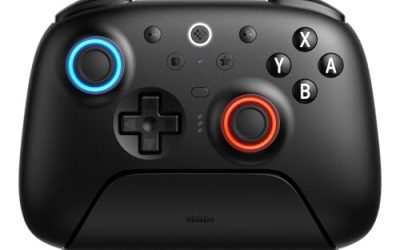
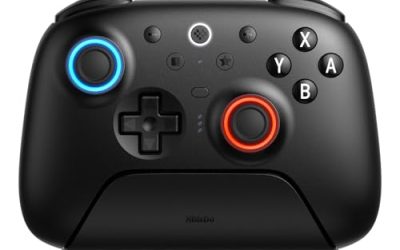
8BitDo Ultimate 2 Bluetooth Controller
The second-player pad pick for the shared-screen co-op Steam lists, with modern sticks, triggers and back buttons.
Specs
- Connectivity: Bluetooth wireless and USB-C wired
- Joysticks: TMR electromagnetic, anti-drift design
- Triggers: Hall effect, with mode switching
- Extras: two remappable back buttons, motion control
- In the box: charging dock included
Xbox Wireless Controller, Carbon Black
The safest guest pad in PC gaming: Steam Input support is universal, the glyphs match what most games display, and it pairs over Bluetooth or its own wireless standard.
- Connectivity: Xbox Wireless and Bluetooth
- Port: USB-C for wired play
- Controls: hybrid D-pad, dedicated Share button
- Power: AA batteries or optional rechargeable pack
Logitech G502 HERO
At a desk, a precise wired mouse turns menus, settings and level select into single clicks between rounds. Eleven programmable buttons cover the confirm and cancel inputs.
Specs
- HERO optical sensor, up to 25,600 DPI
- 11 programmable buttons
- Adjustable weight system
- Wired USB connection
- On-board memory profiles
Samsung T9 Portable SSD 2TB
For moving a Linux game library between machines, or keeping an offline backup of installers, a fast USB-C drive is the simple answer.
Specs
- Capacity: 2 TB portable SSD
- Interface: USB 3.2 Gen 2×2, USB-C connector
- Maker-rated speeds: up to 2,000 MB per second read, 1,950 MB per second write
- Features: Dynamic Thermal Guard, maker-rated drop resistance
How to choose
Choose the Steam copy, because it is the only PC edition on sale. On desktop or laptop, install under Proton and start with the default compatibility tool; a unanimous Platinum file across 31 reports says the current route is a clean one. On Steam Deck, the Verified badge was earned on the build the branch still serves, so no configuration work is expected: install and launch. Pads are this game’s native shape, and shared-screen sessions want one per player.
Who should skip
Skip this one if you are shopping for a native Linux build: Moving Out does not have one, and the empty-shell tab is not a specification waiting to be filled. Skip it if you want a DRM-free offline installer, because no GOG edition exists to buy. Skip it if the Mac text raised a hope: that field is a leftover behind a false flag, and no Mac build is delivered either. And skip it if your co-op plans depend on online matchmaking rather than the local and Remote Play routes the record lists.
FAQ
Is Moving Out native on Linux?
No. Steam’s record for app 996770 flags Windows only, the Linux tab is an empty shell, the single content depot has no operating-system split, and every package flags Windows alone. The whole family agrees: the expansion, the character pack and even the soundtrack all flag Windows only.
How well does Moving Out run under Proton?
ProtonDB’s summary record reads Platinum on all three tiers, across 31 reports with strong confidence. Recent reports describe local multiplayer rated Excellent and clean runs; the faults in the file, black-screen cutscenes and an exit hang, belong to much older Proton versions.
Is Moving Out Steam Deck Verified?
Yes. Valve’s record gives the game its top category, Verified, with all four checks passing and proton-7.0-1 as the recommended runtime. Unusually, the paperwork is current: the test ran in March 2022 on build 6393794, and the public branch still serves that build today.
Can I buy Moving Out on GOG instead?
No. GOG’s own searches return no product for the game and its natural GOG address resolves to the general catalogue, so no GOG edition exists to buy. The Steam copy is the only PC edition.
Final verdict
Moving Out is a Windows-only release whose paperwork rewards a careful read. The Linux tab is a shell, the Mac text is a fossil behind a false flag, and the family, unusually, contains no inflated flag at all, not even on the soundtrack. What Linux players get instead is one of the strongest Proton positions in this cluster: a unanimous Platinum file and a Verified Deck badge whose test build is still the build on sale. Buy the Steam copy, play it under Proton, and read the Mac paragraph as what it is, a leftover, not a promise.
Product and ASIN Reference
| Product | ASIN |
|---|---|
| Valve Steam Deck OLED 512GB | B0CQ3RWQQZ |
| 8BitDo Ultimate 2 Bluetooth Controller | B0F194QFT2 |
| Xbox Wireless Controller, Carbon Black | B08DF248LD |
| Logitech G502 HERO | B07GBZ4Q68 |
| Samsung T9 Portable SSD 2TB | B0CHFS9K14 |