- Top Pick: Microphone Shock Mount with Pop Filter, Mic Anti-Vibration Suspension Shock Mount Holder Clip for Diameter 46mm-51mm Microphone
- Best Value: AT2020 Microphone Shock Mount with Pop Filter, Custom Built for AT2020 Mic
- Premium Choice: AT2020 Shock Mount with Pop Filter, Windscreen and Shockmount to Reduce Vibration Noise for AT2020USB+ Condenser Mic by YOUSHARES
The Microphone Shock Mount with Pop Filter Anti-Vibration is a combination accessory — a suspended elastic-band shock mount and a dual-layer mesh pop filter bundled into one unit. The shock mount isolates the mic from desk-transmitted vibration (footsteps, keyboard taps, chair movement), and the integrated pop filter handles plosive bursts in front of the capsule. At around $20 the combo replaces two separate accessory purchases with one budget-tier unit. This Microphone Shock Mount with Pop Filter review covers the specifications, build, vibration isolation, plosive control and value.

Microphone Shock Mount with Pop Filter, Mic Anti-Vibration Suspension Shock Mount Holder Clip for Diameter 46mm-51mm Microphone


As an Amazon Associate we earn from qualifying purchases. Product prices and availability are accurate as of the date/time indicated.
🛒 Best Price Today on Amazon
Prime members get fast, free shipping on everything above, plus member-only deals. New members get a 30-day free trial — cancel anytime.
As an Amazon Associate we earn from qualifying purchases.
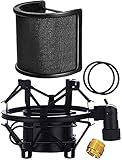
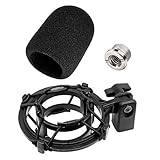


Microphone Shock Mount with Pop Filter at a Glance
| Specification | Detail |
|---|---|
| Type | Combo — shock mount + dual-layer pop filter |
| Mounting | Screw-clamp to mic stand or boom arm; mic suspends in elastic bands |
| Compatible mic mount thread | 5/8″ with 3/8″ adapter included |
| Layer count | Double-layer pop filter mesh |
| Material | Metal shock mount frame, elastic bands, nylon mesh filter, plastic clamp |
| Adjustment range | Pop filter gooseneck adjustable around the mic position |
| Color options | Black |
| Compatibility list | Large-diaphragm condensers — Rode NT1, AT2020, MXL 990, Neewer NW-700 / NW-800 and similar |
| Approx price | Around $20 |
Build Quality & Materials
The combo unit is built around a standard suspended elastic-band shock mount frame — the mic clips into a ring suspended inside the outer frame by tensioned elastic cords, which mechanically isolate the mic from the frame. The pop filter is a dual-layer nylon mesh disc on a short gooseneck attached to the same frame, positioned in front of the mic capsule when assembled. The frame is metal where it needs to be load-bearing, with plastic elements at the gooseneck and clamp.
For a sub-$20 combo unit the build is honest and the engineering pattern is correct. The shock-mount cradle is the standard radio-broadcast design that has been around for decades and is genuinely effective at vibration isolation. The pop filter is dual-layer mesh — equivalent to the budget dual-layer pop filters elsewhere in this guide — and the combined unit delivers two functional accessories for less than the cost of buying them separately. The trade-off is that neither component is the best in class; both are budget-tier.
Mounting & Compatibility
The clamp at the base of the assembly is the standard universal screw-clamp design that grips the pole of any mic stand or boom arm. The thread is 5/8-inch with a 3/8-inch adapter included, which covers virtually all standard mic stands and boom arms. The mic itself does not thread onto the unit — instead, it clips into the suspended ring inside the shock mount frame, which is what provides the vibration isolation.
Compatibility is targeted at large-diaphragm condensers — the Rode NT1, Audio-Technica AT2020, MXL 990, the popular Neewer NW-700 and NW-800 entry-level condensers, and similar mics. It does not fit the broader Blue Yeti or HyperX QuadCast class because those mics have non-standard shapes designed for their own integrated stands. For a typical home-studio large-diaphragm condenser setup on a boom arm, the combo unit is well sized. Pair with one of the arms in our best boom arms guide for the install.
Plosive Reduction Performance
The pop filter component is a standard dual-layer nylon mesh design — equivalent to the budget dual-layer filters elsewhere in this guide. The first mesh disrupts the high-velocity air burst of a plosive consonant, and the air gap between the layers allows the burst to disperse before reaching the second mesh. For everyday streaming, podcasting and content creation the result is effective plosive reduction comparable to a standalone budget dual-layer filter.
The trade-off against a dedicated triple-layer or metal-mesh pop filter is the same as for any dual-layer nylon design — slight upper-frequency attenuation and a marginal edge to multi-layer designs on exceptionally hard plosives. For critical paid studio vocal work, an upgraded dedicated pop filter elsewhere in this guide is the better tool. For the combo use case where convenience and value are the priority, the integrated dual-layer filter is well judged.
Vibration Isolation & Cleaning
The shock mount component is the engineering value of this combo. The suspended elastic-band cradle mechanically isolates the mic from desk-transmitted vibration — footsteps on the floor, keyboard taps, mouse clicks, chair movement, table bumps. All of these would otherwise transmit through the mic stand or boom arm into the mic capsule and appear as low-frequency rumble or clicks on recordings. The shock mount removes that noise cleanly and is genuinely necessary for serious large-diaphragm condenser recording.
Maintenance on the shock mount frame is minimal — wipe the metal frame with a damp cloth occasionally to keep dust off, and check the elastic bands every six months for wear (they can lose tension over years of use and may need replacement, which is straightforward). The pop filter mesh follows the standard nylon-filter cleaning pattern — gentle damp-cloth wipe every two to three months. The combo unit is a multi-year-life piece of equipment with the elastic bands and mesh as the only consumable elements.
Use Cases — Streaming / Podcast / Vocal Recording
For streaming with a large-diaphragm condenser like the Rode NT1, AT2020 or Neewer NW-700, the combo unit is well matched. The shock mount removes the desk-noise problem that any condenser mic on a boom arm picks up, the pop filter handles plosive control, and the single-purchase format is convenient. For a beginner setting up a serious condenser-mic streaming workflow, the combo is a sensible single-buy for both accessories.
For podcasting the same applies — the shock mount is essential for clean condenser recording in any setup where vibration noise matters, and the integrated pop filter handles close-mic plosive control. For critical vocal recording in a controlled studio, upgrading to a dedicated triple-layer pop filter and possibly a more refined shock mount may be the path, but the combo unit provides a strong starting point. For the typical large-diaphragm condenser owner who wants both accessories at a budget price, this is the right buy. See our best XLR microphones guide for compatible mic options.
Verdict
The Microphone Shock Mount with Pop Filter Anti-Vibration is the right buy for a specific user: a streamer, podcaster or home recordist setting up a large-diaphragm condenser (Rode NT1, AT2020, Neewer NW-700 class) on a desk-mounted boom arm, looking for both accessories in a single budget-tier purchase. Inside that envelope it delivers — effective vibration isolation, dual-layer plosive control, broad mic compatibility for the condenser class.
It is not the right buy for Blue Yeti or HyperX QuadCast owners (the mic doesn’t fit the cradle) or for users who want the absolute best engineering in each component (a dedicated triple-layer pop filter plus a dedicated premium shock mount would be the upgrade path). For the typical large-diaphragm condenser owner, however, the combo unit is one of the most sensible single purchases for setting up both accessories at once. Combine with the rest of our best streaming gear gear for a complete setup.
Frequently Asked Questions
Does this combo fit a Blue Yeti?
No. The shock mount cradle is designed for large-diaphragm condensers like the Rode NT1, AT2020 and Neewer NW-700 class. The Blue Yeti has a non-standard shape designed for its own integrated stand, not for a generic shock-mount cradle.
What does the shock mount actually do?
It mechanically isolates the mic from desk-transmitted vibration — footsteps, keyboard taps, mouse clicks, chair movement, table bumps. Without a shock mount, those vibrations transmit through the mic stand into the capsule and appear as low-frequency rumble or clicks on recordings.
Is the integrated pop filter as good as a dedicated one?
It is equivalent to the budget dual-layer nylon pop filters elsewhere in this guide. For everyday streaming and podcasting it is functional and appropriate. For critical paid vocal work, a dedicated triple-layer or metal pop filter is the upgrade.
Do the elastic bands wear out?
Yes, over time — typically several years of regular use before the bands lose tension. Replacement bands are inexpensive and easy to fit. Check the tension every six months and replace when the mic begins to sag in the cradle.
More Mic Accessory Reviews
- Elgato Shock Mount Steel Chassis Vibration Isolation Review
- Neewer Professional Pop Filter Shield Review
- On-Stage Foam Ball Microphone Windscreen Review
- Aokeo Professional Pop Filter Mask Review
- Aokeo 3-Layer 360 Flex Pop Screen Review
- Aokeo Metal Mesh Pop Filter for HyperX QuadCast Blue Yeti Review
- PEMOTech 3-Layer Metal Mesh Foam Etamine Pop Filter Review
- Mudder 5-Pack Foam Mic Cover Windscreen Review
Affiliate Disclosure: As an Amazon Associate, we earn from qualifying purchases. If you click a link and make a purchase, we may earn a small commission at no extra cost to you. Prices and availability are accurate as of publication and may change.