The Aokeo 3-Layer 360° Flex Pop Screen is a meaningful step up from the budget dual-layer pop filter — a triple-layer construction with metal mesh on the outer face, an internal foam layer for airflow dispersion, and an etamine inner mesh for fine-detail filtering. At around $15 it sits a tier above the budget dual-layer Aokeo and offers genuinely better plosive control and higher-frequency transparency. For a streamer or podcaster looking to upgrade beyond the basic dual-layer filter without spending studio money, the 3-Layer 360° Flex is one of the strongest options in its price range. This Aokeo 3-Layer 360° Flex Pop Screen review covers the specifications, build, performance and value.

Microphone Pop Filter,Aokeo Mic Mask Shield,Three-layer Wind Pop Screen With Flexible 360° Gooseneck Clip Stabilizing Arm For All Microphone



As an Amazon Associate we earn from qualifying purchases. Product prices and availability are accurate as of the date/time indicated.
🛒 Best Price Today on Amazon
Prime members get fast, free shipping on everything above, plus member-only deals. New members get a 30-day free trial — cancel anytime.
As an Amazon Associate we earn from qualifying purchases.

Aokeo 3-Layer 360° Flex Pop Screen at a Glance
| Specification | Detail |
|---|---|
| Type | Triple-layer pop filter (metal mesh + foam + etamine) |
| Mounting | Gooseneck with screw-clamp |
| Compatible mic mount thread | Universal clamp; fits 5/8″ and 3/8″ stand poles |
| Layer count | Triple-layer |
| Material | Metal mesh outer, foam middle, etamine inner; metal gooseneck |
| Adjustment range | 360-degree flex; roughly 6-inch gooseneck arm |
| Color options | Black |
| Compatibility list | Blue Yeti, HyperX QuadCast, Shure SM7B, Rode NT1, AT2020 and most desk-mounted USB or XLR mics |
| Approx price | Around $15 |
Build Quality & Materials
The Aokeo 3-Layer 360° Flex Pop Screen is built around a meaningfully more sophisticated design than the budget dual-nylon filters in this guide. The outer face is metal mesh — durable, easy to clean and free from the long-term sag problem of nylon — and behind it sits a layer of acoustic foam to disperse the air burst, followed by an inner etamine mesh to catch any residual airflow. The frame and gooseneck are metal, the clamp is sturdy plastic with a knurled tightening knob, and the overall build feels several tiers above the budget price.
The triple-layer construction is the design pattern used by mid-to-high-tier pop filters and is genuinely more effective than a dual-mesh design at the engineering level. The metal mesh outer in particular is the key durability upgrade — unlike nylon, metal mesh does not stretch, sag or discolour with use, and the filter looks and performs identically after years of service. For the modest price step up from the dual-nylon budget tier, the build improvement is significant.
Mounting & Compatibility
The clamp at the base of the gooseneck is a standard universal screw-clamp that fits the pole of any mic stand or the secondary mount of a boom arm. It does not thread onto the mic body itself — the pop filter mounts mechanically independent of the mic, which is the correct approach for vibration isolation. The clamp opens wide for the typical 5/8-inch or 3/8-inch stand pole and tightens firmly via the knurled knob.
The 360-degree flex is the headline mounting feature. The gooseneck can be shaped into any reasonable position around the mic and holds that position reliably under load. Compatibility is universal across the desk-mounted mic market — Blue Yeti, HyperX QuadCast, Shure SM7B, Rode NT1, AT2020 family and the broader USB and XLR class all work with this filter. Pair with one of the arms in our best boom arms guide and the install is straightforward. For mic pairings see our best USB microphones and best XLR microphones guides.
Plosive Reduction Performance
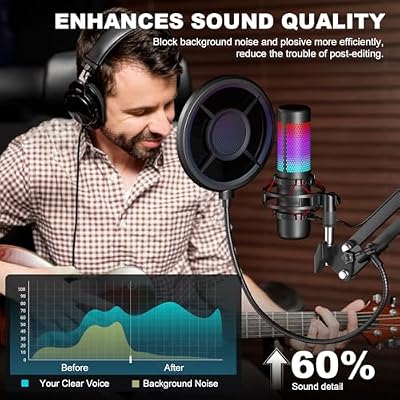
This is where the triple-layer design earns its price premium. The metal mesh outer disrupts the initial high-velocity air burst of a plosive consonant, the foam middle layer disperses the airflow across a wider area, and the etamine inner mesh catches any residual burst before it reaches the mic capsule. The three-stage approach is meaningfully more effective at plosive control than a dual-mesh design, and the audible difference is clear on hard consonants — P, B, T, K — at close mic distances.
Just as important, the triple-layer design preserves upper-frequency detail better than a dual-nylon filter. The foam middle layer absorbs the air burst without significantly attenuating the audio frequencies that matter for speech and vocals, so consonants come through clearer and more articulated. For a streamer or podcaster, the difference is audible in side-by-side comparison even though either filter would be acceptable in isolation. For critical vocal work the triple-layer is closer to studio-tier filtering.
Cleaning & Maintenance
The metal mesh outer is the key maintenance advantage of this filter. Unlike nylon mesh, metal mesh does not degrade — it can be wiped with a damp cloth indefinitely and continues to perform identically over a multi-year lifespan. The foam middle layer is sealed within the filter frame and needs no direct cleaning; the etamine inner mesh requires only the occasional dust-off with a soft brush or a gentle wipe.
Plan a wipe-down of the metal mesh outer every two to three months for a regular-use streaming setup. The gooseneck arm and clamp need essentially no maintenance — a wipe with a dry cloth keeps them tidy. Across a multi-year lifespan, the triple-layer filter with metal-mesh outer is effectively zero-maintenance compared to the once-or-twice-a-year replacement cycle of a budget nylon filter. The cost premium pays back over time.
Use Cases — Streaming / Podcast / Vocal Recording
For streaming, the triple-layer design is a clear upgrade over the budget nylon filters — plosive control is more thorough, high-frequency detail is preserved better, and the metal-mesh durability means the filter still performs perfectly after years of daily use. For a serious streamer or content creator who plans to use the same gear for several years, the modest price premium is well spent. Pair with a quality USB or XLR mic from our best streaming microphones guide for clean speech audio.
For podcasting the same applies — the triple-layer construction handles the close-mic technique that podcasters use, and the preserved high-frequency detail produces more articulated speech in the final mix. For critical vocal recording — sung vocals, voiceover for commercial work — the triple-layer Aokeo is functional studio-tier filtering and is the recommended tier for paid creative work. For users who want one pop filter to cover every use case from streaming through to vocal recording, this is the right tier to buy.
Verdict
The Aokeo 3-Layer 360° Flex Pop Screen is the right buy for a specific user: a streamer, podcaster or content creator who wants meaningfully better plosive control and high-frequency transparency than the budget dual-nylon filters offer, and who values the maintenance-free metal-mesh outer construction. Inside that envelope the filter delivers across every dimension — better filtering, better durability, broader use-case coverage.
It is not the right buy for a strictly budget-first user who needs to keep accessory spend under $10 — for that case, the dual-nylon Aokeo or Neewer filters elsewhere in this guide are the correct picks. For the user looking at the next sensible tier of pop-filter quality, however, the 3-Layer 360° Flex is one of the strongest options at the price and earns a clear recommendation. Combine with the rest of our best streaming gear gear for a complete setup.
Frequently Asked Questions
Is a triple-layer pop filter really better than dual-layer nylon?
Yes, audibly so. The triple-layer design — metal mesh + foam + etamine — provides more thorough plosive reduction and preserves more high-frequency detail than a dual-nylon design. The difference is clear in side-by-side recording.
Does the metal mesh face degrade with use?
No. Unlike nylon mesh, metal mesh does not stretch, sag or discolour with use. The filter performs identically after years of service, which is the key durability advantage over budget nylon filters.
Will this filter fit a Blue Yeti or HyperX QuadCast?
Yes. The universal clamp fits any standard mic-stand pole or boom-arm secondary mount, and the 360-degree gooseneck positions the filter in front of the mic capsule. It works with virtually any desk-mounted USB or XLR mic.
Is this filter good enough for studio vocal recording?
Yes. The triple-layer construction is the design pattern used by mid-to-high-tier studio pop filters and is appropriate for paid vocal recording work, voiceover and commercial content. For the dedicated home studio user it is one of the most cost-effective filter options.
More Mic Accessory Reviews
- Aokeo Metal Mesh Pop Filter for HyperX QuadCast Blue Yeti Review
- PEMOTech 3-Layer Metal Mesh Foam Etamine Pop Filter Review
- Mudder 5-Pack Foam Mic Cover Windscreen Review
- Dragonpad USA Gooseneck Pop Filter Review
- Aokeo Upgraded 3-Layer Pop Filter Metal Mesh Foam Review
- Pop Filter Screen Gooseneck Clamp for Blue Yeti Review
- Microphone Shock Mount with Pop Filter Anti-Vibration Review
- Elgato Shock Mount Steel Chassis Vibration Isolation Review
Affiliate Disclosure: As an Amazon Associate, we earn from qualifying purchases. If you click a link and make a purchase, we may earn a small commission at no extra cost to you. Prices and availability are accurate as of publication and may change.