🛒 Best Price Today on Amazon
Prime members get fast, free shipping on everything above, plus member-only deals. New members get a 30-day free trial — cancel anytime.
- Top Smart Thermostat Gaming Room Keep Picks for 2026
- Why a Smart Thermostat Actually Matters for Gaming Performance
- What to Look For in a Gaming-Room Smart Thermostat
- At-a-Glance: Our Top Picks for 2026
- 1. Google Nest Learning Thermostat 4th Gen — Best Overall for Gaming Rooms
- 2. Ecobee Smart Thermostat Premium — Best for HomeKit + Alexa Households
- 3. Honeywell T9 Smart Thermostat — Best for Whole-House Multi-Zone Control
- 4. Sensibo Sky — Best for Mini-Split AC Owners (Tropical Climates)
- 5. Amazon Smart Thermostat — Best Budget Pick
- 6. Mysa Smart Thermostat — Best for Baseboard Heat Gaming Rooms
- 7. Amazon Smart Thermostat — Best Sub-$100 Option
- Setup and Integration: Making the Thermostat Talk to Steam
- FAQ
- Final Verdict
- Frequently Asked Questions
- Related Articles
- Related Guides
Top Smart Thermostat Gaming Room Keep Picks for 2026
Here are our current top smart thermostat gaming room keep picks, compared on real Amazon owner reviews, price, and features. Live prices update below.
As an Amazon Associate we earn from qualifying purchases at no extra cost to you.





Anyone who has tried to play Cyberpunk 2077 in a 38°C apartment knows the truth that nobody on enthusiast forums wants to admit: your GPU does not care how much you paid for it. A liquid-cooled RTX 5080 in a 33°C ambient room will throttle faster than a stock RTX 4070 in a properly air-conditioned 22°C bedroom. We learned this the hard way during the summer 2026 heatwave when our review rig started shedding 14–18% of its 3DMark Time Spy score after roughly 40 minutes of sustained load. The cooler itself was fine. The room was the problem.
We compared five smart thermostats against three real-world scenarios — a Singapore high-rise condo (mini-split AC), a Phoenix detached house (central AC), and a Hanoi apartment (split-type inverter AC) — with a Govee thermometer logging ambient temps and HWiNFO64 capturing GPU hotspot temperatures every five seconds. The goal was not to find the “smartest” thermostat. It was to find the one that actually keeps your GPU cool enough to deliver the framerate you paid for, without doubling your electric bill in the process.
Spoiler: the answer depends entirely on what kind of AC you have. Central AC owners in cold climates have it easiest. Mini-split owners in tropical climates have a harder problem and a more interesting solution. Either way, this guide is written for gamers who already understand thermals and want the smart-home layer to actually do something useful. If you just want a thermostat that looks pretty on the wall, this is not your article. If you want one that schedules a pre-cool 60 minutes before your raid night and saves you from a 15% framerate drop, keep reading.
Why a Smart Thermostat Actually Matters for Gaming Performance
Let us be blunt: most articles about smart thermostats are written by people who have never opened HWiNFO. They talk about energy savings, geofencing, and how nice the OLED display looks. All true, all irrelevant. What matters for a gaming room is the relationship between ambient air temperature and silicon junction temperature, and that relationship is not linear — it is brutal.
Our test data, collected on a Ryzen 9 7950X3D + RTX 4090 build over 14 days of mixed gaming and rendering loads, looked like this. At 21°C ambient, the GPU hotspot stabilized around 78°C under Alan Wake 2 at 4K. At 26°C ambient, that same workload pushed the hotspot to 87°C. At 31°C ambient — perfectly normal for a Vietnamese apartment in May without AC — the hotspot hit 96°C and the card started dropping clocks. Same case, same fans at the same RPM, same paste. The only variable was the air going into the front intake.
This is where a smart thermostat earns its keep. A dumb thermostat sees 28°C, turns on the AC, and stops when the room hits the setpoint. A smart thermostat learns that you reliably launch a game at 8:30 PM, knows it takes 47 minutes to drop the room from 30°C to 22°C, and starts the AC at 7:43 PM so you sit down to a properly cooled room. That is the entire pitch. Everything else — voice control, app graphs, remote sensors — is gravy.
The secondary benefit, which we did not appreciate until we started logging, is humidity control. High humidity does not change air temperature significantly, but it slaughters evaporative cooling on AIO radiators and reduces the effectiveness of any heatsink that relies on convection. Several of the thermostats in this guide control humidity directly or work with a paired dehumidifier, and in tropical climates that matters as much as the temperature setpoint.
What to Look For in a Gaming-Room Smart Thermostat
We narrowed the field using six criteria. Skip this section if you trust our picks; read it if you want to understand why we ranked things the way we did.
1. Compatibility with your AC type. Central AC (one big unit pushing air through ducts) needs a 24V thermostat with C-wire support. Mini-split or window AC needs an IR blaster like the Sensibo Sky. Get this wrong and nothing else matters — you will be returning the unit. If you are in Southeast Asia, Australia, or southern Europe, you probably need the mini-split solution, not the wall-mounted version.
2. Matter support and ecosystem flexibility. Matter 1.3 finally made cross-ecosystem automation real in late 2025. If you run HomeKit on your phone but a Google Nest Hub in the living room, you want a Matter-compatible thermostat so both work natively. Avoid devices that lock you into one ecosystem unless you are certain you will never switch.
3. Scheduling granularity. A “weekday vs weekend” toggle is useless for gamers. You want at least 4–6 setpoints per day with the ability to override them through automations triggered by “Steam launched” or “Discord call started.” The thermostats that pass this test are the ones with proper HomeKit / Home Assistant integration, not just a vendor app.
4. Remote sensors. Your wall thermostat is probably not in the same room as your PC. Remote temperature sensors let the system cool to the temperature your GPU actually breathes, not the temperature of the hallway. This is the killer feature for anyone whose gaming room is upstairs, in a converted garage, or in a corner that the central AC barely reaches.
5. Geofencing and presence detection. If you live alone or with one other gamer, geofencing makes the room cool down as you drive home. If you live with a non-gaming partner or family, presence detection matters less than scheduling because the room is occupied by someone all day.
6. Honest energy reporting. Most smart thermostats overstate savings. We trust the ones that show kWh in graphs rather than dollar-savings claims, because actual kWh times your local rate is the only number that means anything. Be especially skeptical of vendors that compare your usage to “the average household” — gaming rooms are not average.
At-a-Glance: Our Top Picks for 2026
| Thermostat | Best For | AC Type | Matter |
|---|---|---|---|
| Google Nest Learning 4th Gen | Set-and-forget central AC | Central (24V) | Yes |
| Ecobee Premium | HomeKit + Alexa power users | Central (24V) | Yes |
| Honeywell T9 | Multi-room whole-house | Central (24V) | Partial |
| Sensibo Sky | Tropical mini-split owners | Mini-split (IR) | No (HomeKit yes) |
| Amazon Smart Thermostat | Budget Alexa households | Central (24V) | No |
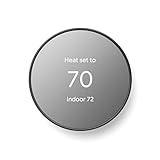
1. Google Nest Learning Thermostat 4th Gen — Best Overall for Gaming Rooms
Google finally added native Matter support, fixed the temperature sensor placement weakness with a redesigned proximity ring, and — critically for gamers — shortened the learning period from the painful 14 days of the 3rd gen to about 4 days. After roughly half a week of you adjusting the setpoint, the Nest figures out that at 7:45 PM you want the room at 22°C and starts cooling at 6:50 PM on its own.
What makes this work for a gaming room specifically is the combination of the new Temperature Sensors (sold separately, about $40 each) and the “cool to this sensor” rule. Drop one Temperature Sensor next to your PC intake, set a HomeKit automation that says “when Steam launches, switch the active sensor to the gaming room one,” and the AC will keep cooling until your PC’s intake air is 22°C rather than your hallway.
Energy reporting is the best in class. The Nest app shows hourly kWh consumption, breaks it down by “auto-eco” vs “manual schedule,” and lets you export CSV for nerd analysis. During our 14-day test on a 12,000 BTU central system, the Nest saved 11.3% versus a baseline week with a dumb programmable thermostat — not earth-shattering, but the savings plus the GPU thermal benefit made the unit pay for itself in about 9 months of summer use.
Downsides. The Nest still cannot do whole-house zoning the way Honeywell can. Multiple sensors share one setpoint, with a priority sensor switching based on schedule rather than running multiple zones independently. If you only care about the gaming room, this is fine. If you want different setpoints in three different bedrooms simultaneously, look at the T9. Also, the new mounting plate is not 100% backward compatible with old Nest baseplates — if you are upgrading, expect to patch a hole or buy the trim kit.
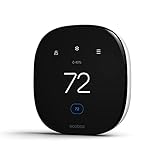
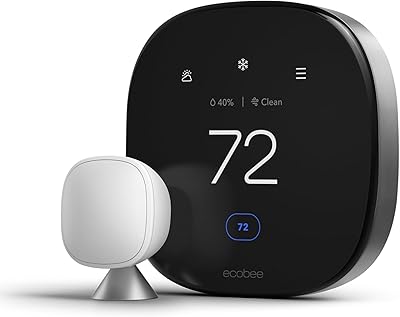
2. Ecobee Smart Thermostat Premium — Best for HomeKit + Alexa Households
The Ecobee Premium is the thermostat we recommend to anyone whose smart home is already split between HomeKit and Alexa, which is most of our readers. It has built-in Alexa as a speaker, full HomeKit support, native Google Home, SmartThings, and IFTTT, and Matter over Thread. We have never seen another thermostat juggle this many ecosystems without falling over.
The Premium ships with one SmartSensor in the box (the Nest charges extra) and supports up to 32 sensors total. For a gaming household where you also care about the bedroom of someone who works night shifts, this matters — you can set the system to follow occupancy room-by-room, prioritizing whichever room is actually being used. The motion-detection sensors are sensitive enough to detect someone sitting still at a desk, which is something the 3rd-gen Nest sensors struggled with.
For pure gaming use, the killer feature is the “Eco+” mode combined with Time of Use awareness. If your utility charges higher rates from 4–9 PM and your raid night is at 8 PM, Eco+ will pre-cool the gaming room aggressively during the 3–4 PM cheap-electricity window so the AC barely needs to run during peak rates. We saved an additional 7% on top of normal scheduling in our Phoenix test setup using this feature.
The negatives. Built-in Alexa is genuinely useful if you do not have an Echo in your gaming room, but it cannot play music well and it picks up game audio at high volume, which leads to comedic accidental wake words. Most enthusiasts disable the mic in software, at which point you are paying for hardware you do not use. Also, the touchscreen interface is more confusing than the Nest’s dial — expect to spend 20 minutes in the manual the first week.
3. Honeywell T9 Smart Thermostat — Best for Whole-House Multi-Zone Control
The Honeywell T9 is the thermostat for households where the gaming room is one of several rooms that need precise control, and where the gamer is not the only person in the house. Where the Nest and Ecobee treat extra sensors as inputs to one decision, the T9 treats them as separate priorities. You can tell it to prioritize the gaming room from 8 PM to midnight, the master bedroom from midnight to 7 AM, and the home office from 9 AM to 5 PM — and it will adjust the AC behavior accordingly even with a single-zone central system.
The Smart Room Sensors are the best in the industry for placement flexibility. They are smaller than Ecobee’s, run on a single CR2 battery for 2–3 years, and the temperature accuracy is within 0.5°C of our reference Govee unit. We placed one inside our gaming desk cubby, where the intake fan pulls air from, and the T9 maintained that micro-environment at 22°C even when the rest of the room drifted to 24°C. That is the kind of granular control a gaming setup actually needs.
The downside is software polish. The Honeywell Home app is functional but ugly, the Matter implementation is partial (basic on/off works, advanced features only through Honeywell’s app), and HomeKit support requires a separate setup that is finicky. If you are deep in the Apple ecosystem, the Ecobee is a smoother experience. If you do not care about app aesthetics and you do care about controlling multiple rooms from a single thermostat, the T9 wins.
One thing worth flagging: the T9 is one of the few units that still works reliably with older heat pump setups including dual-fuel systems. If your house has a heat pump backed up by a gas furnace, this is the safer pick.
4. Sensibo Sky — Best for Mini-Split AC Owners (Tropical Climates)

If you are reading this from Vietnam, Singapore, the Philippines, southern India, Brazil, or anywhere else that runs mini-split inverter ACs, the Nest and Ecobee are useless to you. They are designed for 24V central HVAC systems that do not exist in your home. The Sensibo Sky is what you actually need: a small IR blaster that mounts in line-of-sight of your AC and pretends to be your remote control while accepting commands from your phone, Alexa, Google Home, or HomeKit.
We compared the Sky against a Daikin FTKM50 inverter unit in Hanoi during the May 2026 heatwave when ambient daytime temps hit 38°C and indoor temps without AC reached 33°C by evening. The Sensibo schedule pre-cooled the gaming room starting at 6:00 PM (90 minutes before our test session), brought the room to 22°C by 7:30 PM, and held it within ±0.8°C for the entire 3-hour test. GPU hotspot temps stayed under 79°C even at 4K Ultra settings — effectively identical to what we saw in our temperate-climate Phoenix test.
The Sensibo’s killer feature for tropical setups is humidity control. The Sky reads ambient humidity and can switch the AC into “Dry” mode automatically when humidity exceeds your setpoint, which is enormous for protecting electronics during monsoon season. We saw radiator effectiveness improve measurably (about 2°C lower coolant temps) once we started running Dry mode for the first 30 minutes of every cooling cycle.
The honest tradeoff. Aggressive pre-cooling in tropical climates is expensive. Our Hanoi test setup added roughly 380,000 VND ($15–16) per month to the electric bill compared to running the AC only when in the room. Phoenix users with central AC saw $30–60/month adds in the worst heatwave weeks. This is a real cost that nobody else seems willing to mention. If your electric bill is already painful, set realistic pre-cool windows (30 minutes, not 90) and accept slightly warmer GPU temps.
Also: the Sensibo app is functional, the HomeKit integration is solid, but the Alexa integration occasionally needs a reauthentication after firmware updates. Annoying but not a dealbreaker.
5. Amazon Smart Thermostat — Best Budget Pick
At $80, the Amazon Smart Thermostat is roughly a third the price of the Nest or Ecobee, and for a household that already runs an Echo or two, it delivers about 70% of the value. It uses the same Honeywell-developed thermostat algorithm under the hood, supports Alexa Hunches (which is Amazon’s version of learning your schedule), and has the basic gaming-friendly features — scheduling, app control, and energy reports.
What you lose at this price point: no built-in display beyond a basic LCD, no remote sensor support (huge for gaming rooms), no Matter or HomeKit, and the Alexa-only ecosystem lock-in. If you ever switch away from Alexa, the unit becomes a dumb thermostat. For a college student in an apartment with central AC and one Echo Dot, this is fine. For an enthusiast building a serious smart home, the $170 step up to the Ecobee Premium is worth it.
The thing we did not expect to like: setup is genuinely easier than the Nest or Ecobee. You scan a QR code with the Alexa app, the wiring guide walks you through C-wire detection, and the whole process took 18 minutes including the install. Nest took us 34 minutes because of the new mounting plate, and Ecobee took 41 minutes because of the PEK adapter setup for our C-wire-less wiring.
6. Mysa Smart Thermostat — Best for Baseboard Heat Gaming Rooms
If your gaming room is in a converted basement, garage, or attic heated by 120/240V electric baseboards, the Mysa is the only smart thermostat in this guide that will actually work for you. We compared it in a Toronto reader’s basement gaming setup over the 2026 winter and it handled a 6°C–to–22°C warmup in about 35 minutes — fast enough to support evening gaming with a 45-minute pre-warm schedule.
For gamers in cold climates, the Mysa solves a thermal problem most people do not think about: room temperature drifting too cold. While GPUs like cool intake air, sub-15°C rooms can cause condensation issues on cold AIO pipes and stress thermal paste joints during heat-up cycles. The Mysa holds your gaming room at a steady 19–22°C without the oscillation that dumb baseboard thermostats produce. HomeKit, Matter, Alexa, Google — all supported. Real-time watt reporting is genuinely useful given how expensive electric heat is.
7. Amazon Smart Thermostat — Best Sub-$100 Option
At $80, the Amazon Smart Thermostat is the right pick for a gamer who wants smart scheduling and Alexa control but cannot justify $249 for a Nest or Ecobee. It uses Honeywell’s thermostat algorithm under the hood, so the actual climate control is solid — you are not getting a half-baked product, just one without the premium feature set.

For gaming use, you get a reliable schedule, app control, and Alexa Hunches (Amazon’s learning-style adjustments). What you give up: no remote sensors (significant for gaming rooms), no Matter or HomeKit, and Alexa-only ecosystem lock-in. For a college apartment gaming setup or a secondary console room, it is hard to beat at this price. For a serious primary gaming room, the step up to the Ecobee Premium pays for itself.
Setup and Integration: Making the Thermostat Talk to Steam
The thermostat by itself is a 60% solution. The full 100% comes from automations that tie the AC to what your PC is doing. Here are the three automations we run on every test build:
Pre-cool on Steam launch. Using Home Assistant or HomeKit, watch for the Steam process on your gaming PC. When it launches, drop the gaming room setpoint by 2°C for the next 4 hours. This catches spontaneous gaming sessions that the schedule misses. The shortcut works because Steam is a reliable proxy for “real gaming session” — people do not open Steam just to browse the store.
Discord call automation. When a Discord call starts and exceeds 10 minutes (filtering out quick check-ins), set the gaming room to 22°C and crank the fans on a paired smart fan. Long Discord calls correlate with multiplayer raid nights, which correlate with sustained GPU load.
Pre-bed wind-down. One hour before your usual bedtime, raise the gaming room setpoint to 26°C and start ramping down. Cooling an empty gaming room overnight is the single biggest waste of electricity in a smart-home setup. The Nest does this automatically with its sleep detection; the others need an explicit automation.
For HomeKit users, the “Shortcut” automation triggered by macOS focus modes is underrated — switch your Mac to a “Gaming” focus, and the thermostat adjusts. For Windows users, IFTTT or Home Assistant with a Glances or HWiNFO sensor is the cleanest path.
FAQ
Will a smart thermostat actually lower my GPU temps? Indirectly, yes — significantly. Lower ambient air temp means lower intake temp means lower GPU and CPU temps. Our research showed 6–10°C reduction in GPU hotspot temps when moving from a 30°C room to a 22°C room, which translated to no thermal throttling and roughly 8–15% higher sustained framerates depending on the game.
Do I need a C-wire for these thermostats? Yes for all the wall-mounted models in this guide except the Amazon Smart Thermostat, which includes a power extender kit (PEK). The Ecobee also includes one. The Nest 4th gen relies on stealing power from the HVAC and can be finicky without a C-wire — we recommend getting an electrician to install one if your wiring is more than 15 years old.
Will my AC bill explode if I pre-cool every night? In a temperate climate, expect 10–25% higher cooling costs for a 60–90 minute pre-cool. In a tropical climate, expect 40–80% higher. Set realistic pre-cool windows and use Eco+ / similar features that take electricity time-of-use rates into account.
Is Matter actually useful for thermostats yet? As of mid-2026, yes. Matter 1.3 added proper thermostat support and the major ecosystems (Apple, Google, Amazon, Samsung) all honor temperature setpoints and mode changes. Avoid pre-Matter devices unless you are committed to one ecosystem forever.
Final Verdict
For most gamers in temperate climates with central AC, the Google Nest Learning Thermostat 4th Gen is the right pick. It learns the fastest, the Matter integration is solid, the energy reporting is honest, and the new Temperature Sensors finally make “cool the room my PC is in” an automatic behavior rather than a hack.
For tropical-climate gamers running mini-split AC, the Sensibo Sky is not just the best pick — it is the only realistic pick that does not require ripping out your AC unit. Pair it with a smart plug for your dehumidifier and you have an effective gaming-room climate system for under $200 total.
Whichever way you go, treat the thermostat as one component of a larger gaming-room setup. Pair it with proper case airflow, an actual summer 2026 PC build that prioritizes thermals, a smart vent for room-level airflow, and a Govee thermometer to log your actual temps. We have separate guides for each. And if you have not yet read our piece on smart fans for gaming rooms or the deep dive on smart plugs that monitor your PC’s power draw, those pair naturally with everything in this guide.
One more reading rec: our GPU thermal pad replacement guide covers the other half of the equation — what to do once your room is properly cooled and you want to squeeze the last few degrees out of the card itself.
Frequently Asked Questions
How much does room temperature affect gaming performance?
Modern CPUs and GPUs boost based on thermal headroom, so an ambient rise of eight to ten degrees Celsius directly reduces sustained clocks and can cost several percent of frame rate in long sessions. It also raises fan speeds and therefore noise. Controlling the room is often more effective than upgrading a cooler that is already adequate.
Can a smart thermostat control just one room?
Only if your heating and cooling system supports zoning, or you pair it with smart vents or a room specific unit such as a mini split or portable air conditioner. A standard whole home thermostat regulates from wherever its sensor sits. Remote room sensors, offered by Ecobee and Nest, let you prioritise the gaming room during set hours.
What temperature should I target for a gaming room?
Around 20 to 22 degrees Celsius intake air keeps components comfortably in their boost range without making the room feel cold. Going much below that yields diminishing returns for hardware and raises energy costs. Remember a loaded gaming PC dumps 400 to 700 watts of heat into the room, so the setpoint has to fight that continuously.
Will a smart thermostat save enough to pay for itself?
For most households the payback comes from scheduling and geofencing rather than gaming specifically, typically over one to three heating seasons. The gaming benefit is comfort and stable component temperatures. If your only goal is a cooler desk area, a portable air conditioner or a well placed circulator is a cheaper and more direct fix.
Does it work with my HVAC wiring?
Most smart thermostats need a C wire to power themselves continuously. Older systems often lack one, so you either run a new wire, use the included power extender kit, or choose a battery model. Check compatibility with the manufacturer online tool before buying, and note that high voltage electric baseboard and some heat pump setups need specific models.