Hydroneer is a sandbox mining game about digging, washing dirt and building elaborate gold-mining machinery, developed and published by Foulball Hangover and released on 8 May 2020. Its store categories include online and split-screen co-op, Steam Workshop support and partial controller support, but none of that answers the Linux question, so this article reads the primary records: Steam’s app data, the expansion, the ProtonDB file, Valve’s Deck test sheet and the GOG catalogue.
The short version is that Hydroneer is a Windows game Linux players run through Proton, and on current evidence it runs well. Steam publishes no Linux build, no DRM or account layer is named anywhere, and no anti-cheat system appears in any source.
As an Amazon Associate, we earn from qualifying purchases.
Quick answer
Hydroneer has no native Linux build. Steam flags the game Windows only, its Linux requirements tab is an empty shell, and the one expansion repeats the same record. Under Proton the picture is good: ProtonDB rates it Gold from 62 reports, and Valve rates the Steam Deck Playable, with input caveats rather than performance problems.
What Steam’s own record says
Steam’s platform flags for the game app are unambiguous: Windows true, Mac false, Linux false. The Linux requirements field exists on the record, but it is an empty shell — the Minimum and Recommended headings sit over empty lists. An empty shell is a template the developer never filled in, not a hidden native build. SteamDB’s depot data agrees: its extended OS field is an empty string and no Linux depot surfaces, so this is not a split record, where a delivered native build hides behind a false flag.
The published Windows minimum is the only requirements list the game carries: Windows 10, a quad-core 64-bit Intel or AMD processor at 2.4 GHz, 8 GB of RAM, a 1 GB DirectX 11 dedicated video card and 10 GB of storage. The category list shapes the gear advice later: it names the co-op modes, Steam Workshop, Steam Cloud and Remote Play Together, and — in the store’s own wording — partial controller support, marking a mouse-first game that accepts a pad for part of the job.
The family check: one expansion, no Linux flag anywhere
The game’s record lists exactly one piece of downloadable content: Hydroneer: Journey to Volcalidus, app 2659380, a full expansion whose own record points back at the base game. Read individually, it repeats the base game’s story exactly — Windows true, Mac false, Linux false, same empty-shell Linux field. There is no demo app, and Steam’s store search returns only these two apps. No music or soundtrack app exists in this family, so the usual soundtrack trap — an album carrying a stray Linux flag — cannot form here. The family’s Linux-flag count is zero of two.
DRM and anti-cheat: three empty chairs
Steam’s record names no DRM product: the DRM notice field is empty, and no external account notice appears either, so no launcher or account layer is named in any direction. That silence is a gap in the paperwork, not a certification, and no DRM product is named here because the record names none.
Anti-cheat needs the same care, kept source by source. Steam itself names no anti-cheat system: no notice and no anti-cheat category, despite the published online co-op categories. SteamDB’s detected technologies are Unreal Engine, Intel oneTBB, NVIDIA APEX, NVIDIA DLSS, NVIDIA Nsight Aftermath, NVIDIA PhysX, NvCloth, Ogg, Vorbis and XAudio2 — engine, physics, upscaling and audio libraries, with no anti-cheat system among them. Are We Anti-Cheat Yet, the community tracker, carries no entry for this game; its full dataset was searched by name and by app id and returned nothing. The desktop and Deck positions agree: Valve’s Deck sheet carries no anti-cheat deduction either.
The Proton file
ProtonDB’s summary feed gives the full split: Gold headline, Platinum best-reported, Gold trending, 62 reports, strong confidence — for the Windows build under Proton, the only route Linux players have. One wrinkle needs naming: the ProtonDB game page carries a “Natively Supports” header, contradicting Steam’s own record. The header is a presentation artifact; this article follows Steam, whose flags, requirements shell and depot data all say Windows only.
The report texture behind the Gold is mostly plain sailing on desktop: many reports describe the game running on current Proton builds with no tinkering. The recurring complaints are narrower than the tier suggests — a mouse cursor that escapes the game window on some multi-monitor setups, and a minority of reports, several of them older, where the game failed to open until a different Proton version was forced.
Steam Deck: Playable, and the caveats are about input
Valve’s own compatibility record, read directly from the Deck endpoint, returns category 2 — Playable — and SteamOS separately reads Compatible. The passing item is the one that matters most: the default graphics configuration performs well on Steam Deck. The deductions are all input and legibility items: the default controller configuration is not fully functional (touchscreen, virtual keyboard or a community configuration is required), controller glyphs do not always match the Deck, text entry needs the keyboard invoked manually, and some in-game text is small and may be difficult to read. Valve also notes that the game does not support external Bluetooth or USB controllers on Deck for local multiplayer, a real limit for a game whose split-screen co-op is part of the appeal.
The badge’s paperwork comes from SteamDB’s republication of Valve’s test record, disclosed here as the evidence path: sheet dated 12 May 2022, tested build 8700160, recommended runtime proton-stable. A 2022 date means the badge describes that build; fresher evidence is the ProtonDB file.
Where to buy it
There is no GOG edition of Hydroneer. GOG’s own records return no product: its catalogue and embed searches return nothing, and the address a product page would live at redirects to the general games catalogue, that storefront’s behaviour for titles it does not sell. The game’s only presence on GOG is a Dreamlist entry — a community wishlist page, not an edition you can buy. The Steam copy is therefore the only PC edition on sale.
Gear that fits this record
The picks follow the record: a Playable-rated handheld weak on input rather than performance, and a mouse-first desktop game whose split-screen co-op belongs at a desk.
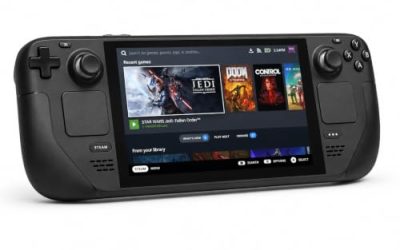
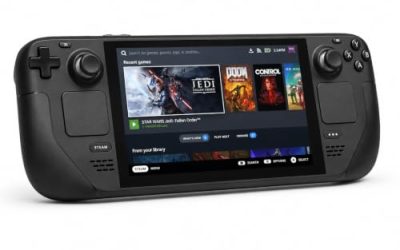
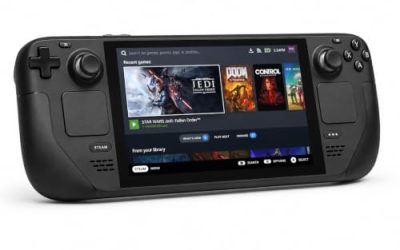
Valve Steam Deck OLED 512GB

The handheld behind the Playable badge. Valve’s sheet says the default graphics configuration performs well, so the hardware is not the bottleneck; the caveats are the controller configuration, the small text and the manual keyboard.
Specs
- Display: 7.4-inch HDR OLED, 1280 by 800, up to 90 Hz
- Processor: AMD Zen 2 and RDNA 2 custom APU
- Memory: 16 GB LPDDR5
- Storage: 512 GB NVMe, plus a microSD slot
- Wireless: Wi-Fi 6E and Bluetooth
- Channel note: Valve sells the Deck mainly through its own store, so Amazon listings are third-party sellers
8BitDo Ultimate 2 Bluetooth Controller

The pad for docked and desktop co-op. The game lists partial controller support, so a pad covers driving while the mouse stays in reach for menus; keep it on the desktop side, since Valve’s sheet excludes external pads from Deck local multiplayer.
Specs
- Connectivity: Bluetooth wireless and USB-C wired
- Joysticks: TMR electromagnetic, anti-drift design
- Triggers: Hall effect, with mode switching
- Extras: two remappable back buttons, motion control
- In the box: charging dock included
Xbox Wireless Controller, Carbon Black

The guest pad for split-screen at a desk; Steam Input support is universal. On the handheld, remember the sheet’s note: external controllers do not carry local multiplayer on Deck.
- Connectivity: Xbox Wireless and Bluetooth
- Port: USB-C for wired play
- Controls: hybrid D-pad, dedicated Share button
- Power: AA batteries or optional rechargeable pack
Logitech G502 HERO

Hydroneer is played with a cursor: digging, aiming wash plants, wiring contraptions and sorting inventory are all pointer work, and the ProtonDB file’s one recurring complaint is about cursor behaviour. A precise wired mouse puts the repeated tool and camera inputs under your thumb.
Specs
- HERO optical sensor, up to 25,600 DPI
- 11 programmable buttons
- Adjustable weight system
- Wired USB connection
- On-board memory profiles
Samsung T9 Portable SSD 2TB

For a Steam library that moves between desktop and dock, or for offline backups of installers, a fast USB-C drive is the simple answer. The headline figure needs a Gen 2×2 host port; on a lesser port the drive runs at that ceiling.
Specs
- Capacity: 2 TB portable SSD
- Interface: USB 3.2 Gen 2×2, USB-C connector
- Maker-rated speeds: up to 2,000 MB per second read, 1,950 MB per second write
- Features: Dynamic Thermal Guard, maker-rated drop resistance
How to choose
Choose the Steam copy, the only PC edition on sale and the exact build both compatibility records describe. On desktop, install it under Proton at the default setting; the Gold headline with a Platinum best-reported tier says the current build behaves, and forcing an older Proton version is a fix for the minority launch problem, not a starting point. Treat mouse and keyboard as primary — the store lists only partial controller support — and add a pad for driving and split-screen. On a Steam Deck, set expectations by the sheet: performance is fine, but budget a community layout, expect small text, and do not plan external-pad local multiplayer. The Volcalidus expansion changes nothing about the platform answer.
Who should skip
Skip Hydroneer on Linux if you only buy native builds: there is none, and no record suggests one is coming. Skip it on the Deck if you want a fully controller-native handheld game — the default configuration is not fully functional, text runs small, and external controllers are excluded from local multiplayer there. Skip it if your library lives on GOG, because no edition exists there.
FAQ
Is Hydroneer native on Linux?
No. Steam flags the game Windows only, its Linux requirements tab is an empty shell, and SteamDB shows no Linux depot. The “Natively Supports” header on the ProtonDB page contradicts that record and should be ignored in favour of Steam’s own data.
How well does Hydroneer run under Proton?
Well, on the published evidence. ProtonDB’s summary gives a Gold headline tier, a Platinum best-reported tier and a Gold trending tier across 62 reports with strong confidence. Most desktop reports describe clean runs on current Proton builds; the recurring notes concern the mouse cursor escaping the window on some multi-monitor setups and, in a minority of older reports, launches needing a forced Proton version.
Is Hydroneer Steam Deck Verified?
No — the badge is Playable, one step below Verified. Valve’s sheet, dated 12 May 2022 and read through SteamDB’s republication, passes the default graphics configuration but deducts for the controller configuration, non-Deck glyphs, manual keyboard invocation and small text, and notes that external controllers are not supported for Deck local multiplayer.
Can I buy Hydroneer on GOG instead?
No. GOG sells no edition; its records return no product, and the only presence there is a Dreamlist wishlist entry, not a purchasable edition. Steam is the only PC storefront for this game.
Final verdict
Hydroneer’s Linux status is simple once the records are read separately: no native build, an empty shell where the Linux specification would sit, an expansion that changes nothing, no DRM or account layer named, and no anti-cheat system in any source that would list one. Against that empty paperwork sits an encouraging play record — a Gold ProtonDB file with a Platinum ceiling and strong confidence, and a Playable Deck badge whose deductions are about controllers and text size. Buy the Steam copy, play it under Proton at a desk, and treat the Deck as a capable second screen for solo digging.
Product and ASIN Reference
| Product | ASIN |
|---|---|
| Valve Steam Deck OLED 512GB | B0CQ3RWQQZ |
| 8BitDo Ultimate 2 Bluetooth Controller | B0F194QFT2 |
| Xbox Wireless Controller, Carbon Black | B08DF248LD |
| Logitech G502 HERO | B07GBZ4Q68 |
| Samsung T9 Portable SSD 2TB | B0CHFS9K14 |