Our Short List of 3

- Display: 7.4-inch HDR OLED, 1280 by 800, up to 90 Hz
- Processor: AMD Zen 2 and RDNA 2 custom APU
- Memory: 16 GB LPDDR5
- Storage: 512 GB NVMe, plus a microSD slot

- Connectivity: Bluetooth wireless and USB-C wired
- Joysticks: TMR electromagnetic, anti-drift design
- Triggers: Hall effect, with mode switching
- Extras: two remappable back buttons, motion control

- Connectivity: Xbox Wireless and Bluetooth
- Port: USB-C for wired play
- Controls: hybrid D-pad, dedicated Share button
- Power: AA batteries or optional rechargeable pack
All 5 Picks at a Glance
| Product | Specs | Action |
|---|---|---|
| Valve Steam Deck OLED 512GB |
| Check price on Amazon |
| 8BitDo Ultimate 2 Bluetooth Controller |
| Check price on Amazon |
| Xbox Wireless Controller, Carbon Black |
| Check price on Amazon |
 Logitech G502 HERO |
| Check price on Amazon |
 Samsung T9 Portable SSD 2TB |
| Check price on Amazon |
Daemon X Machina: Titanic Scion is Marvelous Inc.’s open-world mech sequel, published by XSEED Games with Marvelous USA and Marvelous Europe, and released on September 5, 2025. Linux players asking whether an Arsenal can fly on their system get a short answer from the store record and a longer one from the compatibility layers, and the two do not entirely match: the record is unambiguous, while the report file is thin enough that its rosiest line needs a second look.
This article reads every layer of the Steam record directly: the platform flags, the requirements fields, the depot census, the full add-on family, the anti-cheat documentation, Valve’s Steam Deck sheet and the ProtonDB summary. Where a layer could not be read, the article says so.
As an Amazon Associate, we earn from qualifying purchases.
Quick answer
No. Daemon X Machina: Titanic Scion ships no native Linux build: Steam flags it Windows-only, its single content depot is Windows-configured, and all 43 add-ons repeat the same flag. The Windows build runs through Proton instead, where ProtonDB settles it at Gold from seven reports, and Valve rates it Playable on Steam Deck.
What the Steam record actually sells
The platform flags read windows true, mac false, linux false, and every delivery layer underneath them agrees. The Windows requirements are genuinely populated: the minimum tier asks for Windows 10, a Core i5-10400, 16 GB of memory, a GeForce GTX 1050 and DirectX 12, with a solid-state drive recommended, and the recommended tier is filled in as well. The Mac and Linux requirements fields, by contrast, are empty shells at both tiers: the headings are present and the lists under them are blank.
The depot census is just as one-sided. The game ships exactly one content depot, configured for 64-bit Windows at roughly 48.6 GB, alongside the shared Windows Visual C++ and DirectX redistributables. An art book rides inside the add-on layer as an inner depot of about half a gigabyte; there is no Linux or Mac depot of any size. The icon registry holds the standard client icons and no Linux client icon, and the extended OS field is an empty string. One limit, stated plainly: the record’s launch-entry list could not be surfaced this session, so this article makes no launch-entry claim; the ruling rests on the flags, requirements, depots and icons, which are unanimous.
The add-on family repeats the pattern at scale. All 43 entries in the downloadable content array were read individually: every one is a content or cosmetic pack, from the Into the Abyss expansion and the Mega DLC Collection down to hairstyle sets, emotes and metallic equipment finishes, and every one flags linux false. The family count is zero of 44. No soundtrack app sits anywhere in the array, so the familiar trap, an album flagging Linux support the game itself lacks, cannot fire here. One bookkeeping quirk: a single cosmetic entry, the Deluxe Edition Content Map, still carries a coming-soon marker on its own record, which does not change the base game’s released status. The free demo, a separate app outside the array, flags Windows-only as well.
The Proton route, and a heading that overpromises
ProtonDB’s full summary for this app settles at Gold, with a best-reported tier of Platinum and a trending tier of Gold, drawn from seven reports at low confidence. That is a thin file, and the article treats it as one: the strongest single filing, a desktop report on Linux Mint with a GeForce RTX 4070 SUPER, describes the game working well after switching to Proton Experimental; another filing reports frequent system crashes on a standard Proton build; a Steam Deck filing on an older Proton describes playable sessions with a self-imposed frame-rate cap; and a further report calls the game good out of the box. The pattern is a game that generally runs, with stability varying by system and Proton branch, on evidence too thin to call settled.
One trap deserves its own paragraph. The ProtonDB game page carries a heading claiming native support, generated from the empty Linux requirements field on the Steam record. It does not agree with Steam: no Linux depot, no Linux requirements and no Linux flag exist on the record the heading is drawn from. Readers who land on that page first should follow Steam’s record, not the heading.
Anti-cheat and the co-op question
Titanic Scion is a multiplayer game, with online co-op and cross-platform multiplayer listed among its store categories, so the anti-cheat layer matters. On this record, that layer is documentation silence on every surface checked. The store record carries no DRM notice and no account notice. SteamDB’s detected-technology list names the Unreal Engine, the CRIWARE middleware and an Epic Online Services SDK, which is a services layer for accounts, friends and sessions rather than an anti-cheat product, and no anti-cheat entry appears beside it. The community anti-cheat database holds no entry for this app at all, by store ID or by name. Nothing documented stands between a Proton session and the game’s online modes; the honest caveat is that the ProtonDB file is thin and mostly single-player, so co-op under Proton rests on the absence of a documented wall rather than on a deep pile of multiplayer reports.
Controller support, for the record, is partial: that is what the game’s own record states, with DualShock and DualSense support listed among its categories, and Valve’s Deck test configuration is gamepad-first with the primary player on the controller slot.
Steam Deck: a launch-day Playable sheet
Valve rates Titanic Scion Playable on Steam Deck, and SteamOS separately Compatible. The test configuration passes the checks that matter most: the default controller configuration is fully functional, the game shows Steam Deck controller glyphs, and the default graphics configuration performs well. The one deduction is text size: some in-game text is small and may be difficult to read. A note adds that the game does not default to external controllers, which need a manual switch through the Quick Access Menu. The recommended runtime on the sheet is a beta Proton 10 build.
The paperwork has one age problem. Valve tested build 19468787 on September 5, 2025, the game’s launch day. The current public build is 21187541, published in December 2025, so the badge grades the launch build rather than the code a buyer downloads today. Nothing in the newer build history suggests a regression, and the report file since launch points the other way, but the badge itself is launch-day paperwork.
Gear that fits a Proton hangar
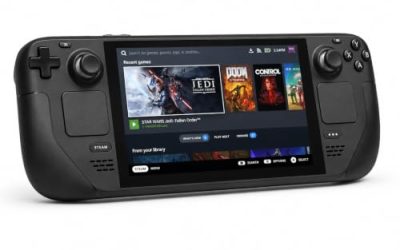
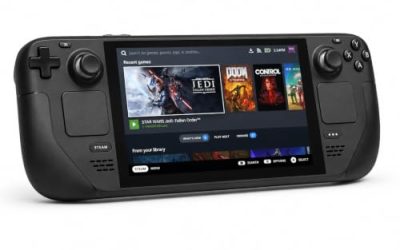
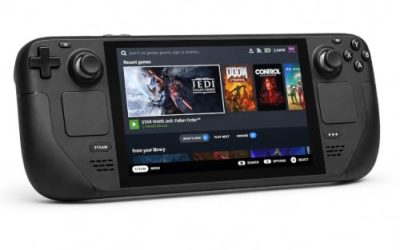
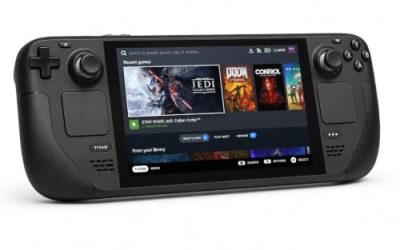
Valve Steam Deck OLED 512GB
- Display: 7.4-inch HDR OLED, 1280 by 800, up to 90 Hz
- Processor: AMD Zen 2 and RDNA 2 custom APU
- Memory: 16 GB LPDDR5
- Storage: 512 GB NVMe, plus a microSD slot
The handheld Valve’s Playable sheet was written for. The deduction to plan around is small text, and the OLED panel’s contrast is the kindest screen in this list for reading it.
8BitDo Ultimate 2 Bluetooth Controller
- Connectivity: Bluetooth wireless and USB-C wired
- Joysticks: TMR electromagnetic, anti-drift design
- Triggers: Hall effect, with mode switching
- Extras: two remappable back buttons, motion control
The docked and desktop pad pick, with back buttons for the menu shortcuts a parts-heavy mech game repeats. Remember the sheet’s note: an external pad may need the Quick Access switch before it takes over.
Xbox Wireless Controller, Carbon Black
- Connectivity: Xbox Wireless and Bluetooth
- Port: USB-C for wired play
- Controls: hybrid D-pad, dedicated Share button
- Power: AA batteries or optional rechargeable pack
The safest guest pad in PC gaming: Steam Input support is universal and the glyphs match what most games display, which suits a record whose own controller rating is partial.
Logitech G502 HERO
- HERO optical sensor, up to 25,600 DPI
- 11 programmable buttons
- Adjustable weight system
- Wired USB connection
For desktop sessions spent in the hangar, tuning loadouts and sorting looted parts, a precise wired mouse turns menu work into single clicks, and eleven programmable buttons cover the inputs a long session repeats.
Samsung T9 Portable SSD 2TB
- Capacity: 2 TB portable SSD
- Interface: USB 3.2 Gen 2×2, USB-C connector
- Maker-rated speeds: up to 2,000 MB per second read, 1,950 MB per second write
- Features: Dynamic Thermal Guard, maker-rated drop resistance
The game’s single depot runs to roughly 48.6 GB before add-ons, so library space fills quickly. A fast USB-C drive moves the install between a desktop and a laptop or keeps an offline backup.
How to choose
Start with the Proton branch. The strongest desktop filing used Proton Experimental, and one standard-branch filing reported repeated crashes, so Experimental or a recent stable branch is the sensible first try, with the other held in reserve if stability wobbles. On the Deck, accept the launch-day shape of the badge: the game performs on default settings, and the real cost is small text, which matters more in a game built around parts and menus than in a pure action title. A self-imposed frame-rate cap is the Deck filing’s own stabiliser. For co-op, nothing documented blocks a Proton session, but the multiplayer evidence is thin, so a group buying for Linux co-op should treat the first session as the test. Finally, size your storage: this is a 50 GB-class download with a large add-on catalogue behind it.
Who should skip
Skip this one if you buy native Linux builds only: no layer of the record offers one, and nothing in the game’s update history points toward a port. Skip it if a seven-report, low-confidence ProtonDB file is below your evidence threshold, because that file, plus one launch-day Deck sheet, is the entire public evidence base. Skip it on Deck if small interface text is a hard limit for you. And skip the add-on bundles until the base game has proven stable on your own system: the cosmetic catalogue is large, and none of it changes the compatibility picture.
FAQ
Is Daemon X Machina: Titanic Scion native on Linux?
No. Steam flags the game Windows-only, its Windows requirements are the only populated set, its single content depot is Windows-configured, and all 43 add-ons flag Linux false. Linux play means the Windows build through Proton.
Why does the ProtonDB page claim native support?
The heading on that page is generated from the Linux requirements field on the Steam record, and that field is an empty shell: headings over blank lists. It is a paperwork artefact, not a build. Steam’s record, which the heading is drawn from, flags Linux false on every layer.
Does the online co-op work under Proton?
No anti-cheat is documented on any layer: the record carries no DRM or account notice, the detected-technology list names a services SDK rather than an anti-cheat, and the community anti-cheat database has no entry for the game. The report file is thin and mostly single-player, so co-op is unblocked on paper rather than proven at scale.
Is the Steam Deck Playable rating current?
The verdict stands, but the paperwork is from launch day: Valve tested the September 2025 launch build, and the public build has moved on since December 2025. Reports filed after launch remain positive in tone, so the badge is best read as a launch-day grade the game has not contradicted.
Final verdict
Daemon X Machina: Titanic Scion is a Windows game on Linux, and a reasonably comfortable one. The record could not be clearer that no native build exists: the 43 add-ons, the depot census and the empty requirements fields all say the same thing. Through Proton the picture is Gold-tier and generally stable, with the honest caveats that the evidence base is seven reports deep, one filing reports crashes, and the Deck’s Playable badge grades the launch build. Mech fans who accept Proton as the route can buy with measured confidence; native-only buyers should pass.
Product and ASIN Reference
| Product | ASIN |
|---|---|
| Valve Steam Deck OLED 512GB | B0CQ3RWQQZ |
| 8BitDo Ultimate 2 Bluetooth Controller | B0F194QFT2 |
| Xbox Wireless Controller, Carbon Black | B08DF248LD |
| Logitech G502 HERO | B07GBZ4Q68 |
| Samsung T9 Portable SSD 2TB | B0CHFS9K14 |