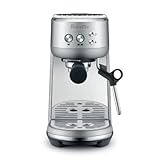
The best semi automatic espresso machines in 2026 are the Breville Bambino Plus for speed, the Gaggia Classic Evo Pro for affordable control, the Rancilio Silvia M for durability, and the Profitec GO for serious single-boiler brewing with fast temperature management.
A semi automatic machine requires you to grind, dose, tamp, lock in the portafilter, start and stop the shot, and steam milk yourself. That extra work is worthwhile if you want to adjust flavor rather than press a one-touch button. The right choice depends less on maximum pressure and more on your routine: how quickly you need coffee, how often you make milk drinks, how much counter space you have, and whether you will tolerate a more involved cleaning schedule.
As an Amazon Associate we earn from qualifying purchases at no extra cost to you.



Best semi automatic espresso machines by coffee routine
| Routine | Best fit | Why it fits | Main compromise |
|---|---|---|---|
| One or two fast drinks before work | Breville Bambino Plus | Very short heat-up, automatic milk steaming option, compact footprint | 54 mm portafilter and less traditional workflow |
| Espresso and occasional cappuccino | Gaggia Classic Evo Pro | 58 mm portafilter, simple controls, broad accessory compatibility | Single boiler needs a wait between brewing and steaming |
| Several milk drinks in one session | Rancilio Silvia M | Powerful steam performance and robust metal construction | Single-boiler temperature switching takes planning |
| Learning espresso seriously | Profitec GO | PID temperature control, pressure display, adjustable brew settings | Higher price and still a single boiler |
| Milk drinks for two or more people | Dual-boiler or heat-exchanger machine | Brewing and steaming are less disruptive to each other | Usually larger, heavier, more expensive, and slower to fully heat |
Boiler types: the decision that affects your whole workflow
Thermoblock and thermocoil systems
Compact machines such as the Breville Bambino Plus use rapid-heating systems rather than a conventional large boiler. They can be ready in roughly 3 to 10 seconds, depending on the program and starting temperature. This is ideal when you make one espresso in the morning and do not want to leave a machine warming for half an hour.
The trade-off is thermal mass. After repeated shots or extended steaming, compact systems can be less consistent than a well-heated boiler machine. They are convenient, but the fastest advertised heat-up time does not mean every part of the group and portafilter is equally hot. Run a brief water flush and warm the portafilter when possible.
Single boilers
Single-boiler machines use one boiler for brewing and steaming. The Gaggia Classic Evo Pro and Rancilio Silvia M are representative choices. Their workflow is simple: brew at espresso temperature, then switch to steam mode and wait for the boiler to heat. After steaming, you normally need to refill and cool the system before brewing again.
For one espresso followed by one cappuccino, this is manageable. For four lattes, the repeated mode changes become the main inconvenience. A PID-equipped machine such as the Profitec GO improves brew-temperature control, but it does not turn a single boiler into a simultaneous brew-and-steam system.
Heat-exchanger and dual-boiler machines
A heat-exchanger machine keeps steam water hot while a separate path supplies brew water. A dual-boiler machine uses separate boilers for each job. These designs are better for entertaining or making multiple milk drinks consecutively because steaming does not require the same pause between shots.
They also demand more space, more warm-up time, and more budget. A large machine is poor value if your routine is one black coffee before leaving home. Consider this class when you regularly prepare three or more milk drinks, want powerful steam, and can leave the machine heating safely.
Heat-up time versus usable heat-up time
Manufacturers often quote the time until the heating system is ready, but usable espresso requires more than a light turning green. The portafilter, basket, group head, and cup should be warm enough to avoid pulling heat from the shot.
For a compact thermoblock machine, a practical routine is:
- Start the machine and let it reach its ready indicator.
- Lock in the empty portafilter or run water through it for 5 to 10 seconds.
- Grind immediately before brewing and begin the shot.
- For milk drinks, steam after brewing unless the machine specifically supports automatic sequencing.
For a boiler machine, allow roughly 15 to 30 minutes when possible. The exact time varies with boiler size, room temperature, voltage, and whether the machine has a PID. A smart plug can schedule warm-up, but never use one unless its electrical rating is suitable for the machine and the manufacturer permits that arrangement.
Portafilter size: why 58 mm matters, and when it does not
A 58 mm portafilter is the commercial standard and gives you the widest choice of precision baskets, dosing cups, tampers, and bottomless portafilters. It is particularly useful if you plan to compare recipes or upgrade accessories.
Many compact machines use 54 mm portafilters, while some entry-level models use smaller proprietary sizes. A smaller portafilter is not automatically worse: it can make excellent espresso when the basket, grinder, and recipe are matched. However, accessory selection may be narrower, and the puck shape can make distribution slightly less familiar.
Do not buy a machine solely because it includes a bottomless portafilter. Bottomless portafilters expose channeling; they do not prevent it. A capable grinder, fresh coffee, even distribution, and a level tamp matter more.
Steam performance: pressure is only part of the answer
Strong steam performance depends on boiler capacity, heating recovery, steam-tip design, and the machine’s ability to maintain pressure while you texture milk. A machine can show a high pressure figure yet produce weak, wet steam if the boiler is small or recovery is slow.
Choose a compact rapid-heating machine for one small latte at a time. Choose a single-boiler machine with a larger steam capacity if you want more control and are willing to wait between modes. Choose a heat-exchanger or dual-boiler design when consecutive milk drinks are routine.
For manual microfoam, start with cold milk and keep the steam tip just below the surface until the pitcher becomes gently warm. Then submerge the tip
Ready to decide? Our #1 pick for 2026 is the One or two fast drinks before work.
Live price & availability on Amazon.