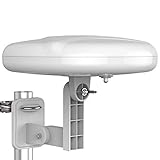
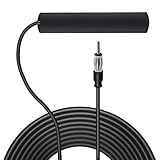
- Top Pick: Antennas Direct ClearStream 4V Outdoor TV Antenna | 20-Inch Mast, Reflectors, Hi-VHF Elements, UHF VHF Signals, Multi-Directional, UHD 4K, 8K, NEXTGEN TV, 70-Mile Range
- Best Value: 2026 TV Antenna for Digital TV Indoor/Outdoor, 200% Wider Signal Reach Long Range Smart HDTV Antenna for Local Channels, Support 4k 8k 1080p with Amplifier Signal Booster
- Premium Choice: 6000+ Miles TV Antenna Indoor, 2026 Digital HDTV Antenna for Local Channels | 360° Long Range Reception with Signal Booster,Supports 8K 4K Smart & Old TVs, Indoor & Outdoor Use,Easy Setup,38ft Coax Cable
Living far from the broadcast towers changes the antenna question completely. In town, a flat indoor panel on a window can pull in a dozen local channels. Out in the country, with trees, hills and thirty or fifty miles of open ground between you and the transmitters, the choice becomes about height, gain, direction and cable length. This guide is for rural and exurban households deciding between a fixed multi-directional outdoor design, a motorized rotating model, and the dual-purpose indoor and outdoor units sold with very large mileage claims.
Seven listings are compared below using only what each title says. A word of caution on the numbers: titles that promise thousands of miles are marketing, since broadcast signals do not travel anywhere near that far, and in 2026 the sensible way to read them is as a hint about gain and amplification rather than a promise. What matters is mounting height, the number of TVs you can serve, and whether the antenna handles both VHF and UHF channels.
Quick Picks
As an Amazon Associate we earn from qualifying purchases at no extra cost to you.


| Product | Best for | Key spec from the title |
|---|---|---|
| Antennas Direct ClearStream 4V | Fixed mast with multi-direction reach | Outdoor, Hi-VHF elements, 70-mile range |
| BEIMQN Indoor/Outdoor Amplified | Flexible mounting | Amplifier signal booster, indoor or outdoor |
| 360-Degree Indoor/Outdoor Antenna | Long cable runs | 360-degree reception, 38ft coax cable |
| FiveStar Motorized Outdoor | Towers in different directions | 360-degree motorized rotation, supports 5 TVs |
| PBD Outdoor Rotating | Remote-controlled aiming | Remote rotation, dual outputs, 40ft RG6 |
| Qboy Waterproof Indoor/Outdoor | Weather exposure | Waterproof, signal booster, 40ft coax |
| FiveStar Attic/Roof Mount | Multi-TV homes | 200-mile claim, supports 4 TVs, J mount kit |
How to Choose
Outdoor and elevated beats clever indoor
Every foot of height helps. A roof mast or a high attic mount clears obstacles that block a signal at ground level, and attic installs are shielded from weather. Rural viewers should favor outdoor antennas with a mounting pole, mast or J mount, which is why the ClearStream 4V and the two FiveStar models lead this list. Indoor/outdoor units can still work if you mount them high outside, but a window-sill placement will rarely satisfy a distant market. Plan the route of the cable at the same time: a drip loop before the entry point, a grounded mast where local code requires it, and a clear path that does not pinch the coax in a window frame all protect the signal and the house.
Fixed, multi-directional or motorized
If all your local stations sit in one direction, a fixed antenna aimed once is simple and reliable. If channels come from two or more directions, a motorized rotator lets you turn the antenna from your couch. The PBD and the motorized FiveStar both list 360-degree rotation. Multi-directional designs like the ClearStream 4V can catch signals from a wide arc without moving parts, though with less reach in any single direction.
Amplifiers, cable and splitting
A built-in amplifier can help when signals are weak or the coax run is long, but it can also overload on strong nearby signals and amplify noise. Cable loss is real: the longer the run, the weaker the picture, so a 40ft RG6 cable is a sensible length for many roof installs. If you plan to feed multiple TVs, look for dual outputs or support for several televisions, as stated on the PBD and FiveStar titles, because splitting a weak signal without an amplifier degrades every set.
Standards, bands and what to ignore
Check that the antenna handles both UHF and VHF, since many rural stations still broadcast on VHF channels. ATSC 3.0 or NEXTGEN TV support is a plus for future broadcasts, though your TV needs a compatible tuner. Ignore resolution claims such as 4K and 8K, because an antenna receives a broadcast signal, not a resolution, and ignore mileage claims that exceed a few hundred miles. Budget models usually cut corners on build quality and weatherproofing, so inspect the mounting hardware. Before buying, run your address through the broadcast map published by the national regulator or a station-lookup tool, note the compass bearing and distance to each tower, and write down whether each channel is VHF or UHF. That one sheet of paper does more to narrow the field than any mileage claim, and it tells you immediately whether a fixed, multi-directional or rotating model suits your hills and trees.
The 7 Best Options
Antennas Direct ClearStream 4V
An outdoor antenna with a 20-inch mast, reflectors, Hi-VHF elements, multi-directional reception, UHD 4K, 8K and NEXTGEN TV support, and a stated 70-mile range. It is built for households whose stations sit in several directions and who want a fixed install without a rotator, mounted on a pole or the roofline and left alone for years.
- Hi-VHF elements and UHF reception cover the main broadcast bands.
- A 70-mile figure reads more conservatively than the grand claims elsewhere on the list.
- Trade-off: the title does not mention an amplifier, so a long cable run may need one.
Skip it if your towers are well beyond the stated range with little line of sight.
BEIMQN Indoor/Outdoor Amplified
A digital TV antenna described as indoor or outdoor, with a signal booster and a claim of 200 percent wider signal reach, supporting 4K, 8K and 1080p. It suits a household that wants to experiment with placement, perhaps starting in an upstairs window and moving to a pole if the picture drops out.
- Flexible placement lets you try several locations in the house or on the roof.
- The built-in amplifier can help with weak signals.
- Trade-off: the title is vague on mounting hardware and cable length.
Skip it if you want a clearly specified mast or rotator system.
360-Degree Indoor/Outdoor Antenna
This model lists 360-degree reception, a signal booster, support for smart and older TVs, easy setup and a 38ft coaxial cable. It is aimed at buyers who want enough cable to reach from a porch, eave or low roof down to the set without buying a separate run.
- The 38ft coax gives room to mount outside.
- Support for older TVs suits secondary rooms and workshops.
- Trade-off: the 6000-plus-mile claim should be ignored, and the title gives no pole or rotator details.
Skip it if you need a rotator or a multi-TV feed.
FiveStar Motorized Outdoor
A motorized outdoor antenna with 360-degree rotation, a 200-mile range claim, a smart amplified design, ATSC 3.0 support, five-TV capability and tool-free setup with a mounting pole. It speaks to larger households where stations are scattered around the compass.
- Motorized rotation lets you chase stations in different directions.
- Support for five TVs fits a larger household.
- Trade-off: rotating motors are moving parts exposed to weather over the years.
Skip it if every station lies in the same direction, where a fixed antenna is simpler.
PBD Outdoor Rotating
An outdoor antenna with 360-degree remote rotation, long-range UHF and VHF reception, a built-in high-gain amplifier, dual TV outputs, a mounting pole and 40 feet of RG6 cable. The package reads as a complete kit for a two-TV home with stations in mixed directions.
- The remote rotation spares you from climbing a ladder to re-aim.
- Dual outputs serve two TVs from one antenna.
- Trade-off: dual outputs share the signal, so weak areas may see a dip on each set.
Skip it if you need to feed more than two televisions.
Qboy Waterproof Indoor/Outdoor
A digital antenna with a 6000-plus-mile claim, a signal booster, a waterproof and durable build, support for 1080P, 4K and 8K, and a 40ft coaxial cable. The weather-resistant description is the draw for exposed rural spots such as a barn roof, a pole or a deck rail.
- Waterproof construction suits an exposed rural mount.
- A 40ft cable is useful for a pole or roof install.
- Trade-off: no rotator, mast or multi-TV details appear in the title.
Skip it if you need to aim at stations in different directions.
FiveStar Attic/Roof Mount
An outdoor HDTV antenna with a 200-mile claim, attic or roof mounting, VHF and UHF support, a four-TV capacity, an installation kit with J mount and ATSC 3.0 readiness. It is a practical choice for people who want a permanent install and no motor to maintain.
- The J mount and installation kit simplify mounting on a roof edge or eave.
- Attic mounting offers weather protection and a cleaner look.
- Trade-off: it is a fixed design, so you aim it once and live with that direction.
Skip it if you want remote rotation.
Which One Fits Your Situation
Stations come from two or three directions
The PBD Outdoor Rotating antenna and the motorized FiveStar both rotate. The PBD adds remote control and dual outputs, while the FiveStar lists capacity for five televisions, so the choice comes down to how many sets you need to feed.
You prefer a simple fixed install
The FiveStar Attic/Roof Mount and the ClearStream 4V both avoid moving parts. Choose the first for multi-TV needs, and the second if you want multi-directional reach from a single mast without a motor. Either way, aim once with a helper watching the signal strength on the TV, tighten everything down, and avoid touching it again until a storm gives you a reason to.
You are serving a large household
The motorized FiveStar lists support for five TVs, the most among these seven, and its tool-free setup with a mounting pole keeps installation within reach of a patient homeowner with a ladder and a free afternoon.
You have a weather-exposed location
The Qboy lists a waterproof build, and the attic option of the FiveStar Attic/Roof Mount keeps the antenna out of the elements.
Common Mistakes
- Believing thousand-mile claims instead of checking your actual distance to the towers.
- Mounting low or indoors in a deep rural location, then blaming the antenna.
- Splitting the signal to many TVs with no amplifier.
- Choosing a UHF-only antenna in an area where stations broadcast on VHF.
- Using a long, thin or damaged coax cable that wastes the signal before it reaches the TV, or letting the cable kink where it enters the house.
Related guides
- Combination Smoke And Carbon Monoxide Detectors
- Aio Liquid Coolers For High Performance Gaming
- Graphics Cards For Low Wattage Power Supplies
Frequently Asked Questions
How far can an antenna really receive?
It depends on terrain, height and transmitter power. Most reliable reception is within fifty to seventy miles with a clear line of sight, so the 70-mile figure is the one to take seriously.
Do I need an amplifier?
Often yes for long cable runs or multiple TVs, but not for strong signals, where an amplifier may overload the tuner. Many antennas let you bypass it.
Does ATSC 3.0 matter?
It is the newer broadcast standard, also called NEXTGEN TV. The antenna itself usually works for either, but your TV needs a tuner that supports it. Rollout varies by market, so many rural stations still transmit only the older standard, and the labels on these listings are best read as future-proofing rather than a current benefit.
Should I hire an installer?
Roof and mast work carries a fall risk, and a professional can aim the antenna accurately using a signal meter. If you do it yourself, stay well clear of power lines, work with a helper, use proper safety gear and wait for dry, calm weather. A rotating model reduces how often you need to climb back up after the first install.