- Top Pick: Red Light Therapy for Face and Body, Red Infrared Light Therapy Lamp with Stand Led 660nm Red Light-Therapy& 850nm Infrared Light Device for Body
- Best Value: Viconor Red Light Therapy for Face and Body, Red Infrared Light Therapy Lamp with Stand Led 660nm & 850nm Infrared Light Device for Body
- Premium Choice: Hooga Red Light Therapy Panel Device – 660nm Red & 850nm Near Infrared Light Therapy, LED Light Therapy Lamp for Face & Body, 40 LEDs, Timer, Adjustable Stand – HG200
The best red light therapy devices for home use depend on the area you want to treat: choose a mask for your face, a compact panel for targeted sessions, or a larger panel when you need broader coverage.
Before buying, compare the device’s stated wavelengths, illuminated treatment area, irradiance and measurement distance, session guidance, eye-safety instructions, and how easily it fits your space. A high irradiance number alone does not mean a device is more effective: measurement methods and distances differ, and light intensity falls as you move away from the LEDs.
- The best red light therapy devices for home use depend on the area you want to treat: choose a mask for your face, a compact panel for targeted sessions, or a larger panel when you need broader coverage.
- Quick comparison by home setup
- How to choose: match the device to your routine
- Device-specific trade-offs
- Eye protection, session time, and setup checks
- Decision matrix: which type fits your home?
- What to verify before buying
Quick comparison by home setup
| Home setup | Best-fit device class | Typical wavelengths | Coverage and practical trade-off |
|---|---|---|---|
| Face-focused routine, limited space | LED face mask, such as Omnilux Contour Face | Red around 633 nm; near-infrared around 830 nm | Fits the face and stores easily; does not treat the neck or body at the same time. |
| Desk, bedside, or targeted treatment | Compact panel, such as Hooga HG300 | Commonly 660 nm red and 850 nm near-infrared | Useful for a smaller area; reposition it for other body parts. |
| Wall or stand-mounted home station | Mid-size panel, such as Joovv Solo 3.0 | Red and near-infrared; check the selected configuration | More convenient for repeated, broader sessions, but needs a dedicated location. |
| Large treatment area or shared household use | Large panel, such as PlatinumLED BioMax 900 | Multiple red and near-infrared bands, depending on model | Can cover more of the body per position; costs more and takes up more room. |
Wavelengths above are representative product specifications, not proof that one device will produce a particular result. Confirm current model details and manufacturer instructions before purchase; product configurations can change.
As an Amazon Associate we earn from qualifying purchases at no extra cost to you.
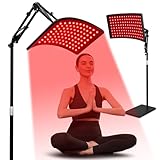


How to choose: match the device to your routine
1. Start with the area you can realistically treat
A face mask is convenient if your goal is a repeatable face-only routine. A small panel gives more flexibility for the face, hands, or a localized area, but you must position it carefully and move it between sites. A large panel makes sense when you expect to treat larger areas regularly and have room to mount or store it. Buying more coverage than you will use can mean paying for a device that is awkward to set up.
2. Compare wavelengths and claims, not just LED count
Red light devices commonly specify wavelengths near 630–670 nm; near-infrared devices often include bands around 810–850 nm. Red light is visible, while near-infrared is largely invisible. Some panels offer both, and some offer several bands. More wavelengths do not automatically mean better treatment: look for clearly stated wavelengths and a credible explanation of the intended use rather than a long list of numbers.
These devices are not interchangeable with medical treatment. Evidence varies by condition, device, and treatment protocol. If you are addressing a health concern, have a photosensitive condition, or take medication that increases light sensitivity, ask a qualified clinician whether use is appropriate.
3. Interpret irradiance alongside distance and session guidance
Irradiance is usually reported in milliwatts per square centimeter (mW/cm²), but readings are meaningful only with the measurement distance and method. A figure measured close to the panel cannot be compared directly with one measured farther away. Ask whether the manufacturer specifies the distance, whether the reading is at the center or across the treatment area, and what session duration it recommends.
A useful planning calculation is dose = irradiance × time. If a device delivered a uniform 20 mW/cm² for 300 seconds, the theoretical dose would be 6 J/cm² (20 × 300 ÷ 1,000). In practice, output may not be uniform across the area, and the stated irradiance may not match your actual distance. Use this calculation to understand the units—not to invent a target dose or override the manual.
Device-specific trade-offs
Omnilux Contour Face: the low-fuss face option
This flexible mask is designed for facial use and specifies red light around 633 nm and near-infrared around 830 nm. Its main advantage is predictable placement: the LEDs sit close to the intended area without needing a stand or measuring distance. Its limitation is coverage; it is not a full-face-and-neck panel. Follow its instructions on session length and frequency, and do not assume that a mask’s close fit makes eye-safety directions optional.
Hooga HG300: a compact panel for targeted use
The HG300 is a small tabletop panel commonly specified with 660 nm red and 850 nm near-infrared LEDs. It suits users who want a panel they can move between a desk, shelf, or treatment area. The trade-off is that a compact panel covers less area than a larger unit, so treating multiple body areas may require repositioning and additional sessions. Check the current model’s recommended distance and irradiance data rather than extrapolating from another panel size.
Joovv Solo 3.0 and PlatinumLED BioMax 900: broader coverage
A mid-size panel such as the Joovv Solo 3.0 can be a better fit for a fixed home station, especially if convenience and a repeatable setup matter more than portability. The larger PlatinumLED BioMax 900 is intended for broader coverage and offers multiple wavelength bands, depending on configuration. Larger panels take more space, are less convenient to move, and generally cost more. Their advantage is practical: fewer position changes may make a routine easier to maintain.
Eye protection, session time, and setup checks
- Follow the device’s eye guidance. Bright visible LEDs can be uncomfortable, and near-infrared is not visible as a warning cue. Use any supplied eye protection as directed; never stare into LEDs. If the manual says to avoid facial exposure or wear goggles, follow that instruction.
- Use the stated distance and schedule. A panel’s irradiance changes with distance. Start with the manufacturer’s session duration and frequency rather than extending exposure because the light feels mild.
- Make the setup repeatable. Mark the floor or use a stand position so you can return to the same distance. For a small panel, treat one area at a time and keep track of repositioning.
- Check heat, ventilation, and stability. Keep panels clear of fabric and other obstructions, use a secure mount, and follow electrical and cooling instructions.
- Reassess if you have a reaction. Stop use if you experience unexpected irritation or discomfort, and seek medical advice if symptoms persist.
Decision matrix: which type fits your home?
| Your situation | Choose | Why |
|---|---|---|
| You want a face-only routine and quick storage | Flexible LED mask | Consistent positioning with little setup; limited treatment area. |
| You want to treat different small areas and can reposition | Compact panel | More versatile than a mask, with a smaller footprint than a full panel. |
| You expect frequent sessions across a broader area | Mid-size or large panel | More coverage per position, provided you have space and a stable mount. |
| You travel or need to put the device away after each use | Mask or compact panel | Easier to store and transport; check dimensions, weight, and power requirements. |
What to verify before buying
Confirm the exact model’s wavelength list, usable treatment dimensions, irradiance measurement distance, recommended session protocol, eye-safety instructions, warranty, and return policy. Compare total cost with the routine you will actually follow: a smaller device used consistently may be a better fit than a powerful panel that is inconvenient to set up. The best red light therapy devices for home use are the ones whose coverage and instructions match your intended use—not simply the ones with the biggest power number.
Ready to decide? Our #1 pick for 2026 is the Face-focused routine, limited space.
Live price & availability on Amazon.