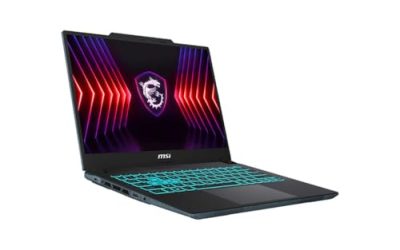
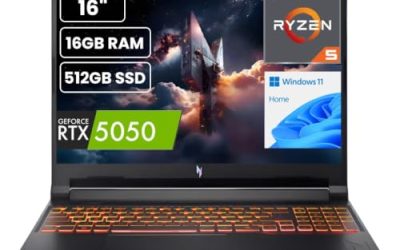
The best processor for a gaming laptop is not a part you can buy on its own. Laptop CPUs are soldered to the motherboard (a BGA package, not a socket), so Intel and AMD do not sell them as boxed retail products the way desktop chips are sold. Choosing a gaming laptop processor really means choosing a laptop that carries it — which is why this guide ranks the current CPU tiers by use case and then matches each tier to a gaming laptop currently sold on Amazon US that exemplifies it.
Disclosure: As an Amazon Associate we earn from qualifying purchases.
If you are assembling a tower instead, our best processor for gaming guide covers the desktop chips; everything below is strictly about mobile processors and the laptops built around them.
How the current gaming laptop CPU tiers stack up
Tier 1 — HX flagships (desktop replacements). Intel’s Core Ultra 9 275HX (Arrow Lake-HX) and AMD’s Ryzen 9 9955HX3D (Fire Range) sit at the top. Both are derived from desktop silicon, both are fed with very high power limits in big 16- to 18-inch chassis, and both are aimed at players who also stream, record or compile on the same machine. AMD’s X3D variant adds a stacked 3D V-Cache die for 128MB of total L3 cache, which is specifically a gaming feature: more of the game’s working set stays on-chip instead of going out to RAM.
Tier 2 — mainstream HX. The Core Ultra 7 255HX keeps the same Arrow Lake-HX design with fewer cores (20 instead of 24) and typically lands in 16-inch laptops with mid-range GPUs. This is the tier where CPU performance stops being the bottleneck for almost any current GPU pairing.
Tier 3 — performance H-series for thin laptops. Intel’s Core Ultra 9 285H (Arrow Lake-H) is a 45W-class part for slim 16-inch machines. It gives up sustained multi-core headroom versus the HX chips but keeps strong single-core speed and adds an NPU, and it lets makers build laptops under 2 kg with real gaming GPUs.
Tier 4 — Ryzen AI (Strix Point). AMD’s Ryzen AI 9 HX 370 mixes Zen 5 and Zen 5c cores in a power envelope tuned for 14-inch laptops. Its Radeon 890M integrated graphics are unusually capable — in TweakTown’s review of the Strix Point Zephyrus G16, the 890M handled casual and even 1080p gaming on its own — and its XDNA 2 NPU is the strongest of the chips here for local AI features.
What the published numbers say: in Notebookcheck’s review of the MSI Raider A18 HX, the Ryzen 9 9955HX3D scored 2,072 points in Cinebench 2024 Multi Core and 38,864 in Cinebench R23 Multi Core, and Notebookcheck’s own performance section concludes that AMD’s Fire Range “equals Intel Arrow Lake HX, at lower power consumption” — the Raider held its chip at a 135W sustained limit, while Notebookcheck’s test data for the Core Ultra 9 275HX in ASUS’s ROG Strix SCAR 16 shows a 145W sustained limit. In other words, the two flagship tiers are close enough that the laptop around the chip — cooling, GPU wattage, screen — matters as much as the badge.
One warning that applies to every tier: the same CPU name can perform very differently in two laptops, because each maker sets its own sustained power limit. Always read the specific model’s limits, not just the processor name.
The picks: one laptop per processor tier
1. Lenovo Legion Pro 7i Gen 10 — Core Ultra 9 275HX tier
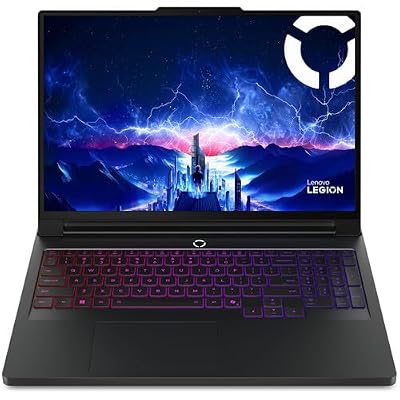
Lenovo’s flagship 16-incher is the cleanest expression of the Arrow Lake-HX tier: the 275HX runs with 24 cores (8 performance + 16 efficiency) and P-core boost up to 5.4 GHz, and Lenovo’s Coldfront cooling is specified for a combined CPU-plus-GPU total of 250W, so the processor is not starved next to the RTX 5080’s 175W TGP. This is the tier for high-refresh 1600p gaming plus heavy background work — streaming, recording, compiling — without the CPU becoming the limit.
Specs
- CPU: Intel Core Ultra 9 275HX, 24 cores / 24 threads, up to 5.4 GHz, 36MB cache
- GPU: NVIDIA GeForce RTX 5080 Laptop, 16GB GDDR7, 175W TGP
- Display: 16-inch OLED, 2560 x 1600, 240Hz, 500 nits
- Memory: 32GB DDR5-6400 (2 x 16GB SO-DIMM)
- Storage: 1TB PCIe Gen5 NVMe SSD
- Ports: Thunderbolt 4, USB-C (DisplayPort, 140W power delivery), 4x USB 3.2 Type-A, HDMI 2.1, 3.5mm combo jack
- OS: Windows 11 Home
- Warranty: One Year Legion Ultimate Support (per the Amazon listing)
Upgradeability: Lenovo’s listing specifies two DDR5 SO-DIMM slots (up to 64GB) and two M.2 2280 slots — one PCIe 5.0 x4 and one PCIe 4.0 x4 — so both memory and storage can grow after purchase.
2. MSI Raider A18 HX — Ryzen 9 9955HX3D tier
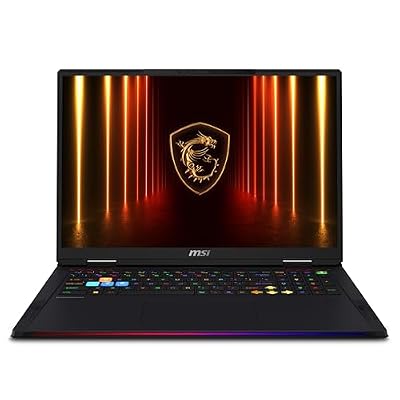
MSI’s 18-inch Raider is built around AMD’s flagship: the Ryzen 9 9955HX3D pairs 16 Zen 5 cores with 128MB of L3 cache thanks to 3D V-Cache, the largest cache of any laptop CPU here, which is exactly what cache-sensitive games reward. Notebookcheck measured the chip holding a 135W sustained power limit in this chassis (in the RTX 5080 configuration it reviewed) and called the Raider one of the most powerful laptops on the market. The Amazon configuration below steps up to the RTX 5090 at up to 175W, per MSI’s published figures for the A9WJG model. Pick this tier if gaming frame rates are the priority and the laptop will live on a desk — at 3.64 kg before its 400W adapter, it is a desktop replacement in the literal sense.
Specs
- CPU: AMD Ryzen 9 9955HX3D, 16 cores / 32 threads, up to 5.4 GHz, 128MB L3 cache (3D V-Cache)
- GPU: NVIDIA GeForce RTX 5090 Laptop, 24GB GDDR7, up to 175W
- Display: 18-inch Mini LED, 3840 x 2400 (UHD+), 120Hz
- Memory: 64GB DDR5 (2 x 32GB SO-DIMM)
- Storage: 2TB PCIe Gen5 NVMe SSD
- Ports: 2x USB4 40Gbps, USB 3.2 Gen 2 and Gen 1 Type-A, HDMI 2.1, SD card reader, 2.5Gb Ethernet, 3.5mm combo jack
- Battery: 99Wh
- OS: Windows 11 Pro
- Warranty: 24 months on Notebookcheck’s reviewed configuration; confirm the term on the US listing
Upgradeability: Notebookcheck’s teardown notes confirm the Raider’s memory, storage and Wi-Fi are all modular — two SO-DIMM slots and two M.2 slots, with the SSD sitting under a thermal plate connected to the cooling system.
3. ASUS ROG Zephyrus G16 (GU605CR-XS97) — Core Ultra 9 285H tier

The 285H is Intel’s answer for thin gaming laptops: 16 cores (6 performance, 8 efficiency, 2 low-power efficiency), boost up to 5.4 GHz, and an AI Boost NPU, in a 45W base-power class that suits a slim chassis. ASUS pairs it with an RTX 5070 Ti held to 115W (95W plus 20W Dynamic Boost, per ASUS’s own specification), which is the honest trade of this tier — you lose sustained CPU and GPU wattage versus the HX machines above and gain a laptop that is genuinely portable. Creators who travel and game at 1600p are the natural audience.
Specs
- CPU: Intel Core Ultra 9 285H, 16 cores / 16 threads, up to 5.4 GHz, 24MB cache, NPU up to 13 TOPS
- GPU: NVIDIA GeForce RTX 5070 Ti Laptop, 12GB GDDR7, ROG Boost 1565MHz at 115W
- Display: 16-inch ROG Nebula OLED, 2560 x 1600, 240Hz
- Memory: 32GB LPDDR5X-7467, soldered on board
- Storage: 2TB PCIe 4.0 NVMe M.2 SSD
- Ports: Thunderbolt 4 (DisplayPort, power delivery), USB 3.2 Gen 2 Type-C, 2x USB 3.2 Gen 2 Type-A, HDMI 2.1 FRL, SD (UHS-II) card reader, 3.5mm combo jack
- OS: Windows 11 Pro
- Warranty: ASUS limited warranty; term printed on the listing
Upgradeability: ASUS states plainly that the LPDDR5X memory is on board with no expansion possible, so buy the 32GB configuration if that is what you need. Storage is the open door: the chassis has two M.2 PCIe slots in total, leaving room for a second drive.
4. ASUS TUF Gaming A14 (FA401WV-WB94) — Ryzen AI 9 HX 370 tier

The Ryzen AI 9 HX 370 is the efficiency pick that still plays: 12 cores (Zen 5 plus Zen 5c), boost up to 5.1 GHz, a 50-TOPS XDNA 2 NPU — the strongest NPU in this guide — and the Radeon 890M integrated GPU for light gaming away from the charger. In the 1.46 kg TUF Gaming A14, ASUS adds a discrete RTX 4060 at up to 100W TGP with a MUX switch, so the little machine covers esports and 1080p/1600p gaming in a 14-inch frame. Choose this tier for a laptop that travels daily and games at night.
Specs
- CPU: AMD Ryzen AI 9 HX 370, 12 cores / 24 threads, up to 5.1 GHz, Radeon 890M integrated graphics, NPU up to 50 TOPS
- GPU: NVIDIA GeForce RTX 4060 Laptop, 8GB GDDR6, up to 100W max TGP, MUX switch
- Display: 14-inch IPS, 2560 x 1600, 165Hz, G-SYNC
- Memory: 16GB LPDDR5X, soldered on board
- Storage: 1TB PCIe 4.0 SSD
- Ports: USB4 Type-C, USB 3.2 Gen 2 Type-C, 2x USB 3.2 Gen 2 Type-A, HDMI 2.1, microSD card reader, 3.5mm combo jack
- OS: Windows 11 Home
- Warranty: ASUS limited warranty; term printed on the listing
Upgradeability: the LPDDR5X memory is soldered, so the 16GB is fixed for the life of the machine. ASUS lists two M.2 PCIe 4.0 slots (up to 4TB of extendable storage), so adding a second SSD later is straightforward.
5. Lenovo Legion Pro 5i Gen 10 — Core Ultra 7 255HX tier
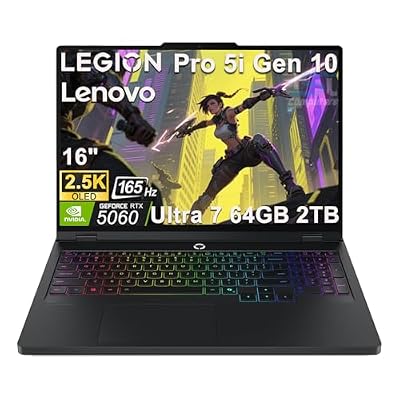
The 255HX is the value end of the HX line: 20 cores (8 performance + 12 efficiency), boost up to 5.2 GHz and a 55W base power, per Intel’s published specifications. In the Legion Pro 5i it is paired with an RTX 5060 at a full 115W TGP, which is the right balance — at this level the GPU, not the CPU, sets the frame rate in most games, and the 255HX still has cores to spare for streaming or coursework. Note that the Amazon listing below is a seller-configured unit carrying 64GB of memory and a 2TB SSD, above the factory base configuration.
Specs
- CPU: Intel Core Ultra 7 255HX, 20 cores / 20 threads, up to 5.2 GHz, 30MB cache
- GPU: NVIDIA GeForce RTX 5060 Laptop, 8GB GDDR7, 115W TGP
- Display: 16-inch OLED, 2560 x 1600, 165Hz, G-SYNC, 500 nits
- Memory: 64GB DDR5 (as configured in this listing)
- Storage: 2TB NVMe SSD (as configured in this listing)
- Ports: Thunderbolt 4, USB-C (DisplayPort 2.1, 100W power delivery), 3x USB Type-A, HDMI 2.1, RJ-45 Ethernet, 3.5mm combo jack
- OS: Windows 11 Home
- Warranty: 1-year Courier or Carry-in base warranty (per Lenovo’s specification sheet)
Upgradeability: Lenovo’s specification sheet for the Legion Pro 5 (16IAX10) confirms two SO-DIMM slots and two M.2 2280 PCIe 4.0 slots, so both the memory and storage remain user-upgradeable even in this tier.
Which processor tier should you buy?
- Maximum gaming performance, desk-bound: the X3D tier (Ryzen 9 9955HX3D). The 128MB cache is a gaming-specific advantage no Intel mobile chip currently matches, and Notebookcheck’s figures show it matching Arrow Lake-HX multi-core output at a lower sustained wattage.
- Gaming plus heavy multitasking or content creation: the Core Ultra 9 275HX tier. Twenty-four cores and high sustained limits make it the safer all-rounder when the laptop also renders, compiles or streams.
- Portable 16-inch gaming and creating: the Core Ultra 9 285H tier — thinner, lighter and quieter by design, with the understanding that its GPU wattage is capped well below the big chassis.
- Small laptop, long battery, light gaming on the iGPU: the Ryzen AI 9 HX 370 tier, with the strongest NPU and integrated graphics here.
- Sensible mainstream gaming: the Core Ultra 7 255HX tier. For most current games the GPU decides the frame rate, and this tier spends the budget there instead of on cores you will rarely use.
Whichever tier you choose, verify three things on the exact model before ordering: the sustained CPU power limit the maker allows, the GPU’s TGP (the same GPU name can span a wide wattage range), and whether the memory is soldered — because with a laptop processor, the machine around the chip is the product.