The screen on the back of a camera is fine for framing a snapshot and frustrating for judging focus on a shoot. An on-camera monitor fixes that by giving you a larger, brighter panel on a hot shoe or arm, plus tools that make exposure and focus visible at a glance. This guide covers seven field monitors for filmmakers, streamers who run a mirrorless or DSLR rig, and anyone who shoots interviews or events with a camera on a tripod or gimbal.
Your decision comes down to a few trade-offs: brightness for outdoor work versus a panel you only use indoors, screen size versus rig weight, and whether you want the camera-assist tools (waveform, peaking, LUT) or just a bigger picture. Power matters too, since a monitor that eats batteries or lacks a mount ruins a shoot. One more detail: a security display shown in the same search results is not a camera monitor, and it was left out here.
Quick Picks
| Product | Best for | Key spec from the title |
|---|---|---|
| NEEWER F700 | Bright outdoor shooting | 7″ 1920×1080 touch screen, 2000nit, 3D LUT |
| FEELWORLD F5 Prox | Compact bright rigs | 5.5″ touch, 1600nit, 4K HDMI in/out |
| FEELWORLD S55 V3 | Indoor and studio work | 6″ 1920×1080 IPS, 500nit, battery and bag |
| VILTROX DC-550 | Outdoor kits with accessories | 5.5″ touch, 1200 nits, sunshade hood |
| Portkeys HD7H | Operators who like physical shortcut keys | 7″ 1280×720 IPS, 1000nit, 4K30p HDMI input |
| Atomos Shinobi II | Light photo and video rigs | 5.2″ HDMI HDR touchscreen, battery, charger |
| NEEWER F100 | Basic framing and focus checks | 7″ 1280×800 IPS, 450nit, peak focus histogram |
How to Choose
Brightness in nits
A nit is a unit of luminance, and a higher figure means a screen that stays readable in daylight. Read the nit rating in the listing title or spec table, and note that most numbers describe peak brightness. A 500nit panel is comfortable in a studio but is a weaker bet in direct sun, while the 1000nit-plus panels here are aimed at outdoor use. Photos on the listing showing a sunshade or hood tell you the maker expected bright conditions.
Size, resolution and sharpness
Resolution is stated as pixel dimensions, such as 1920×1080 or 1280×720, and size is measured diagonally. A 5-inch to 5.5-inch monitor is easy to carry and mount; 7 inches is easier to read but adds weight and an extra mounting arm. Check whether the listing states the native resolution of the panel rather than only the signal it can accept, since a 1080p-capable input does not mean a 1080p screen.
Assist tools and signal support
Look for named tools: peaking and focus assist for sharpness, waveform and histogram for exposure, false color, and 3D LUT support to preview a color grade. Then check the HDMI line. “4K HDMI in/out” means the monitor can receive and pass along a 4K signal, which is handy if you also record to an external device. Note any frame-rate limit in the title, such as 4K30p, and compare it to your camera’s output.
Power, mounting and accessories
Field monitors typically run from camera-style batteries, and several listings bundle a battery and bag. Check whether a battery plate is included, whether a charger comes with it, and what type of mount is shown. A hot shoe or arm mount should be visible in the listing photos. Also look for a sunshade or hood in the box, and follow the manufacturer’s instructions when attaching accessories to a rig.
The 7 Best Options
NEEWER F700

The F700 is the brightest and sharpest panel in this roundup on paper, pairing a 7-inch 1920×1080 touch screen with a 2000nit rating. It targets operators who shoot outdoors, work with a larger rig and want a full tool set, including 3D LUT, peak focus, HDR and waveform, plus 4K HDMI loop in and out.
- Strength: 2000nit brightness and a 1920×1080 IPS touch panel.
- Strength: HDMI loop through, waveform and 3D LUT in one unit.
- Limit: 7 inches is a lot of screen to carry on a small rig.
Skip it if your camera is a compact setup where every ounce matters.
FEELWORLD F5 Prox

At 5.5 inches and 1600nit, the F5 Prox sits between portable and bright, and the title mentions a battery bag with an F750 battery. Touch control, 3D LUT, HDR and waveform focus tools make it a capable choice for a small cinema rig or a gimbal-mounted camera.
- Strength: 1600nit rating in a 5.5-inch body.
- Strength: battery bag listed, plus 4K HDMI in and out.
- Limit: the title does not state the screen resolution, so check the full spec sheet on the listing.
Skip it if you want the larger 7-inch view for a full cine rig.
FEELWORLD S55 V3

The S55 V3 trades peak brightness for an easy-to-read 6-inch 1920×1080 IPS panel at 500nit. It comes with an F550 battery and bag, and features 4K HDMI in and out, 3D LUT and waveform focus assist, so it suits interviews, studio sets and controlled lighting.
- Strength: 6-inch 1920×1080 IPS screen with a bundled battery.
- Strength: 3D LUT, waveform and 4K HDMI input and output.
- Limit: 500nit is modest brightness for sunny exteriors.
Skip it if you mostly shoot in direct sun without a hood.
VILTROX DC-550

The DC-550 is a 5.5-inch touch screen rated at 1200 nits, supplied with a sunshade hood and a battery according to the title. It lists 3D LUT, HDR and 4K HDMI support, and it fits the operator who wants a compact outdoor monitor with a few accessories included.
- Strength: 1200 nit rating with a sunshade hood.
- Strength: touch screen with 3D LUT and HDR tools.
- Limit: title is cut off, so check the full spec sheet on the listing for the resolution and HDMI details.
Skip it if you need a 7-inch panel or confirmed pixel dimensions before buying.
Portkeys HD7H

The HD7H is a 7-inch IPS monitor rated at 1000nit with a 1280×720 panel and support for a 4K30p HDMI input. Top shortcut keys give quick access to common functions, and a sunshade is listed, which suits a camera operator who prefers buttons to menus.
- Strength: 1000nit brightness with a sunshade.
- Strength: dedicated top shortcut keys.
- Limit: 1280×720 is lower resolution than the 1920×1080 panels here.
Skip it if you need a sharper panel for judging fine focus.
Atomos Shinobi II

The Shinobi II is a lightweight 5.2-inch HDMI monitor with an HDR touchscreen, and the title lists a battery, charger and hot shoe accessory. It is the most compact option here and fits photographers who also shoot video and want a small add-on rather than a full cine setup.
- Strength: 5.2-inch size in a lightweight design.
- Strength: battery and charger listed with an HDR touchscreen.
- Limit: the title is cut off, so check the full spec sheet on the listing for brightness and resolution.
Skip it if you want waveform and 3D LUT tools confirmed in the title.
NEEWER F100
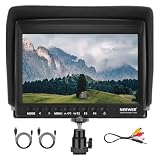
The F100 is a 7-inch 1280×800 IPS monitor with 450nit brightness and HDMI 1080p input. It adds a peak focus histogram and a sunshade, which makes it a simple framing and focus tool for indoor shooting with a DSLR or mirrorless camera.
- Strength: 7-inch IPS screen with peak focus and histogram.
- Strength: sunshade listed alongside HDMI 1080p input.
- Limit: 450nit is the dimmest rating in this roundup.
Skip it if you shoot outdoors in strong light.
Which One Fits Your Situation
A sunny outdoor or event shoot
Go bright: the NEEWER F700 at 2000nit, the FEELWORLD F5 Prox at 1600nit or the VILTROX DC-550 at 1200 nits with a hood. The Portkeys HD7H is a sensible 1000nit alternative.
A streaming or podcast desk with a mirrorless camera
Indoors, brightness matters less. The FEELWORLD S55 V3 or NEEWER F100 gives a large, easy view for checking framing and focus beside your PC and capture card.
A gimbal or small handheld rig
Weight is the issue. The Atomos Shinobi II and the FEELWORLD F5 Prox keep the rig compact while still providing a touch interface.
A budget-conscious first monitor
The NEEWER F100 and the Portkeys HD7H are the simpler entries, both offering 7-inch screens, a sunshade and a focus tool without a premium feature set.
Common Mistakes
- Buying on nits alone and ignoring panel resolution.
- Forgetting to check the HDMI cable and connector type matches the camera.
- Skipping the battery plate or charger when the listing does not include one.
- Mounting a 7-inch screen on a rig that cannot hold the weight.
- Assuming every monitor includes waveform, LUT and peaking tools.
Frequently Asked Questions
Do I need a monitor with a touch screen?
Not strictly. Touch makes menu changes faster, but physical buttons, as on the Portkeys HD7H, can be easier with gloves or on a moving rig.
What does HDMI loop out do?
Loop out passes the camera signal through to a second device, such as a recorder or a capture card, while the monitor still displays it.
Can I use a camera monitor with a PC?
Only through a capture setup. A field monitor is designed to show a camera feed, so check the input type and signal limits before connecting a computer.
Is higher brightness always better?
No. Extra nits help in daylight but can raise power draw, so a brighter panel is only worth it if you shoot outdoors. For indoor work, a sharper panel with good focus tools often matters more than a peak brightness figure you will never use, and the battery lasts longer when the screen runs at a lower level. Whatever you choose, confirm the battery plate, charger and cable in the box, since several listings name a battery and bag while others show only the monitor.