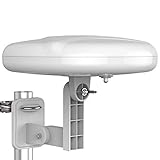
- Top Pick: 2026 TV Antenna for Digital TV Indoor/Outdoor, 200% Wider Signal Reach Long Range Smart HDTV Antenna for Local Channels, Support 4k 8k 1080p with Amplifier Signal Booster
- Best Value: GE Outdoor HD Digital TV Antenna, Long Range Smart TV Antenna | Supports 4K 1080P HD Smart TV VHF UHF, J Mount Included for Attic or Outdoor, Weather Resistant, 29884
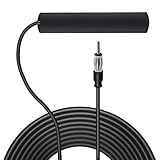
- Premium Choice: DAANT TV Antenna Indoor Long Range | Supports 4K 1080p Smart TV Signal Reception with 16ft HDTV Coax Cable
Over-the-air television has one honest limit: distance and obstacles between your roof and the broadcast tower. “Long range” on a package can mean a lot of things, from a flat indoor panel with an amplifier to a roof-mounted yagi with a mast. Before you compare brands, decide how far your stations really are, whether you can mount anything outdoors, and how many TVs the signal has to reach.
This roundup is for cord-cutters in 2026 who live in fringe-signal areas, rural homes, or buildings where nearby towers are blocked by hills or other structures. Picks are judged only on what each listing states: indoor or outdoor design, cable length, amplifier presence, mounting hardware, output count and the standards it names. Maker range claims are quoted as claims, not as promises, because real reception depends on terrain and the antenna’s position.
Quick Picks
As an Amazon Associate we earn from qualifying purchases at no extra cost to you.




| Product | Best for | Key spec from the title |
|---|---|---|
| BEIMQN Indoor/Outdoor Antenna | Flexible placement | Indoor/outdoor, amplifier booster |
| GE Outdoor HD Antenna (29884) | Attic or outdoor mount | VHF/UHF, J mount, weather resistant |
| DAANT Indoor Long Range | Simple window setup | 16 ft coax cable |
| URIIU Indoor Antenna | Far-from-window placement | 33 ft coax, amplifier |
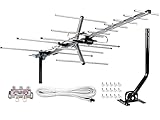
| Five Star Yagi Antenna | Remote rural homes | Up to 200 mile claim, supports 4 TVs, mounting pole |
| intelbras Indoor Antenna | Longer cable run | Amplifier, 16.5 ft cable |
| PBD Outdoor Rotating Antenna | Hard-to-aim towers | 360-degree remote rotation, dual outputs, 40 ft RG6 |
| QIRUOZ 360-Degree Indoor Antenna | Older and newer TVs | 360-degree reception, 13 ft coax |
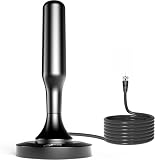
| HIDB Magnetic Indoor Antenna | Easy setup | Magnetic base, 10 ft cable |
How to Choose
Indoor, attic or roof: placement matters more than the label
Height and clear line of sight carry more weight than any number on the box. An attic or roof-mounted unit sees farther than a panel stuck to a wall. If your listing names a mount, such as a J mount or mounting pole, you can raise the antenna; if it is indoor-only, plan to place it near a window facing the towers. Trees, metal siding, brick and low-e window glass all weaken reception, so a spot with a short, clear path outdoors beats a perfect spec on a bookshelf.
Check the band: VHF and UHF
Some local stations broadcast on VHF, and many on UHF. A title that names VHF/UHF, like the GE and PBD listings, tells you both bands are covered. Titles that skip band names are not necessarily wrong, but you should confirm on the seller page before relying on them for stations on lower channels.
Amplifiers, cable length and outputs
An amplifier can help with a long cable run or splitting to several TVs, but it can also overload a strong signal from a nearby tower. Cable length is a practical limit: 10 ft is tight, 16 to 33 ft gives breathing room, and a 40 ft RG6 run suits outdoor installs. Dual outputs or “supports 4 TVs” matter if you feed more than one set.
Treat huge range numbers with caution
Claims such as 200 miles or 5000 miles are not comparable and should be read as marketing. Ignore them and focus on design, mounting and cabling. Budget models cut corners on weatherproofing, gain and connector quality, so an outdoor unit built for exposure is a safer choice for fringe areas. Connector quality also matters: a loose or corroded coax fitting can undo the benefit of a good antenna.
The 9 Best Options
BEIMQN Indoor/Outdoor Amplified Antenna
A flexible pick for buyers who are not sure whether the antenna will end up inside a window or outside on a bracket. The listing mentions both uses in one title. That makes it a sensible first purchase if you plan to try a window position this month and move it to a porch or eave later, without buying a second antenna.
- Described for indoor and outdoor use with an amplifier signal booster.
- Names 4K, 8K and 1080p support and a “200% wider signal reach” claim.
Trade-off: the percentage claim has no baseline and no mounting hardware is named. Skip it if you want a documented outdoor kit with pole and bracket, because you would have to source mounting hardware and sealing for outdoor use yourself.
GE Outdoor HD Antenna (29884)
For homeowners who want a conventional outdoor antenna with a recognizable brand name and clear mounting provisions. It is the classic choice for a suburban house with a sloped roof or attic where a fixed, aimed antenna can sit above most obstructions.
- Covers VHF and UHF, with a J mount included for attic or outdoor installation.
- Weather resistant and listed for 4K and 1080P smart TVs.
Trade-off: no amplifier, cable length or output count appears in the title. Skip it if you need to feed several TVs without extra gear, or if you want a built-in amplifier to compensate for a long coax run into the house.
DAANT Indoor Long Range Antenna
Fits apartment dwellers who want a straightforward panel near a window with a generous lead to the TV.
- 16 ft HDTV coax cable gives placement flexibility.
- Supports 4K and 1080p signal reception.
Trade-off: no amplifier or band details are stated. Skip it if you live far from the towers and need a boosted or outdoor solution. It is best thought of as a tidy, low-effort indoor option for people already in decent signal territory.
URIIU Indoor Antenna with 33 ft Coax
Aimed at rooms where the TV sits far from the best window, so the long cable matters as much as the antenna.
- A 33 ft coaxial cable lets you place the antenna away from the set.
- High-gain reception with an amplifier, for 4K, 1080P and older TVs.
Trade-off: the “5000+ miles” figure cannot be taken literally. Skip it if you prefer a roof-mounted design. Even with the long lead, an indoor antenna still sits behind walls and roofing, so expect the position near glass and as high as possible to matter more than the cable.
Five Star Yagi Antenna
For rural homes where stations sit a long way off and a roof or attic install is possible. It is the only listing with a mounting pole and installation kit alongside a multi-TV claim.
- Attic or roof mount with installation kit and mounting pole.
- Supports 4 TVs and includes radio/FM reception.
Trade-off: a “200 mile” claim is aspirational and the yagi shape needs careful aiming. Skip it if you cannot mount hardware or want an omnidirectional design. A yagi is directional, so stations sitting in opposite compass directions will not both come in without re-aiming, and the pole needs a secure, grounded installation.
intelbras Indoor HD Antenna
A middle-of-the-road indoor choice with an amplifier and a longer cable than most flat panels.
- Amplifier signal booster for local channels.
- 16.5 ft cable and 4K/1080p support.
Trade-off: the title offers little else, no band or mounting details. Skip it if you want rotation or outdoor use. Think of it as a modest upgrade from a basic flat panel for a bedroom or den where cable length is the main issue.
PBD Outdoor Rotating Antenna
Best where stations sit in different directions and you do not want to climb up and re-aim. The remote rotation is its defining feature.
- 360-degree remote rotation with UHF/VHF reception and a built-in high-gain amplifier.
- Dual TV outputs, a mounting pole and 40 ft RG6 cable.
Trade-off: the motor and mast add installation work. Skip it if you want a plug-and-place indoor panel. The rotator needs power and a clear mast position, and you should secure the long RG6 run so wind and weather do not strain the connectors over time.
QIRUOZ 360-Degree Indoor Antenna
For households with a mix of older and newer TVs that need a single indoor option.
- 360-degree reception with an amplifier booster for VHF and UHF.
- 13 ft coax cable and 4K, 1080P and 8K support.
Trade-off: the cable is shorter than several rivals. Skip it if the TV is far from your best window. It works best in a living room where the set sits close to a south- or tower-facing window and the lead can stay short and tidy.
HIDB Magnetic Indoor Antenna
An easy-install choice for renters who want something that sticks to a metal surface and needs no tools.
- Magnetic base for quick placement.
- 10 ft cable and OTA digital HD reception.
Trade-off: no amplifier is mentioned and the cable is the shortest. Skip it if you need to reach distant stations. It suits dorm rooms, rentals and small apartments close to the broadcast towers, where the goal is a clean, removable setup rather than maximum reach.
Which One Fits Your Situation
You live in a rural area with a distant tower
The Yagi is the one built around a roof or attic mount with a pole, and the PBD rotating unit helps when towers are in different directions.
You rent and cannot drill into walls
The HIDB magnetic antenna and the DAANT window panel avoid hardware entirely, while the URIIU gives the longest cable for flexible placement.
You have an attic and want a branded outdoor antenna
The GE 29884 includes a J mount for attic or outdoor use and covers both VHF and UHF.
You want to feed more than one TV
The Yagi lists support for four TVs and the PBD has dual outputs, which makes them the most naturally suited here.
Common Mistakes
- Believing a mile figure on the box instead of checking your own location and obstacles.
- Putting an indoor panel in a basement or interior room and expecting full channel lineups.
- Adding an amplifier when the nearest tower is already strong.
- Forgetting to rescan channels after moving or re-aiming the antenna, which leaves new stations missing from the guide even when they are coming in fine.
- Using a short cable that forces a poor placement, when a few extra feet would let you reach a better window or the attic.
Related guides
- Combination Smoke And Carbon Monoxide Detectors
- Aio Liquid Coolers For High Performance Gaming
- Graphics Cards For Low Wattage Power Supplies
Frequently Asked Questions
Are amplified antennas always better?
No. An amplifier helps weak signals and long cable runs but can overload receivers near a strong tower. In those cases an unamplified antenna may behave better.
Does 4K need a special antenna?
Antennas generally do not care about resolution; the broadcast determines the picture. A “4K” label is mostly a compatibility claim, so concentrate on gain, placement and bands.
Indoor or outdoor for long range?
Outdoor or attic mounting is usually the stronger option for distant stations because it gains height and avoids walls. Indoor models suit nearby towers and apartments. If you are unsure, start by looking up which broadcast towers serve your address and how far away they are, then match the antenna type to that distance.
Can one antenna feed several TVs?
Some listings, like the Yagi and the PBD, name multiple TV support or dual outputs. For others, a splitter and possibly an amplifier will be needed. Each split weakens the signal a little, which is another reason to start with the strongest antenna placement you can manage.