

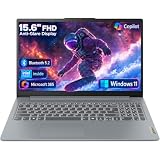
- Top Pick: Lenovo 15.6" FHD Business Laptop, Intel Processor, 8GB DDR5, 128GB Storage | 1TB Cloud Storage, 2026 Edition, Copilot AI+Office 365, Slim PC for Student & Home Office, Win 11, Arctic Grey
- Best Value: Lenovo 2027 16" FHD Business Laptop, Intel i5-13420H, 16GB DDR5, 512GB SSD | Office 365, Copilot AI, 8-Core H-Series Processor, WiFi 6, Bluetooth 5.2, Fast Charge, Numeric Keypad, HD Webcam, Windows 11
- Premium Choice: Lenovo Flagship Chromebook, 14'' FHD Touchscreen Slim Thin Light Laptop Computer, 8-Core MediaTek Kompanio 520 Processor, 4GB RAM, 64GB eMMC, WiFi 6,Chrome OS, Abyss Blue
A student laptop has to survive a lecture hall, a library table, a dorm desk and a backpack, usually all in the same day. Choosing a Lenovo narrows the field to a brand with a wide ladder of models, from a touchscreen Chromebook to 16 gigabyte Windows notebooks with full-size keyboards. The hard part is that the listings look alike: nearly every title says 15.6 inch, FHD and Windows 11, yet the memory, storage and processor underneath differ in ways that decide whether the machine still feels quick in year three.
This guide ranks ten listed Lenovo models by the facts printed in their titles, not by brand reputation. It suits high school and college students, parents buying for the 2026 school year, and anyone who wants a note-taking, research and streaming machine rather than a gaming rig. Where a title is vague, such as a bare Intel processor with no model name, the write-up says so, because a missing spec is information too.
Quick Picks
As an Amazon Associate we earn from qualifying purchases at no extra cost to you.




| Product | Best for | Key spec from the title |
|---|---|---|
| Lenovo 16″ Business Laptop | Heavier coursework and multitasking | Core i5-13420H, 16GB DDR5, 512GB SSD |
| Lenovo V15 (Ryzen 5) | Balanced all-rounder | Ryzen 5 7520U, 16GB DDR5, 512GB SSD |
| Lenovo V15 (Ryzen 3) | Wired connectivity on campus | Ryzen 3 7320U, 16GB, RJ-45 |
| Lenovo V15 Ultra Slim | Ports for projectors and Ethernet | 16GB DDR5, 256GB SSD, HDMI, Ethernet |
| IdeaPad Slim 3i | Light carry and extra card storage | Core i3-N305, 8GB, 256GB SD card |
| Lenovo IdeaPad 15.6″ | Simple home and class use | 8GB DDR5, 128GB, USB-C |
| Lenovo 15.6″ Business Laptop (Grey) | Glare-prone rooms | Anti-glare screen, 8GB DDR5, USB-C |
| Lenovo 15.6″ Business Laptop (cloud storage) | Students who live in cloud files | 8GB DDR5, 128GB, 1TB cloud storage |
| Lenovo Premium 15.6″ | Large combined storage | 128GB UFS plus 500GB external |
| Lenovo 14″ Chromebook | Web apps and a touchscreen | 14″ FHD touch, 4GB RAM, 64GB eMMC |
How to Choose
Memory and storage set the lifespan
Eight gigabytes of RAM runs a browser with a dozen tabs plus a word processor, but 16GB leaves headroom for four more years of heavier software. Storage matters just as much. A 128GB drive fills quickly after Windows updates and a few large apps, which is why 256GB or 512GB is the safer floor for a four-year degree. Cloud storage and external cards soften the problem but never fully replace internal space.
Match the processor to the coursework
Writing, research and video calls are handled by an entry chip such as the Core i3-N305 or Ryzen 3 7320U. Engineering software, large spreadsheets or light video editing point toward the Core i5-13420H or the Ryzen 5 7520U. Several titles here only say Intel Processor or Intel Quad Core without a model number, so compare those on the spec sheet before assuming they match the named chips.
Screen, ports and battery for a backpack life
FHD means 1920 by 1080 pixels, the minimum worth accepting for reading documents. An anti-glare finish helps in bright lecture halls. For ports, look for USB-C, HDMI for projectors, and Ethernet if dorm Wi-Fi is unreliable. Battery claims in titles, such as 8 hours or long battery life, are vague, so favor listings that give a number.
What to ignore and where budget models cut corners
Skip stuffed titles that promise Copilot, Office 365 and cloud storage as if they were hardware. Those are software or subscription extras, and their terms vary. Budget laptops cut corners on storage size, memory, and sometimes on the keyboard and webcam. The software platform also matters: Chrome OS runs web apps well but cannot install classic Windows programs, so check which software the school requires.
One more filter worth applying: Windows 11 Pro appears on several of these listings, and it adds business-oriented management features that most students will never touch. Do not read the edition label as a performance signal. A Pro machine with 8GB and 128GB is still an 8GB, 128GB machine, and a lower-tier edition with 16GB and 512GB will feel faster in practice.
The 10 Best Options
Lenovo 16″ FHD Business Laptop (Core i5-13420H)
This is the strongest spec sheet in the group: a 16 inch FHD display, Intel Core i5-13420H eight-core H-series processor, 16GB DDR5 and a 512GB SSD, with Wi-Fi 6, Bluetooth 5.2, fast charge, a numeric keypad and an HD webcam.
- Strength: memory and storage are both comfortable for multitasking.
- Strength: the numeric keypad helps with spreadsheets and data entry.
- Trade-off: the 16 inch body is bulkier to carry than a 14 inch model.
Skip it if the laptop must slide into a small bag every day, or if a lighter 14 inch frame is a priority for long commutes between buildings.
Lenovo V15 (Ryzen 5 7520U)
The V15 with a Ryzen 5 7520U pairs 16GB DDR5 with a 512GB SSD on a 15.6 inch FHD screen. The title also lists a webcam with a privacy shutter, a numeric keypad and Windows 11 Pro.
- Strength: a named processor with 16GB and 512GB gives a clear performance story.
- Strength: a webcam shutter suits shared dorm rooms.
- Trade-off: the title makes comparisons with other chips that are marketing claims, not a measured result.
Skip it if an ultra-light frame matters more than a full keyboard, or if the idea of trusting a comparison written into a listing title feels shaky.
Lenovo V15 (Ryzen 3 7320U)
This V15 steps down to a Ryzen 3 7320U but keeps 16GB DDR5 and a 512GB SSD, adds an RJ-45 Ethernet port, and includes a shuttered webcam and numeric keypad on a 15.6 inch FHD panel.
- Strength: the Ethernet port helps where campus Wi-Fi is crowded.
- Strength: it keeps 16GB and 512GB at the entry processor tier.
- Trade-off: the Ryzen 3 chip sits below the Ryzen 5 sibling for heavy tasks.
Skip it if the coursework includes demanding software, where the Ryzen 5 is a safer step up.
Lenovo V15 Ultra Slim
Described as an ultra slim college laptop, this model lists a 15.6 inch anti-glare FHD display, an Intel quad-core processor, 16GB DDR5, a 256GB SSD, Wi-Fi 6, Ethernet, HDMI and an 8 hour battery.
- Strength: HDMI and Ethernet cover presentations and wired connections.
- Strength: an 8 hour battery figure is stated, which is rare in this group.
- Trade-off: the processor model is not named.
Skip it if the exact chip matters, since the title leaves that detail out and the buyer would have to confirm it on the full spec sheet.
Lenovo IdeaPad Slim 3i (Core i3-N305)
The IdeaPad Slim 3i uses an eight-core Core i3-N305 with 8GB LPDDR5, 128GB UFS storage plus a 256GB SD card, Windows 11 Pro and Wi-Fi 6, on a 15.6 inch FHD screen billed as lightweight.
- Strength: the included 256GB SD card boosts usable storage.
- Strength: Windows 11 Pro and a lightweight frame suit a student carrying it daily.
- Trade-off: internal storage is only 128GB, and the card is slower than an SSD.
Skip it if files need to live on fast internal storage.
Lenovo IdeaPad 15.6″ (Intel Quad Core)
This IdeaPad lists an Intel quad-core processor, 8GB DDR5, 128GB storage, Wi-Fi 6, Bluetooth 5.2, USB-C and Windows 11 for home and student use, in Cloud Grey.
- Strength: USB-C and Wi-Fi 6 cover modern accessories and networks.
- Strength: a plain IdeaPad spec line is easy to understand.
- Trade-off: 8GB and 128GB leave little room to grow.
Skip it if the laptop must last through a full degree without upgrades.
Lenovo 15.6″ Business Laptop (Anti-Glare, Arctic Grey)
This listing stresses an anti-glare screen, with a 15.6 inch FHD panel, 8GB DDR5, 128GB storage, Wi-Fi 6, USB-C and a long battery claim under Windows 11.
- Strength: an anti-glare finish helps in bright lecture rooms.
- Strength: USB-C is included for charging and accessories.
- Trade-off: the processor is only called Intel Processor, with no model.
Skip it if processor details are needed to compare against other listings.
Lenovo 15.6″ Business Laptop (1TB Cloud Storage)
This one bundles 1TB of cloud storage, Copilot AI and Office 365 with a 15.6 inch FHD screen, 8GB DDR5, 128GB storage and Windows 11.
- Strength: the cloud storage allowance offsets the small internal drive.
- Strength: Office software is mentioned for coursework.
- Trade-off: the cloud and software extras depend on subscription terms.
Skip it if working offline is common, since cloud files need a connection.
Lenovo Premium 15.6″ (128GB UFS Plus 500GB External)
The Premium listing counts 628GB of storage by combining a 128GB UFS drive with a 500GB external unit, along with 8GB DDR5, Wi-Fi 6, Windows 11 Pro and a slim, ultralight description.
- Strength: the added external drive gives a large pool for files.
- Strength: Windows 11 Pro is included.
- Trade-off: only 128GB is built in, and the external drive must travel with the laptop.
Skip it if a single internal drive is preferred.
Lenovo 14″ Flagship Chromebook
The Chromebook is the outlier: a 14 inch FHD touchscreen, an eight-core MediaTek Kompanio 520, 4GB RAM, 64GB eMMC storage, Wi-Fi 6 and Chrome OS in Abyss Blue.
- Strength: a touchscreen and a smaller 14 inch body ease note-taking and carry.
- Strength: Chrome OS suits web-based coursework.
- Trade-off: 4GB RAM and 64GB storage limit heavy use.
Skip it if the course needs Windows-only programs.
Which One Fits Your Situation
You are heading into engineering or data-heavy classes
The 16 inch Core i5-13420H model has the most capable processor and 512GB of storage, which fits larger software and projects.
You need a dependable all-rounder for any major
The V15 with Ryzen 5 and 16GB balances memory and storage without leaving the named-chip comfort zone.
You carry the laptop everywhere and present often
The V15 Ultra Slim offers HDMI, Ethernet and a stated 8 hour battery, while the IdeaPad Slim 3i adds a card for extra files.
Your coursework lives in the browser
The 14 inch Chromebook fits web-first classes, and its touchscreen suits note-taking.
Common Mistakes
- Buying 8GB and 128GB without planning how to handle storage later.
- Counting cloud storage or Office bundles as hardware value.
- Treating Intel Processor with no model as equal to a named chip.
- Choosing a Chromebook without checking the school’s software list.
- Ignoring ports until the first projector or Ethernet-only room.
Frequently Asked Questions
Is 8GB of RAM enough for a student laptop?
It handles browsing, documents and video calls. Students who multitask heavily or keep the laptop for years should aim for 16GB.
Is a Chromebook a good choice for college?
It works if assignments are web-based. It cannot run classic Windows programs, so engineering or design courses may need a Windows laptop.
Does Copilot in a listing matter?
It is a software feature tied to the Windows software, not a hardware upgrade. Treat it as a bonus, not a reason to choose one laptop over another.
How much storage should a student get?
Aim for 256GB or more of internal storage. Smaller drives can work with cloud backup, but they fill up faster over several years.









