Hollyland has quietly built one of the deepest wireless microphone lineups in the creator market, and for filmmakers the choice is no longer whether the brand has a suitable system, but which tier of the Lark family matches the shoot. The range runs from a phone-only starter kit to a flagship with 32-bit float internal recording and timecode, and every system below is a current Hollyland model sold on Amazon US. This guide compares the five systems that matter for video work, using manufacturer-published specifications only, so you can match a kit to your camera, your crew size and your backup-recording needs before you buy.
As an Amazon Associate, we earn from qualifying purchases.
The Short Answer
For most filmmakers, the Hollyland Lark Max is the sweet spot: it records 48 kHz/24-bit audio, keeps up to 14 hours of backup recording inside each transmitter, and feeds a camera receiver with a colour touchscreen. Shooters who want the strongest safety net should step up to the Lark Max 2, which adds 32-bit float internal recording, timecode and wireless monitoring. Crews that need talent to stay nearly invisible on camera should look at the Lark M2S, whose transmitters weigh 7 grams and hide behind a collar. The Lark M2 remains the flexible all-rounder with three receiver types in one case, and the Lark A1 is the entry point for phone-based filmmaking. If you are still deciding which microphone style suits your wider setup, our guide to the best microphone options for 2026 covers the broader field beyond this one brand.
What to Check Before Choosing a Hollyland System
Recording purpose. A two-person interview, a narrative short and a run-and-gun documentary place different demands on a wireless kit. Interviews need two transmitters and clean dialogue capture; narrative work benefits from a transmitter that accepts an external lavalier for hidden placement; documentary work rewards long range and internal backup recording when a take cannot be repeated.
Audio format. Every system here records or transmits at least 48 kHz/24-bit audio as published by Hollyland. The step that matters for film work is the Lark Max 2, which moves to 32-bit float internal recording, giving editors far more headroom to rescue loud or quiet takes in post.
Receivers. Camera receivers connect over a 3.5 mm cable and mount on a hot shoe, which suits mirrorless and cinema cameras. USB-C and Lightning receivers plug straight into phones and tablets. Combo kits bundle several receiver types, which matters if the same kit has to serve a camera on weekdays and a phone on weekends.
Internal recording. Only the two Max systems record inside the transmitter. On the Lark Max and Max 2, a dropped wireless link does not lose the take, because a local copy exists. The M2, M2S and A1 rely on the receiver or phone to capture audio, so placement and line of sight matter more.
Range and latency. Hollyland publishes line-of-sight ranges for each system, from 200 metres on the A1 up to 340 metres on the Max 2; real sets with walls and bodies in the way will see less. Hollyland does not publish latency figures for the Lark line, so any latency number quoted by a third party should be treated as that reviewer’s measurement rather than a specification.
Battery and accessories. Transmitter runtimes run from a single long shooting block to a full day, and every kit here includes a charging case that extends total use. Required extras are modest: furry windshields for outdoor dialogue, a 3.5 mm TRS cable for camera receivers, and the LarkSound app for noise-cancellation and gain control on the smaller systems.
Hollyland Lark Max 2

The Lark Max 2 is Hollyland’s flagship and the system aimed squarely at working filmmakers. Its transmitters record 32-bit float audio internally, so a shouted line or a whispered one can both be recovered in the edit without clipping or a buried noise floor. The system supports timecode, which keeps wireless audio aligned with camera files on multi-device shoots, and it can run up to four transmitters into one receiver for panel discussions and small ensemble scenes. The Ultimate Combo pairs two transmitters with both a camera receiver and a USB-C receiver, plus Hollyland’s OWS monitor earphones, which allow wireless monitoring of the mix without a cable run back to the camera. Reviewers consistently single out the monitoring and timecode support as the features that separate it from creator-grade kits, but those are workflow judgements; the published hardware case rests on the recording format, the range and the receiver flexibility.
Specs
- Audio: 32-bit float internal recording, 32-bit full-chain transmission
- Range: up to 340 m (1,115 ft) line of sight, as published
- Receivers: camera receiver and USB-C receiver (Ultimate Combo)
- Internal recording: yes, with timecode support
- Battery: up to 36 hours total with the charging case
- Transmitter weight: 14 g
- Tier: premium
Hollyland Lark Max
The original Lark Max remains the benchmark two-person film kit in the range. Each transmitter carries 8 GB of onboard storage and records up to 14 hours of backup audio, so the safety copy is automatic rather than an afterthought. The camera receiver uses a colour touchscreen for gain and mode control, and the transmitters accept an external lavalier through a 3.5 mm input, which is the detail narrative shooters care about when a mic has to disappear under wardrobe. Hollyland rates the link at up to 250 metres line of sight, and the environmental noise cancellation can be engaged when a location is noisier than planned. For a solo operator or a two-person crew that does not need four-channel recording, this is the system that covers the most film scenarios per kit.
Specs
- Audio: 48 kHz/24-bit
- Range: up to 250 m (820 ft) line of sight, as published
- Receivers: camera receiver with colour touchscreen
- Internal recording: yes, 8 GB per transmitter, up to 14 hours
- Battery: transmitter up to 7.5 hours, up to 22 hours with the charging case
- Extras: environmental noise cancellation, 3.5 mm lavalier input on the transmitter
- Tier: premium
Hollyland Lark M2S Combo

The M2S is built around one idea: the microphone should not be visible in the frame. Each transmitter weighs 7 grams, uses a titanium clip, and carries no logo, so it sits behind a collar or lapel without drawing the eye. The Combo version is the filmmaker’s configuration, bundling a camera receiver, a USB-C receiver and a Lightning adapter cable in one case, which lets the same pair of transmitters serve a mirrorless camera, an Android phone and an iPhone. Audio is 48 kHz/24-bit, noise cancellation is adjusted through the LarkSound app, and Hollyland publishes a 300 metre line-of-sight range. There is no internal recording, so the camera or phone is the only copy of the take; for controlled interview and talking-head work, that trade is usually acceptable in exchange for the invisible fit.
Specs
- Audio: 48 kHz/24-bit
- Range: up to 300 m (1,000 ft) line of sight, as published
- Receivers: camera receiver, USB-C receiver, Lightning adapter cable
- Internal recording: no
- Battery: up to 30 hours total with the charging case
- Transmitter weight: 7 g with titanium clip
- Tier: mid-range
Hollyland Lark M2 Combo

The Lark M2 is the flexibility pick. The Combo version ships with three receivers, camera, USB-C and Lightning, so one kit covers a camera body, current phones and older iPhones without adapters bought later. The camera receiver can switch between mono and stereo output, which helps when two speakers need to land on separate channels for the edit. Transmitters weigh 9 grams, run up to 10 hours per charge with noise cancellation off, and the charging case takes the camera configuration to roughly 40 hours of total use. Like the M2S, there is no internal recording, and noise cancellation is a single-button control on the transmitter with further adjustment in the app. For filmmakers who split time between a camera and a phone and want one case to grab, this is the practical choice.
Specs
- Audio: 48 kHz/24-bit
- Range: up to 300 m (1,000 ft) line of sight, as published
- Receivers: camera receiver, USB-C receiver and Lightning receiver
- Internal recording: no
- Battery: transmitter up to 10 hours, up to 40 hours total with the charging case
- Transmitter weight: 9 g
- Tier: mid-range
Hollyland Lark A1
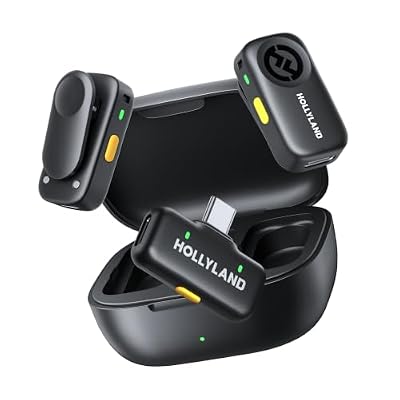
The A1 is Hollyland’s starter system, aimed at phone-based shooting. It pairs two transmitters with a plug-in phone receiver and records 48 kHz/24-bit audio with three levels of intelligent noise cancellation, adjustable in the LarkSound app alongside EQ and reverb. Hollyland publishes a 200 metre line-of-sight range and up to 54 hours of total battery life with the charging case, which is generous for a kit at this level. The honest limitation for filmmakers is the receiver: this USB-C version serves phones, tablets and USB-C action cameras, and there is no camera receiver in the box, so it suits mobile journalism, behind-the-scenes capture and phone-first productions rather than a mirrorless main camera. Within that role, it is a coherent and inexpensive way into the Lark ecosystem.
Specs
- Audio: 48 kHz/24-bit
- Range: up to 200 m line of sight, as published
- Receivers: USB-C plug-in receiver (this version)
- Internal recording: no
- Battery: up to 54 hours total with the charging case
- Noise control: three-level intelligent noise cancellation via the LarkSound app
- Tier: budget
Which Hollyland System Fits Your Shoot?
Choose the Lark Max 2 for narrative and documentary work where takes cannot be repeated and post-production headroom matters. Choose the Lark Max for two-person interviews and general film work with an automatic backup recording on every take. Choose the M2S when the microphone must vanish on camera and the receiver set still needs to cover a camera. Choose the M2 when one kit has to move between a camera and several phones. Choose the A1 when the phone is the camera and the budget is the deciding factor. Across the range, the published specifications are consistent and conservative, and the real dividing lines are internal recording, receiver count and transmitter size rather than basic audio quality.
Frequently Asked Questions
Which Hollyland microphone is best for narrative film work?
The Lark Max 2 is the strongest fit, because its 32-bit float internal recording protects dynamic dialogue takes and its timecode support keeps audio aligned with camera files. The Lark Max is the alternative when two transmitters are enough and 24-bit backup recording covers the risk.
Do Hollyland Lark systems record backup audio inside the transmitter?
Only the Max line does. The Lark Max stores up to 14 hours per transmitter on 8 GB of onboard memory, and the Lark Max 2 records 32-bit float internally. The M2, M2S and A1 send audio to the receiver or phone and keep no local copy.
Can one Hollyland kit work with both a camera and a phone?
Yes, if you buy a Combo version. The Lark M2 Combo includes camera, USB-C and Lightning receivers, and the Lark M2S Combo includes a camera receiver, a USB-C receiver and a Lightning adapter cable. Single-receiver kits are limited to the receiver type in the box.
How far do Hollyland wireless microphones really reach?
Hollyland publishes line-of-sight ranges of 200 metres for the A1, 250 metres for the Lark Max, 300 metres for the M2 and M2S, and 340 metres for the Max 2. Walls, bodies and crowded radio environments shorten those figures, so treat them as open-air ceilings rather than set guarantees.
Final Verdict
Hollyland’s Lark family gives filmmakers a clean ladder. The Lark Max 2 is the flagship for productions that need 32-bit float recording, timecode and monitoring; the Lark Max is the dependable two-person kit with backup recording built in; the M2S and M2 trade internal recording for smaller transmitters and wider receiver compatibility; and the A1 opens the range to phone shooters. Pick by the risk you cannot afford, a lost take, a visible mic or a missing receiver, and the right system in this lineup follows from that answer.
Product and ASIN Reference
| Product | ASIN |
|---|---|
| Hollyland Lark Max 2 Ultimate Combo (2TX + Camera RX + USB-C RX + Charging Case) | B0F2YG21R3 |
| Hollyland Lark Max Duo (2TX + Camera RX + Charging Case) | B0C5R9H796 |
| Hollyland Lark M2S Combo (2TX + Camera RX + USB-C RX + Lightning Cable) | B0DNQ95NKY |
| Hollyland Lark M2 Combo (2TX + Camera RX + USB-C RX + Lightning RX) | B0CT633X1L |
| Hollyland Lark A1 (2TX + USB-C RX + Charging Case) | B0F3D55D5R |