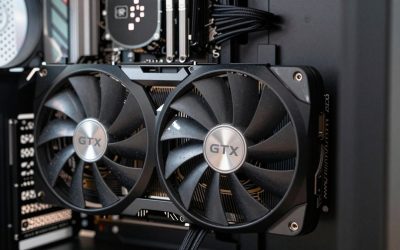
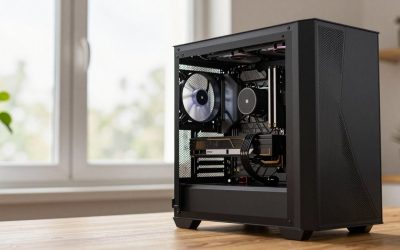
- Top Pick: msi Gaming RTX 3050 Ventus 2X 6G OC Graphics Card (NVIDIA RTX 3050, 96-Bit, Boost Clock: 1492 MHz, 6GB GDDR6 14 Gbps, HDMI/DP, Ampere Architecture)
- Best Value: ASUS Dual NVIDIA GeForce RTX 5060 8GB GDDR7 OC Edition (PCIe 5.0, 8GB GDDR7, DLSS 4, HDMI 2.1b, DisplayPort 2.1b, 2.5-Slot Design, Axial-tech Fan Design, 0dB Technology), 3 Year Warranty
- Premium Choice: MSI Gaming GeForce RTX 3060 12GB 15 Gbps GDRR6 192-Bit HDMI/DP PCIe 4 Torx Twin Fan Ampere OC Graphics Card
Resident Evil 7: Biohazard is not a demanding game in 2026. Built on Capcom’s RE Engine and originally released in 2017, it is very well optimized for PC and runs smoothly on even entry-level modern hardware. Any current budget gaming PC with a dedicated GTX 16-series / RTX 30-series or Radeon RX 5000/6000-class GPU and a quad-core CPU from the last 6-7 years will handle it at 1080p 60+ FPS on high settings. For 1440p or 4K, or for stable high-refresh-rate performance, you only need a mid-range GPU from the last two generations.
- Official PC System Requirements (Approximate)
- How Demanding Is Resident Evil 7 in 2026?
- GPU Choices by Resolution: What to Expect
- CPU, RAM and Storage Notes for Resident Evil 7
- Example PC Builds for Resident Evil 7 in 2026 (General Price Ranges)
- Laptop and Handheld Suitability
- Settings That Raise FPS the Most
- Final Notes for 2026 Players
As an Amazon Associate we earn from qualifying purchases at no extra cost to you.


Official PC System Requirements (Approximate)
The specifications below are approximate, based on the publisher’s store page listing for Resident Evil 7: Biohazard on Steam. Storage requirement has increased slightly over time due to patches and DLC.
| Component | Minimum | Recommended |
|---|---|---|
| OS | Windows 7 / 8 / 8.1 / 10 64-bit required | Windows 7 / 8 / 8.1 / 10 / 11 64-bit required |
| CPU | Intel Core i5-4460 (2.7 GHz) / AMD FX-6300 or better | Intel Core i7-3770 (3.4 GHz) / AMD FX-9590 or equivalent or better |
| GPU | NVIDIA GeForce GTX 760 (2GB) / AMD Radeon R7 260x (2GB) | NVIDIA GeForce GTX 1060 (3GB) / AMD Radeon RX 480 (4GB) |
| RAM | 8 GB | 8 GB |
| Storage | 24 GB available space (SSD recommended) | 24 GB available space (SSD recommended) |
| DirectX | Version 11 | Version 11 / 12 |
| Notes | 1080p / 30 FPS on Low-Medium settings expected | 1080p / 60 FPS on High settings at 60Hz expected |
Resident Evil 7 caps at 8GB RAM on its official spec sheet, which is rare for modern titles. In practice on Windows 10/11 with background applications, 16GB is the more comfortable real-world standard in 2026, but the game itself does not require it.
How Demanding Is Resident Evil 7 in 2026?
Unlike recent open-world RE Engine titles or the Resident Evil 4 remake, Resident Evil 7 is a linear, corridor-based first-person horror game. The Baker house and surrounding areas are small, highly instanced environments with limited draw distances, baked lighting, and no large-scale open-world streaming or complex crowd simulation. That makes it light on both CPU and GPU.
It was also one of the best-optimized PC ports Capcom has released. VRAM usage is modest, shader compilation stutter is minimal compared to newer titles, and it scales well on older hardware. In 2026, the game is effectively a lightweight title. If your PC can run Resident Evil Village or Resident Evil 4 remake, it will run Resident Evil 7 with considerably higher frame rates and lower power draw.
GPU Choices by Resolution: What to Expect
The following expectations are based on approximate ranges reported in public outlet testing from sources such as TechPowerUp, Tom’s Hardware, and TechSpot at max or near-max settings without upscaling. Actual performance varies by specific card model and CPU pairing.
1080p (Full HD) – 60 to 144+ FPS
This is the easiest target. The original recommended GPU was a GTX 1060 / RX 480 for 60 FPS at 1080p High.
- Entry-level modern GPUs (GeForce GTX 1650, GTX 1660 Super, Radeon RX 5500 XT, RX 6500 XT, Arc A380): Expect roughly 75-110 FPS on High. Capable of 60 FPS locked even with shadows and volumetric lighting at High.
- Budget-current GPUs (GeForce RTX 3050 6GB / RTX 4060, Radeon RX 6600 / RX 7600, Arc A580 / A750): Expect roughly 120-180+ FPS on Max settings. Overkill for 60Hz, ideal for 120/144Hz monitors.
For a cheap 1080p build in 2026, you do not need to spend on a high-end card for this game. A used GTX 1660 or RX 6600 class card is already more than enough.
1440p (QHD) – 90 to 165 FPS
1440p increases pixel load by about 78% over 1080p, but Resident Evil 7 handles it well because textures and effects are not excessively heavy.
- Mid-range GPUs (GeForce RTX 3060 / RTX 4060, Radeon RX 6600 XT / RX 7600 XT, Arc A770): Expect roughly 90-130 FPS on Max. Very smooth for 60-144Hz displays.
- Upper mid-range GPUs (GeForce RTX 4060 Ti / RTX 4070, Radeon RX 6700 XT / RX 7700 XT): Expect roughly 130-180+ FPS on Max. You will be CPU-limited in some interior scenes before you are GPU-limited.
4K (UHD) – 60 to 120+ FPS
4K is playable without a flagship GPU thanks to the game’s age. RE7 has no mandatory ray tracing, and its volumetric lighting is far less expensive than in newer RE Engine games.
- Mid-high GPUs (GeForce RTX 4070 / RTX 4070 Super, Radeon RX 7800 XT): Expect roughly 70-100 FPS at 4K Max without upscaling.
- High-end GPUs (GeForce RTX 4070 Ti / RTX 4080 / RTX 5070 class, Radeon RX 7900 XT / 7900 XTX): Expect roughly 100-160+ FPS at 4K Max. Easy 4K/60 lock with headroom for DSR or downsampling.
The game supports resolution scaling and AMD FidelityFX. Interlaced rendering is an older in-engine option that boosts FPS at a noticeable image quality cost; modern upscalers are a better alternative if you need extra performance at 4K on a weaker card.
CPU, RAM and Storage Notes for Resident Evil 7
CPU: Not CPU-Bound
Resident Evil 7 does not feature heavy physics simulation, large NPC counts, or open-world streaming. It is primarily single-thread dependent and benefits from strong single-core speed, but it does not require many cores.
Any modern 4-core / 8-thread CPU (e.g., Intel Core i3-10100F / i3-12100F or newer, AMD Ryzen 3 3100 / Ryzen 5 3600 or newer) will keep you above 100 FPS at 1080p when paired with a capable GPU. Upgrading from a 6-core to an 8-core CPU provides almost no benefit in this specific title. If you are building new in 2026, a current Core i5-14400 / Ryzen 5 5600 / Ryzen 5 7600 class CPU will never be the bottleneck here.
Stutter is uncommon, but as with all RE Engine games, keeping background CPU load low and running Windows 10/11 with updated chipset drivers helps maintain consistent frame pacing.
RAM: 8GB Meets Spec, 16GB Recommended for 2026
Officially, 8GB is enough. Resident Evil 7 itself typically uses 4-6GB of system RAM in-game. However, in 2026 with Windows 11, Discord, a browser, and other background apps, total system usage often exceeds 10GB. A 16GB (2x8GB) DDR4 or DDR5 kit in dual-channel mode is the practical baseline for a smooth experience and costs very little. There is no measurable FPS gain going from 16GB to 32GB in this game alone.
Storage: SSD Strongly Preferred
The 24GB install size is small by modern standards. Capcom lists an HDD as functional, but an SSD is highly recommended. On an SSD, load times between the main house, guest house, and exterior areas are typically 2-5 seconds, while on a 7200 RPM HDD they can be 10-20 seconds. As a linear game without continuous background streaming, there is no texture pop-in advantage to an NVMe over a SATA SSD; either is excellent compared to an HDD.
Example PC Builds for Resident Evil 7 in 2026 (General Price Ranges)
Prices are general ranges for new parts in the US market in 2026 and will vary by retailer, region, and whether you buy used. No specific store links are needed for a game this lightweight.
Budget 1080p / 60+ FPS Build – Approximately $550 to $750
- CPU: Intel Core i3-12100F / i5-12400F or AMD Ryzen 5 5500 / 5600
- GPU: Radeon RX 6600 / RX 7600 or GeForce RTX 3050 6GB / RTX 4060
- RAM: 16GB (2x8GB) DDR4 3200
- Storage: 1TB SATA or NVMe SSD
- What to expect: 1080p Max settings, well above 100 FPS. Handles 1440p/60 on High as well.
This tier is the value sweet spot. Anything in this range already exceeds the recommended spec by a large margin and will run the game quietly and efficiently.
Mid-Range 1440p / High-Refresh or 4K / 60 FPS Build – Approximately $900 to $1300
- CPU: Intel Core i5-14400 / i5-13400F or AMD Ryzen 5 7600 / Ryzen 7 5700X3D
- GPU: GeForce RTX 4060 Ti / RTX 4070 or Radeon RX 7700 XT / RX 7800 XT
- RAM: 16GB or 32GB (2x16GB) DDR4/DDR5
- Storage: 1TB NVMe SSD
- What to expect: 1440p Max at 120+ FPS, or 4K Max at 70-100+ FPS without upscaling. Headroom for newer, more demanding Resident Evil titles.
You do not need this level of hardware for Resident Evil 7 alone, but it is a logical choice if you want a general-purpose 2026 gaming PC that will also handle modern releases at high refresh rates.
Laptop and Handheld Suitability
Gaming Laptops
Resident Evil 7 runs excellently on gaming laptops. Any laptop with a GeForce GTX 1650 / RTX 2050 / RTX 3050 Laptop or Radeon RX 6500M / 7600M class GPU and a 6-core Intel 11th Gen / AMD Ryzen 5000 series CPU or newer will achieve 1080p 60 FPS on High/Medium-High. Thin-and-light laptops with integrated graphics such as AMD Radeon 780M or Intel Arc integrated can run the game at 1080p Low-Medium around 30-45 FPS based on public outlet testing, but a dedicated GPU is recommended for a stable 60 FPS.
Steam Deck, ROG Ally and Other Handhelds
This is an ideal handheld title. Resident Evil 7 is verified as Playable on Steam Deck and runs with very low power draw.
- Steam Deck (LCD / OLED): At 1280×800, Medium-High settings with shadows at Medium and volumetric lighting at Low/Medium, expect approximately 60 FPS locked at 45-60Hz, with 4-6 hours of battery life on OLED at 30-40W. Public testing from outlets like TechPowerUp and community benchmarks show it holds 60 FPS more consistently than many newer RE Engine games.
- ROG Ally / Ally X, Legion Go, similar Ryzen Z1 / Z1 Extreme handhelds: At 1080p Low-Medium or 900p High, expect 60-90 FPS in Performance/Turbo mode. At 720p, you can lock 60 FPS on High while keeping fan noise low.
The game’s dark, high-contrast art style is well suited to the OLED screens on newer handhelds and laptops.
Settings That Raise FPS the Most
If you want to push frame rate on a lower-end PC or handheld, adjust these first. They provide the largest performance gains for the smallest visual loss in Resident Evil 7:
- Shadow Quality and Shadow Cache: The single biggest FPS lever. High and Very High shadows are soft and expensive, especially in the densely shadowed main house. Dropping from Very High to High or Medium can improve frame rate by 10-20% with minimal loss in dark corridors. Keep Shadow Cache enabled if available.
- Volumetric Lighting Quality: Controls the fog, dust shafts, and light beams in the house and swamp. High is atmospheric but costs heavily on older GPUs. Setting it to Medium or Low often yields a 8-15% gain and is barely noticeable during fast movement.
- Ambient Occlusion (SSAO / HBAO+): Adds contact shadows in corners and under furniture. HBAO+ looks slightly better but is more expensive. Switching from HBAO+ to SSAO or disabling it entirely can recover 5-12% performance, useful for integrated graphics or handhelds.
- Reflections and Screen Space Reflections: Noticeable on wet floors and in the guest house bathroom. Disabling or setting to Low gives a 4-8% boost with little impact in most areas, which are not highly reflective.
- Anti-Aliasing (FXAA / TAA / SMAA): Not a large performance hit, but FXAA is the cheapest and SMAA offers a good balance. If you need a few extra frames, FXAA over TAA saves a small amount with a slightly softer image.
Settings you can usually leave at High or Max with little cost: Texture Quality (if you have 4GB+ VRAM, as textures are not very large), Texture Filtering (Anisotropic 8x vs 16x is under 2% difference), and Chromatic Aberration/Color Correction (post-process toggles with no meaningful FPS impact). Start with the Max preset, then lower shadows and volumetric lighting first before touching anything else.
Final Notes for 2026 Players
Resident Evil 7: Biohazard has no ray tracing mode to worry about, no heavy shader compilation issues like several 2023-2024 releases, and no need for frame generation. It benefits from V-Sync or a frame-rate limiter if you exceed your monitor’s refresh rate, as RE Engine can show minor tearing above 144 FPS. If you are sensitive to motion, locking to 60, 90, or 120 FPS via the driver or in-game limiter will provide smoother pacing than an uncapped frame rate. For most players in 2026, the challenge will not be running Resident Evil 7, but deciding whether to enable its optional widescreen black bars and grain filters for the intended horror presentation.