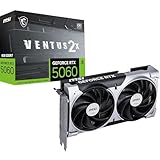
Vanilla Minecraft runs on a laptop from a decade ago. Minecraft with shaders is a different game entirely: packs like Complementary, BSL, and SEUS PTGI turn the renderer into a full deferred pipeline with shadow maps, volumetric light, screen-space reflections, and in the path-traced packs, real ray tracing. That makes the GPU the dominant component at 1440p and 4K, while Java’s single-threaded chunk generation and long render distances still hammer one CPU core. Pairing means a graphics card strong enough for the shader pack you actually want, plus a fast single-core processor and enough RAM for the JVM. The five picks below scale from a modest 1080p shader setup to path tracing at 4K.
Quick Picks
| Pick | Tier | Why |
|---|---|---|
| ASUS Dual GeForce RTX 5060 Ti 16GB | Budget 1080p/1440p | 16GB and strong OpenGL drivers for Iris/OptiFine |
| Sapphire Pulse Radeon RX 9060 XT 16GB | Value 1440p | 16GB at a lower price for lighter packs |
| MSI GeForce RTX 5070 Ventus 3X OC 12G | Sweet spot 1440p | Heavy packs at 1440p high refresh |
| Gigabyte GeForce RTX 5070 Ti Gaming OC 16G | 1440p ultra / 4K | Path-traced packs at 1440p, heavy packs at 4K |
| ASUS TUF Gaming GeForce RTX 5090 32GB | 4K path tracing | SEUS PTGI and Bedrock RTX at 4K |
How We Chose
Shader packs are a rasterization workload with a ray-tracing tail, so we weighed two things: raw shader throughput, using the relative positioning in launch reviews from TechPowerUp, Hardware Unboxed, and Gamers Nexus, and ray-tracing capability for players eyeing path-traced packs or Bedrock RTX. We also leaned toward NVIDIA because Java Minecraft still runs on OpenGL through Iris or OptiFine, and NVIDIA’s OpenGL driver has historically delivered better consistency. VRAM was a secondary filter, since high-resolution texture packs and long render distances can push past 8GB.
As an Amazon Associate we earn from qualifying purchases at no extra cost to you. Product prices and availability are accurate as of the date shown and are subject to change.


ASUS Dual GeForce RTX 5060 Ti 16GB
The RTX 5060 Ti 16GB is the entry card we would recommend for shaders because of the driver, not just the speed. TechPowerUp’s launch positioning puts it in the same tier as the RX 9060 XT 16GB, and in Java Minecraft with Complementary Reimagined at 1080p that class should land roughly in the 90-120 fps range at a 16-chunk render distance, and 60-80 fps at 1440p. The 16GB buffer handles 512x resource packs. At 4K it is a 35-45 fps card with medium shader profiles. The con: it is priced above the AMD equivalent for very similar rasterization, so the premium buys OpenGL driver maturity and DLSS.
Sapphire Pulse Radeon RX 9060 XT 16GB
The RX 9060 XT 16GB is for players who run lighter packs like BSL or Complementary Unbound and want 16GB for less money. Hardware Unboxed and TechSpot placed it level with the RTX 5060 Ti in rasterization, so expect roughly 85-115 fps at 1080p with a mid-weight pack and 55-75 fps at 1440p. It handles Bedrock Edition shaders well through DirectX. The con: Java Minecraft’s OpenGL path has historically been less consistent on Radeon drivers, so you may see more frame-time variance with heavy Iris packs than on the NVIDIA card.
MSI GeForce RTX 5070 Ventus 3X OC 12G
The RTX 5070 is our sweet spot for heavy packs at 1440p. TechPowerUp positioned it 20-30 percent ahead of the RTX 5060 Ti, which translates to roughly 110-140 fps at 1440p with Complementary Reimagined at high, and 60-75 fps at 4K with the same pack. It also has enough ray-tracing performance for Bedrock RTX at 1440p with DLSS 4. The con: 12GB of VRAM is the smallest buffer in this list, and a 4K texture pack combined with a 32-chunk render distance can approach that limit.
Gigabyte GeForce RTX 5070 Ti Gaming OC 16G
The RTX 5070 Ti is the card for path-traced shader packs at 1440p or heavy rasterized packs at 4K. TechPowerUp and Tom’s Hardware placed it 20-30 percent ahead of the RTX 5070, meaning roughly 140-170 fps at 1440p with Complementary Reimagined, 80-100 fps at 4K with the same pack, and playable 50-65 fps at 1440p with SEUS PTGI at a moderate render distance. Sixteen gigabytes covers any texture pack. The con: at 1080p and with lighter packs, Java’s single-threaded CPU limit caps you long before this card is stressed, so it only makes sense with heavy shaders.
ASUS TUF Gaming GeForce RTX 5090 32GB
The RTX 5090 is for path tracing at 4K, whether that is SEUS PTGI in Java or Bedrock RTX. Gamers Nexus and TechPowerUp positioned it 30-40 percent ahead of the RTX 5080, and in path-traced Minecraft that class should hold roughly 70-90 fps at 4K with PTGI at a 12-chunk distance, and well over 100 fps with DLSS 4 in Bedrock RTX. The 32GB buffer swallows any resource pack. The con: cost and a 1000W power supply, and in rasterized packs at anything under 4K the CPU is the wall, making this card only sensible for path tracing.
Platform Costs to Budget For
Java Minecraft is famously single-threaded, so the platform matters more than the shader-pack conversation usually admits. A B650 or B850 motherboard is enough for any Ryzen, and a B860 board handles Intel Core Ultra. RAM is critical: 32GB of DDR5-6000 lets you allocate 8-12GB to the JVM for modpacks and shaders while leaving room for the system. Cooling: a 120mm tower cooler handles a Ryzen 5 or Core Ultra 5, while an X3D processor, which lifts chunk-loading performance noticeably, deserves a dual-tower or 240mm liquid cooler. Power supplies: 650W for the two 16GB mid-range cards and the RTX 5070, 750W for the RTX 5070 Ti, and 1000W for the RTX 5090.
Bottleneck Check by Resolution
At 1080p with a mid-weight pack, Minecraft is CPU-bound on everything faster than the RTX 5060 Ti. Chunk generation and entity ticking on one thread cap a Ryzen 5 9600X in the 120-150 fps range with shaders active, so the GPU sits partially idle. At 1440p the balance shifts: heavy packs make the RTX 5070 the limit, which is what you want, and a fast six-core CPU keeps pace. At 4K and with path tracing, every card here is GPU-bound and the CPU only needs strong single-thread performance. If your frame rate tanks when flying across new terrain but recovers when standing still, the CPU and RAM are the issue, not the GPU.
Our Verdict
For most shader players in 2026, the MSI GeForce RTX 5070 Ventus 3X OC 12G is the right card for 1440p with heavy packs, and the ASUS Dual GeForce RTX 5060 Ti 16GB is the budget choice thanks to NVIDIA’s OpenGL consistency. The RTX 5070 Ti unlocks path tracing at 1440p, and the RTX 5090 is strictly for 4K path tracing.
FAQ
Is Minecraft with shaders CPU or GPU heavy?
Both. Shaders load the GPU heavily at 1440p and 4K, but Java’s chunk generation and entity logic run on one CPU thread, so a fast single-core processor is still essential.
How much VRAM do Minecraft shaders need?
Eight gigabytes works at 1080p with default textures. High-resolution resource packs, long render distances, and 4K push past 10GB, so 12GB or more is safer.
Is NVIDIA or AMD better for Minecraft shaders?
NVIDIA has historically offered more consistent OpenGL performance for Java Minecraft through Iris and OptiFine. AMD cards work well, especially in Bedrock Edition, but may show more frame-time variance with heavy Java packs.
What GPU do I need for SEUS PTGI?
Path-traced packs need at least an RTX 5070 Ti for 1440p at playable frame rates, and an RTX 5090 for 4K.
Sources and Methodology
The frame-rate ranges in this guide are approximate and derived from the relative GPU positioning in launch reviews published by TechPowerUp, Hardware Unboxed, Gamers Nexus, Tom’s Hardware, and TechSpot. Those outlets do not benchmark Java Minecraft with community shader packs, so we translated their rasterization and ray-tracing rankings onto typical shader-pack behavior at each resolution. None of the figures were measured by this site, and results vary widely with shader pack, render distance, and CPU.
Ready to decide? Our #1 pick for 2026 is the ASUS Dual GeForce RTX 5060 Ti 16GB.
Live price & availability on Amazon.