Best Generac Home Generators by Power Needs and Fuel Type
The best Generac home generator for most buyers is a Guardian air-cooled standby model sized around the home’s essential loads: the 14kW or 18kW class for smaller homes, 22kW for many average homes, and 24kW–26kW for larger homes or whole-house coverage.
Choosing by the biggest advertised wattage alone can lead to an unnecessarily expensive installation—or a generator that cannot start your well pump, air conditioner, or electric heat. The better approach is to match four things: running wattage, motor-starting demand, fuel supply, and transfer-switch capacity.
As an Amazon Associate we earn from qualifying purchases at no extra cost to you.

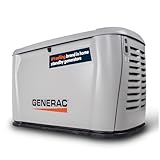

Quick comparison: which Generac class fits?
| Generac class | Typical best use | Fuel and installation notes | Transfer-switch consideration |
|---|---|---|---|
| PowerPact, approximately 7.5kW | Essential circuits in a small home or apartment-style property | Useful where the goal is refrigeration, lighting, internet, and a few outlets rather than whole-home operation | Usually paired with an appropriately sized essential-load panel |
| Guardian, 10kW–14kW | Small homes, cabins, and essential loads including one modest HVAC system | Air-cooled standby design; check local availability and whether the model supports natural gas, LP, or both | A 100-amp or smaller essential-load arrangement may be sufficient, depending on the electrical design |
| Guardian, 18kW–22kW | Typical three-bedroom homes with a refrigerator, sump pump, gas furnace, electronics, and one central air conditioner | A practical middle range for whole-home or nearly whole-home backup when major electric heating loads are excluded | Often makes sense with a 200-amp automatic transfer switch when the service and load calculation support it |
| Guardian, 24kW–26kW | Larger homes, multiple HVAC systems, well pumps, workshops, or more electric appliances | Higher capacity does not automatically solve every startup surge; load management may still be useful | Designed for larger service configurations, but the installer must match the switch, service rating, and local code requirements |
Generac model specifications, supported fuels, controller features, and transfer-switch bundles can vary by market and revision. Confirm the current installation manual and model number before purchasing.
Best Generac generator by home size and outage plan
Small home or essential circuits: PowerPact or 10kW–14kW Guardian
Choose this range if your priority is keeping the refrigerator, freezer, lights, Wi-Fi, security system, garage door, sump pump, and gas furnace operating. It is also appropriate when you are comfortable leaving electric water heaters, ovens, clothes dryers, and central air conditioning disconnected during an outage.
A smaller generator can be the most sensible choice when the electrical panel is crowded or the fuel supply is limited. An electrician can install an essential-load transfer setup that excludes circuits likely to overload the generator. This generally costs less than sizing a standby unit for every circuit in the house.
Average home: 18kW or 22kW Guardian
The 18kW–22kW range is often the best balance for a typical home using natural gas or propane appliances. It can support normal lighting, refrigeration, communications equipment, a gas furnace, a sump pump, and one central air-conditioning system—provided the air conditioner’s starting current and the home’s other simultaneous loads fit within the design.
These models are a better fit than a small essential-load generator if you want the convenience of leaving most household circuits active. However, “whole-house” does not mean unlimited simultaneous demand. An electric range, electric dryer, heat pump, water heater, and multiple air conditioners can exceed even a large residential standby generator.
Large home or high electrical demand: 24kW–26kW Guardian
Move into the 24kW–26kW class when the property has several HVAC systems, a large well pump, a workshop, medical equipment, an electric water heater, or a heat pump. These generators provide more operating headroom, but they still require a professional load calculation.
If the home uses electric resistance heat, a large pool heater, or an electric vehicle charger, ask about automatic load management rather than assuming the biggest air-cooled model can run everything. Generac-compatible load-management equipment can temporarily disconnect lower-priority loads when the generator is heavily loaded, then reconnect them as capacity becomes available.
Worked sizing example: why starting watts matter
Suppose an outage plan includes these approximate running loads:
- Refrigerator: 700 watts
- Gas furnace blower: 600 watts
- Sump pump: 900 watts
- Internet equipment, lights, and security: 500 watts
- Central air conditioner: 3,500 watts while running
The running total is about 6,200 watts. If the air conditioner and sump pump start at the same time, their startup surge could add several thousand watts for a brief period. A 10kW generator may operate the running load, but it could struggle with coincident motor starts. An 18kW model offers substantially more starting margin.
This is why a simple appliance-wattage total is not enough. Ask the HVAC and pump installers for the locked-rotor or startup information, often listed as LRA on equipment documentation. The generator installer can then determine whether the unit can start those motors directly or whether a soft starter or load-management module would improve reliability.
Natural gas versus liquid propane
Natural gas: best for long utility outages
Natural gas is convenient when the property already has a properly sized, reliable gas service. It does not require a storage tank refill, so runtime is effectively limited by the utility supply and the generator’s maintenance needs. That makes it attractive for multi-day outages.
The trade-off is that a generator may produce less power on natural gas than on propane. The exact output depends on the model, gas pressure, regulator, installation, altitude, and temperature. The gas line must also deliver enough flow while other appliances are operating. An undersized pipe can cause low pressure, shutdowns, or poor starting.
Liquid propane: best where gas service is unavailable
Propane works well for rural homes, cabins, and properties where natural-gas service is unreliable or unavailable. It can also provide a stable fuel reserve if the tank is filled before storm season.
Runtime depends on tank size, ambient temperature, generator load, and whether the tank is above-ground or underground. A 250-gallon tank does not provide 250 gallons of usable fuel: the tank is normally filled only to about 80 percent for expansion space. At a light household load, it may last for several days; at high continuous load, consumption rises sharply.
For planning, ask the dealer for the model’s propane consumption at 25 percent, 50 percent, and
Ready to decide? Our #1 pick for 2026 is the PowerPact, approximately 7.5kW.
Live price & availability on Amazon.