

- Top Pick: Govee Gaming Light for Monitor G1, RGBIC LED Backlight for 27-34 Inch PC
- Best Value: Govee Smart RGB LED Strip Lights 16.4ft, Work with Alexa, Google Assistant
- Premium Choice: MATICOD LED Lights for TV Led Backlight, 9.84ft RGB Led Strip Lights USB TV Lights Behind 32-43in, APP Remote Control Music Sync TV Led Light for Bedroom Gaming Home Décor
Affiliate disclosure: As an Amazon Associate we earn from qualifying purchases. This post contains affiliate links — if you buy through them we may earn a small commission at no extra cost to you. This never affects our recommendations.
As an Amazon Associate we earn from qualifying purchases at no extra cost to you.


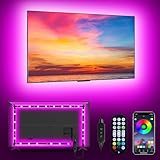

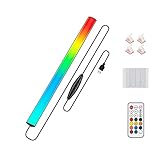


There is a reason pro streamers and esports arenas are bathed in colored light — it is not just for looks. Bias lighting, the practice of placing ambient light behind your monitor or desk, has a documented effect on eye strain. When your screen is the only bright object in a dark room, your pupils are constantly adjusting between the luminous display and the surrounding darkness. A soft backlight at roughly 10–15% of your monitor’s peak brightness bridges that contrast gap, reducing fatigue during long sessions. The payoff is dual: your eyes thank you after a four-hour raid, and your setup photographs like a magazine spread.
In 2026, RGB light strips have matured well beyond basic color wheels in a phone app. The best options now offer per-pixel addressable LEDs, real-time screen color capture, deep smart-home integration, and full synchronization with your PC’s RGB ecosystem. Whether you want TV bias lighting, a desk underglow, or full PC case sync, there is a strip built for the job. Below are the five best RGB light strips for a gaming setup this year, tested for color accuracy, app reliability, sync performance, and installation simplicity.
In a hurry? See the top-rated RGB Light Strip for Gaming Setup deals available right now:
🛒 Check Rgb Light Strip For Gaming Setup Prices on Amazon →🛒 Best Price Today on Amazon
Prime members get fast, free shipping on everything above, plus member-only deals. New members get a 30-day free trial — cancel anytime.
Start 30-Day Prime Free Trial →See Today’s Amazon DealsThe 5 Best RGB Light Strips for Gaming in 2026
1. Govee Gaming Light Strip G1
The Govee Gaming Light Strip G1 is the go-to choice for gamers who want strong ambient performance at an accessible price point. Spanning 6.56 feet with 66 individually addressable LEDs, the density works out to roughly 10 LEDs per foot — enough to produce smooth color gradients without visible banding when viewed in a dark room. Out of the box the strip ships with a 3M adhesive backing and a corner clip set, making desk-edge or monitor-back installation a clean, no-drill affair that takes under ten minutes.
Control runs through the Govee Home app, which is available on iOS and Android and supports both Bluetooth and Wi-Fi depending on the controller version. The app ships with dozens of preset scenes, a music-reactive mode that pulses to audio, and — the real headgear feature — Govee’s DreamView screen sync. Using a USB camera or the companion PC software, DreamView samples your display content in real time and maps those colors to the strip behind your monitor, producing a convincing ambilight clone at a fraction of the Philips price. The sync latency is around 50–80 ms, which is imperceptible in practice during gameplay.
The G1 also integrates with Alexa and Google Home for voice control, and Govee’s own ecosystem means pairing it with Govee smart bulbs or floor lamps creates a unified room-wide scene. Color accuracy is strong in the warm-to-neutral range, though deep blues and purples can trend slightly toward cyan on some units — a known quirk of the LED binning at this price tier.
Pros: Excellent density for the price, reliable screen sync, broad ecosystem, easy install
Cons: Blue-purple color accuracy could be tighter, Bluetooth range is limited without Wi-Fi controller
2. Philips Hue Play Gradient Lightstrip
If budget is secondary to quality, the Philips Hue Play Gradient Lightstrip is in a class of its own for TV and monitor bias lighting. Designed specifically as a TV backlight, it attaches directly to the back of your screen and uses a gradient diffuser to blend multiple simultaneous colors across its length — no abrupt zone transitions. The result is a smooth, cinema-quality ambilight effect that mirrors what is on screen in real time when paired with a Philips Hue Sync Box.
The LED count varies by size (the 55-inch model packs 59 LEDs), but the gradient architecture means each section can display an independent color without the blocky look you get from cheaper zone-based strips. Brightness peaks at 1,500 lumens on some configurations, making it visible even in a room with ambient daylight — something most competitor strips cannot claim. The Hue Sync app handles screen capture on PC and Mac, analyzes your content by screen region, and drives the corresponding strip segments with minimal latency.
Where the Philips Hue ecosystem earns its premium is in reliability and longevity. The Zigbee-based communication is rock solid, scenes save locally to the bridge so nothing breaks if your internet drops, and Hue’s Matter certification means full interoperability with Apple Home, Google Home, and Amazon Alexa simultaneously. Third-party integration for platforms like Home Assistant is equally mature. For a serious setup that doubles as home theater lighting, this is the most polished option available.

Pros: Gradient diffusion eliminates zone banding, premium build quality, best-in-class smart home integration, Matter certified
Cons: Expensive (~$130 plus Sync Box for full screen sync), requires Hue Bridge for full features
Check Price on Amazon
3. Corsair iCUE Lighting Node CORE
The Corsair iCUE Lighting Node CORE takes a fundamentally different approach: instead of ambient room lighting, it is built to synchronize the RGB on your PC’s internal components. The unit connects up to six addressable RGB fans via a single USB 2.0 header and is fully managed through Corsair’s iCUE software on Windows. If your build already uses Corsair peripherals — keyboard, mouse, headset, or RAM — the Lighting Node CORE ties them all into one choreographed light show with zero separate apps.
iCUE itself is one of the most feature-complete RGB management suites on the market. Hardware lighting layers, game integration triggers (your setup pulses red when you take damage in supported titles), ambient scene modes, and audio visualization are all built in. The software also supports hardware lighting profiles that store animations directly on the controller, so your fans keep their pattern even if iCUE is not running at startup. Per-LED control across each fan blade is supported, enabling spiral, radial, and wave animations that look significantly more polished than the standard zone-split of budget controllers.
The Lighting Node CORE is not a traditional strip in the desk or TV sense — it is a PC-internal controller. That said, for gamers whose primary aesthetic goal is a cohesive case build rather than room ambiance, nothing in this price range competes on ecosystem depth. Pair it with Corsair LL120 or QL120 fans and the results are genuinely striking through a tempered glass panel.
Pros: Best-in-class PC ecosystem sync, per-LED fan control, hardware profile storage, iCUE game integration
Cons: PC-internal only (not room ambient), requires Corsair fans for full effect, iCUE can be CPU-heavy
Check Price on Amazon
4. Govee Immersion TV Backlight T2
The Govee Immersion T2 is the most technologically ambitious entry on this list and arguably the best value for TV gamers specifically. Its key differentiator is a physical camera bar that mounts above or below your TV and captures the actual screen image at 30 fps, feeding real-time color data to the LED strip attached to the back of the TV. Unlike software-based sync solutions, the camera approach works with any content source — gaming consoles, Blu-ray players, streaming devices — because it reads the screen itself rather than a software hook.
The strip portion covers most TV sizes up to 65 inches and uses dual-row LEDs for increased brightness and color saturation. Govee segments the strip into independently controlled zones that the camera addresses individually, delivering a convincing surround-light effect where the left side of the screen mirrors the left edge colors and vice versa. In practice, the sync is accurate to within about one or two color zones’ worth of position, which is precise enough that you stop noticing the approximation within minutes of use.
Setup takes roughly 20–30 minutes and involves running the camera cable around the TV frame, but Govee’s clip system is tidier than it sounds. The Govee Home app manages scenes, camera sync sensitivity, and off-screen glow intensity. Music mode and manual scenes are available when a gaming console is off. At approximately $80, the T2 fills the gap between the budget G1 strip and the premium Philips Hue solution for console-first gaming households.

Pros: Camera sync works with any HDMI source including consoles, dual-row LEDs for higher brightness, no PC required
Cons: Camera cable routing can be fiddly, 30 fps capture has slight motion blur on fast scene cuts, limited to TV use
Check Price on Amazon
5. TP-Link Tapo L930-5
The TP-Link Tapo L930-5 is the dark horse of the lineup — a 16.4-foot multicolor segment strip that punches well above its ~$25 price tag. It supports 16 million colors across independently addressable segments, runs natively over Wi-Fi (no hub required), and is one of the first consumer RGB strips to ship with Matter certification out of the box. That last point is significant: Matter-compatible strips work seamlessly with Apple Home, Google Home, and Amazon Alexa simultaneously, future-proofing your investment as the smart home standard matures.
The Tapo app is clean and intuitive, offering gradient modes, music sync via the device microphone, and a scene library that covers the core gaming aesthetics — deep purple, neon cyan, pulsing red, and so on. The L930-5 model ships as a five-pack of shorter segments, giving you flexibility to run strips across multiple surfaces: monitor back, desk underside, shelf edge, and entertainment center simultaneously from a single controller. This modular approach is genuinely unique at this price point.
Color rendering is strong across the warm and mid spectrum; the brightness on the cool end does not quite match premium strips, but in a bias lighting context where you want the light softer than your screen, that is rarely a limitation. For first-time buyers building a gaming room aesthetic on a budget — or for anyone who wants the simplest possible Matter-compatible setup — the Tapo L930-5 is the easiest recommendation on this list.
Pros: Lowest price, Matter certified, modular 5-segment design, no hub needed, solid Tapo app
Cons: Lower peak brightness than premium options, music sync uses microphone (no camera or software grab), color accuracy drops slightly at cool temperatures
Check Price on Amazon
Comparison Table
| Strip | LEDs/Density | App | Sync Method |
|---|---|---|---|
| Govee Gaming Light Strip G1 | 66 LEDs / 6.56 ft | Govee Home | Camera/PC screen sync |
| Philips Hue Play Gradient | 59 LEDs / gradient | Hue Sync | PC/Mac screen sync + Sync Box |
| Corsair iCUE Lighting Node CORE | Per-fan LED control | iCUE (PC) | PC ecosystem / game triggers |
| Govee Immersion TV Backlight T2 | Dual-row zones | Govee Home | Camera bar (any HDMI source) |
| TP-Link Tapo L930-5 | 5 segments / 16.4 ft | Tapo | Mic-based music sync |
How to Choose the Best Gaming RGB Light Strip
Know your primary use case first. The single most important variable is where the light will live. A TV gaming setup calls for a different product than a PC desk build or a multi-surface room installation. The Govee T2 and Philips Hue Gradient are engineered for TV backs; the Corsair Lighting Node CORE belongs inside a PC case; the Govee G1 and Tapo L930-5 are versatile enough for desks, shelves, and monitor surrounds.
LED density matters more than total LED count. A 6-foot strip with 60 LEDs produces noticeably smoother gradients than a 10-foot strip with the same 60 LEDs spread thinner. For bias lighting directly behind a monitor, aim for at least 9–10 LEDs per foot. For room accent strips placed behind furniture or along ceiling coves, lower density is acceptable because the diffusion distance is greater.

Evaluate the sync ecosystem against your gear. If you are deep in the Corsair iCUE ecosystem, adding a non-Corsair strip creates a second app, second sync engine, and a fractured experience. Conversely, if you use a mix of brands for peripherals, a neutral option like the Tapo L930-5 or Govee Home ecosystem may unify your room better than a proprietary platform. Govee’s ecosystem in particular has the broadest cross-category coverage of any mid-market brand in 2026 — strips, bulbs, lamps, heaters, and fans all sync together in a single app.
Screen sync method determines compatibility. Software-based sync (Govee G1, Philips Hue Sync) requires a PC or laptop as the source device and typically works only with content displayed on that PC. Camera-based sync (Govee T2) works with any display and any source — PlayStation, Xbox, Nintendo Switch, Apple TV — making it the only real choice for console gaming households. If you split time between PC and console on the same TV, the T2 is the more versatile pick at the $80 tier.
Smart home and voice control are increasingly standard. Matter certification (Tapo L930-5, Philips Hue) is the emerging baseline for interoperability. If your home uses multiple voice assistants or platforms, prioritizing Matter support now saves compatibility headaches later. For simpler setups, Alexa and Google Home support — available across all five strips on this list — covers the day-to-day voice control use case adequately.
Installation adhesive quality varies significantly. Budget strips often ship with thin 3M tape that fails within weeks on warm surfaces near PC exhausts or above TVs. The Philips Hue Gradient ships with stronger adhesive and mounting clips. If you are installing any strip in a high-heat zone, supplement the factory adhesive with aftermarket 3M 300LSE tape for a permanent hold.
Final Verdict
For most PC gamers, the Govee Gaming Light Strip G1 hits the sweet spot: 66 high-density LEDs, real-time screen sync, Alexa and Google support, and a price under $30 that leaves room in the budget for better peripherals. It is the fastest way to make a gaming desk look intentional without a significant commitment.
If you game primarily on a TV and want the most accurate bias lighting available regardless of input source, the Govee Immersion T2 is the upgrade worth making at $80. The camera-based sync removes every compatibility limitation in one move.
For a setup where your monitor or TV is the centerpiece and budget is flexible, the Philips Hue Play Gradient Lightstrip delivers a product-quality experience that is visibly better than anything else in its category — smoother gradients, more stable connectivity, and an ecosystem that will still be thriving five years from now.
PC builders who want internal RGB cohesion above all else should look past ambient strips entirely and go directly to the Corsair iCUE Lighting Node CORE, which makes your fans, keyboard, mouse, and RAM speak the same language with no configuration friction.
And if you are just starting out — or equipping a secondary gaming room on a tight budget — the TP-Link Tapo L930-5 at ~$25 with Matter support is an absurdly good entry point that does not ask you to compromise much.
Whichever strip you choose, adding bias lighting is one of the highest-return upgrades in a gaming setup: inexpensive, reversible, and genuinely useful for your eyes during the sessions that go longer than planned.
Frequently Asked Questions
Where should I place RGB light strips in my setup?
Mount strips behind your monitor and desk for indirect bias lighting, which reduces eye strain and adds ambiance. Behind-monitor placement makes the screen pop without causing glare.
Do RGB light strips reduce eye strain?
Bias lighting behind your monitor lessens the harsh contrast between a bright screen and a dark room, which can reduce eye fatigue during long sessions. It is a genuine comfort benefit.
How do I sync RGB strips with my PC?
Choose strips compatible with your motherboard ecosystem or peripheral software, or use strips with a screen-sync feature that matches lighting to on-screen colors for an immersive effect.
Should I get USB or wall-powered RGB light strips?
USB strips turn on and off with your PC and stay tidy for desk setups. Wall-powered strips offer more length and brightness for full-room lighting. Pick based on your coverage needs.
Related Articles
Looking for more on this topic? Browse the hand-picked guides below — each one applies the same scoring rubric used in this review.






