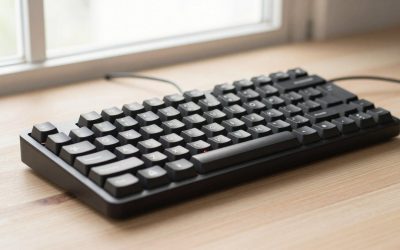
- Top Pick: Dacoity Gaming Keyboard, Full Size RGB Backlit Quiet Computer Keyboard, Wrist Rest, Silent Keys, Multimedia Keys, Anti-ghosting, Waterproof Light Up USB Wired Keyboard for PC Mac Xbox Gamer Office
- Best Value: TECKNET Wired Gaming Keyboard, RGB Backlit Keyboard with Metal Panel Design
- Premium Choice: HyperX Alloy Core RGB – Membrane Gaming Keyboard, Comfortable Quiet Silent Keys with RGB LED Lighting Effects, Spill Resistant, Dedicated Media Keys, Compatible with Windows 10/8.1/8/7 – Black
Affiliate disclosure: As an Amazon Associate we earn from qualifying purchases. This post contains affiliate links — if you buy through them we may earn a small commission at no extra cost to you. This never affects our recommendations.
As an Amazon Associate we earn from qualifying purchases at no extra cost to you.


Not everyone wants a compact keyboard. If you run spreadsheets during the day and grind ranked matches at night, a tenkeyless or 65% layout simply does not cut it. Financial analysts, data entry workers, programmers who live in the numpad, and simulation gamers who map controls to number keys all need that full-size 100% layout — and they deserve hardware that performs at a high level without compromise.
The 2026 market for full-size gaming keyboards is the strongest it has ever been. Mechanical switch technology has matured, wireless latency is now genuinely competitive with wired connections, and premium boards now ship with features previously reserved for enthusiast custom builds. At the same time, the budget tier has improved significantly, with Outemu and Gateron switches closing the gap on Cherry MX in both feel and longevity. Whether you are spending $50 or $250, there is a full-size gaming keyboard built for your use case. This guide covers the top five picks across every budget and use case, with hands-on notes on build quality, actuation feel, software, and long-term value.
In a hurry? See the top-rated Full-Size Gaming Keyboard deals available right now:
🛒 Check Full-Size Gaming Keyboard Prices on Amazon →🛒 Best Price Today on Amazon
Prime members get fast, free shipping on everything above, plus member-only deals. New members get a 30-day free trial — cancel anytime.
Start 30-Day Prime Free Trial →See Today’s Amazon DealsQuick Comparison Table
| Keyboard | Switch Type | Connectivity | Backlighting |
|---|---|---|---|
| SteelSeries Apex Pro | OmniPoint 2.0 (adjustable magnetic) | Wired USB-C | Per-key RGB |
| Corsair K100 RGB | Cherry MX Speed / Optical-Mech | Wired USB-C | Per-key RGB |
| Logitech G915 Lightspeed | GL Tactile / Clicky / Linear | 2.4GHz + Bluetooth | Per-key RGB |
| Keychron Q6 Pro | Gateron G Pro (hot-swap) | 2.4GHz + Bluetooth + USB-C | Per-key RGB |
| Redragon K580 Vata | Outemu Blue / Red / Brown | Wired USB | Per-key RGB |
Our Top Picks
1. SteelSeries Apex Pro — Best Overall
The SteelSeries Apex Pro remains the most technically advanced full-size gaming keyboard on the market in 2026. Its hallmark feature is the OmniPoint 2.0 magnetic actuation switch, which lets you dial in actuation distance anywhere from 0.1 mm to 4.0 mm — per key. That means you can set WASD to a hair-trigger 0.2 mm for faster inputs while keeping less-used keys at a deeper, more deliberate actuation to prevent misfires. No other mass-market keyboard offers this level of per-key customization.
Beyond the switches, the Apex Pro ships with a small OLED display on the top-right of the frame. It shows active profiles, Discord notifications, system stats, and custom GIFs — a small touch that feels genuinely useful rather than gimmicky. The aluminum alloy top frame is sturdy, the keycaps are double-shot PBT on the 2026 revision (an upgrade from the older ABS caps), and the braided USB-C cable is detachable.
RGB lighting is per-key with full GRB spectrum via SteelSeries GG software, which also handles macro programming, profile management, and actuation adjustment. The software is among the least intrusive in the gaming peripheral space.
Pros:
- Per-key adjustable actuation — genuinely game-changing for competitive play
- OLED display adds real utility
- Aluminum build with PBT keycaps on 2026 model
- Responsive and well-supported software ecosystem
Cons:
- Wired only — no wireless option
- Premium price (~$200) may not suit casual users
- OmniPoint switches are proprietary — no third-party swap options
Check Price on Amazon
2. Corsair K100 RGB — Best Premium
Corsair’s K100 RGB is the brand’s flagship full-size keyboard, and it earns that designation. The headline is the iCUE Control Wheel on the top-left corner — a physical aluminum dial that can be mapped to volume, media playback, backlight intensity, zoom level, or any custom macro. It is one of the most practical hardware controls added to a gaming keyboard in recent years, and once you have it, losing it feels like a regression.
The K100 ships in two switch configurations: Cherry MX Speed Silver (linear, 1.2 mm actuation, 45g) for the fastest possible inputs, or Corsair’s OPX optical-mechanical switch (1.0 mm actuation, light linear feel, rated for 150 million keystrokes). Both are excellent. The OPX variant is the better choice for gaming; the Cherry MX Speed is preferred by those who also type heavily.
Build quality is exceptional — the K100 has a thick aluminum plate, a no-flex chassis, and per-key RGB that is among the most vivid and accurate implementations available. iCUE software supports deep macro creation, lighting synchronization across Corsair devices, and hardware profile storage on the keyboard’s onboard memory.

The main drawback is the price. At ~$230, the K100 is the most expensive keyboard on this list. For users who are already invested in the Corsair iCUE ecosystem, it makes obvious sense. For everyone else, the SteelSeries Apex Pro offers more unique features at a lower price.
Pros:
- iCUE Control Wheel is practical and well-implemented
- Two excellent switch options (Cherry MX Speed / OPX optical)
- Premium aluminum build with outstanding RGB
- Extensive iCUE software integration
Cons:
- Most expensive option on this list
- iCUE software is resource-heavy
- No wireless connectivity
3. Logitech G915 Lightspeed — Best Wireless Full-Size
The Logitech G915 Lightspeed solves the one problem that held wireless gaming keyboards back for years: latency. Logitech’s proprietary LIGHTSPEED 2.4GHz wireless technology delivers a 1 ms report rate that is indistinguishable from a wired connection in practice. Combined with up to 30 hours of battery life (with RGB at 50% brightness) and Bluetooth for device switching, the G915 is the wireless full-size keyboard to beat in 2026.
The design is aggressively low-profile. Logitech’s GL switches — available in Tactile, Clicky, and Linear variants — use a compressed travel distance of 2.7 mm total, compared to the 4 mm standard of full-height MX switches. This makes the G915 feel different from most mechanical keyboards, closer to a laptop keyboard in terms of hand position. Gamers coming from membrane boards will adapt quickly; those accustomed to high-travel switches may need an adjustment period.
The aluminum alloy top frame keeps the board rigid, and the per-key RGB (called LIGHTSYNC) is vivid and supports Logitech G HUB software integration. G HUB is competent without being exceptional — it handles all the basics well and supports Logitech’s ecosystem of mice and headsets.
At ~$180, the G915 is not cheap, but it is the only full-size wireless option on this list that delivers both low-latency performance and a premium build.
Pros:
- LIGHTSPEED wireless with 1 ms report rate — genuinely lag-free
- 30-hour battery life is class-leading
- Dual-mode (2.4GHz + Bluetooth) for easy device switching
- Slim, clean design with solid aluminum frame
Cons:
- Low-profile GL switches are not for everyone
- No hot-swap support
- Battery life drops significantly with full RGB brightness

4. Keychron Q6 Pro — Best for Mechanical Enthusiasts
The Keychron Q6 Pro is the full-size answer for keyboard enthusiasts who want enthusiast-grade hardware without building from scratch. It ships with a gasket-mounted typing experience — the PCB and plate float on silicone gaskets rather than being screwed directly to the case, which absorbs vibration and produces a softer, more cushioned sound profile. Tap the keys and you immediately notice the difference from a standard plate-mounted board.
The Q6 Pro supports QMK and VIA firmware, meaning every key is fully remappable, including layers, macros, and tap-hold behaviors — no software required beyond a browser-based configurator. It ships with Gateron G Pro switches (available in Red, Brown, or Blue), and the PCB is hot-swappable with a 5-pin/3-pin compatible socket, so you can pull the stock switches and install any MX-compatible switch of your choice within minutes.
Connectivity is triple-mode: USB-C wired, 2.4GHz wireless dongle, and Bluetooth. Battery life is rated at 4,000 mAh — Keychron claims roughly 300 hours on Bluetooth without RGB, which is exceptional.
The typing experience on the Q6 Pro is the best on this list by a meaningful margin. The gasket mount, pre-lubed stabilizers, and south-facing RGB (which reduces shine-through inconsistency) combine to produce a keyboard that punches far above its price.
Pros:
- Gasket mount delivers superior sound and feel
- QMK/VIA support — fully open firmware, no proprietary software
- Hot-swap PCB — change switches without soldering
- Triple-mode wireless with enormous battery capacity
Cons:
- Heavier than most keyboards (about 1.5 kg with aluminum case)
- No dedicated media keys — function layer required
- Stock switches are decent, not exceptional — budget for aftermarket switches for best results
5. Redragon K580 Vata — Best Budget
At under $60, the Redragon K580 Vata does not compete with the keyboards above on build quality or switch feel. What it does is offer a full-size gaming keyboard with per-key RGB, dedicated macro keys along the left column, a volume roller, and media controls — features that many boards at twice the price omit — for a price that is genuinely accessible.
The K580 uses Outemu switches, which are Cherry MX-compatible clones available in Blue (clicky), Red (linear), and Brown (tactile). Outemu switches are not premium, but they are consistent and rated for 50 million keystrokes. The Blue variant has a satisfying click; the Red is smooth enough for gaming. The ABS keycaps show shine faster than PBT alternatives, which is the most visible long-term compromise at this price.
The chassis is plastic but feels solid for the category. RGB lighting covers all keys and is configurable through Redragon’s software (or via onboard controls without software). The six dedicated macro keys on the left side are a genuine bonus for MMO players or productivity users who benefit from extra programmable inputs.
The K580 is not the keyboard to buy if you can stretch to $100 or more. But for first-time mechanical keyboard buyers, students, or users who want a numpad without a large investment, it delivers strong value.

Pros:
- Exceptional value — full RGB, macro keys, numpad under $60
- Six dedicated macro keys along the left column
- Cherry MX-compatible switches — easy to replace if desired
- Volume roller and media controls included
Cons:
- ABS keycaps wear and shine over time
- Plastic chassis lacks premium feel
- Outemu switches are functional but not refined
- Software is basic compared to premium alternatives
How to Choose a Full-Size Gaming Keyboard
Switch Type: Linear, Tactile, or Clicky
Switches are the most personal choice in keyboard buying. Linear switches (Red, Speed Silver, GL Linear) move straight down with no tactile bump — fast and quiet, preferred by most competitive gamers. Tactile switches (Brown, G Pro Brown, GL Tactile) have a bump mid-travel that confirms actuation without an audible click — a good balance for mixed gaming and typing. Clicky switches (Blue, GL Clicky) produce an audible click at actuation — satisfying for typing, potentially disruptive in shared spaces. If you are new to mechanical keyboards, start with a tactile switch and adjust from there.
Wired vs. Wireless
Wireless gaming keyboards have closed the latency gap significantly. Logitech LIGHTSPEED and similar 2.4GHz technologies now operate at or below 1 ms report rates, which are imperceptible in competitive play. Bluetooth adds flexibility for multi-device use but typically runs at a higher latency (around 7 ms) — acceptable for casual play, not ideal for ranked competitive gaming. Wired keyboards remain the simplest and most reliable choice; wireless is worthwhile if cable management is a priority or you frequently switch between devices.
Build Quality: Aluminum vs. Plastic
Aluminum-framed keyboards (Apex Pro, K100, G915, Q6 Pro) resist flex, dampen vibration, and last longer. They are also heavier — a consideration if you travel with your keyboard. Plastic frames (K580 and most budget boards) are lighter and cheaper but show wear faster. For a keyboard you plan to use daily for several years, spending the extra amount on an aluminum frame is worthwhile. For a secondary setup or a first keyboard, plastic is acceptable.
Software and Firmware
Most gaming keyboards rely on proprietary software for RGB customization, macro programming, and profile switching. Quality varies significantly: SteelSeries GG and Logitech G HUB are among the most polished, Corsair iCUE is powerful but heavy on system resources, and Redragon’s software is basic but functional. The outlier is the Keychron Q6 Pro, which uses QMK/VIA open-source firmware — no software download required, everything configurable in a browser, and full community support for custom layouts and macros.
Final Verdict
For most gamers who need a full-size keyboard, the SteelSeries Apex Pro is the best all-around choice in 2026. The adjustable actuation switches are a genuine competitive advantage, the OLED display adds real utility, and the 2026 revision corrects the ABS keycap issue with double-shot PBT. It hits the sweet spot between premium build quality and unique features that actually affect gameplay.
If wireless is non-negotiable, the Logitech G915 Lightspeed is the clear winner — its LIGHTSPEED 2.4GHz connection is the most reliable wireless implementation available, and the 30-hour battery makes it genuinely portable. Enthusiasts who want the best typing experience and complete firmware control should look at the Keychron Q6 Pro, which delivers gasket-mount sound and feel alongside QMK/VIA flexibility. Budget buyers who need a full numpad without breaking $60 will find the Redragon K580 Vata gets the job done.
The Corsair K100 is for Corsair ecosystem users who want the best the brand offers — the iCUE Control Wheel is one of the most practical hardware additions to a gaming keyboard in recent years, and the OPX switch option is excellent for fast-paced gaming.
Frequently Asked Questions
Q: Is a full-size keyboard better for gaming than a tenkeyless or 65% layout?
Full-size keyboards are not inherently better for gaming — the advantage is the numpad, which is irrelevant for most game genres. Tenkeyless and smaller layouts let you position your mouse closer to the center of your desk, which can reduce shoulder strain during long sessions. Choose full-size if you actively use the numpad for work, simulation games, or productivity, not simply because you assume bigger is better.
Q: Do all the keyboards on this list support Windows and macOS?
All five keyboards on this list are compatible with Windows at full feature support. The Logitech G915 and Keychron Q6 Pro include macOS key legends and work with macOS natively; the Q6 Pro additionally ships with a Mac layout keycap set. The SteelSeries Apex Pro and Corsair K100 function on macOS but their companion software (SteelSeries GG and Corsair iCUE) is Windows-primary — RGB and macros still work, but some features may be limited on macOS.
Q: How important is polling rate for a gaming keyboard?
Most gaming keyboards today report at 1,000 Hz (1 ms), which is the standard that virtually all competitive games benefit from. Some keyboards now offer 2,000 Hz or 8,000 Hz modes (including the Apex Pro), but the practical difference above 1,000 Hz is negligible for keyboard inputs — unlike mice, where higher polling rates can improve cursor precision. For full-size keyboard buyers, 1,000 Hz is more than sufficient; do not pay a premium specifically for higher polling rates.
Related Articles
Looking for more on this topic? Browse the hand-picked guides below — each one applies the same scoring rubric used in this review.