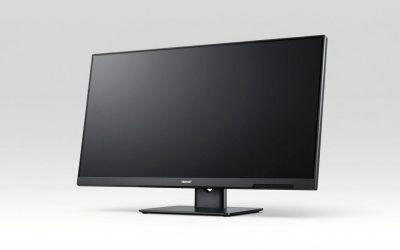
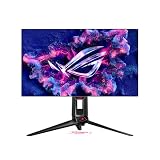
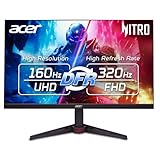
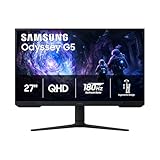
- Top Pick: ASUS TUF Gaming 27" 2K HDR Gaming Monitor (VG27AQ) – QHD (2560 x 1440), 165Hz (Supports 144Hz), 1ms, Extreme Low Motion Blur, Speaker, G-SYNC Compatible, VESA Mountable, DisplayPort, HDMI,Black
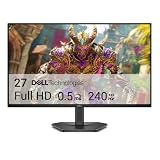
- Best Value: Dell 27 240Hz Gaming Monitor – SE2726HG – 27-inch FHD (1920×1080) 240Hz Display, in-Plane Switching (IPS) Technology, AMD FreeSync Premium, TÜV 3-Star, 2X HDMI, DisplayPort 1.4, Tilt
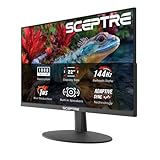
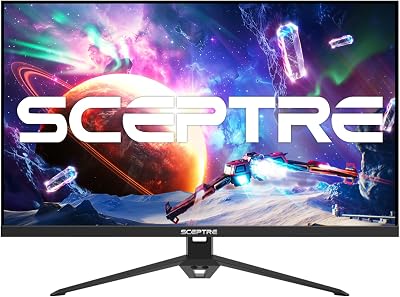
- Premium Choice: Sceptre 27-inch FHD 1080p IPS Gaming LED Monitor up to 165Hz 144Hz 1ms DisplayPort HDMI, FreeSync FPS RTS Build-in Speakers Gunmetal Black 2022 (E275B-FPT165)
Affiliate disclosure: As an Amazon Associate we earn from qualifying purchases. This post contains affiliate links — if you buy through them we may earn a small commission at no extra cost to you. This never affects our recommendations.
As an Amazon Associate we earn from qualifying purchases at no extra cost to you.



The 27-inch 1440p 165Hz sweet spot has never been more competitive. Whether you’re pushing frames in fast-paced shooters, grinding ranked in MOBAs, or doing creative work between sessions, a monitor that delivers both speed and color fidelity is no longer a luxury — it’s the baseline expectation in 2026. IPS panels have matured dramatically, closing the gap with OLED in color accuracy while remaining far more accessible in price. This guide cuts through the noise and ranks the five best options on the market right now, followed by a buyer’s guide to help you make the right call for your setup.
In a hurry? See the top-rated 27-Inch 165Hz IPS Gaming Monitor deals available right now:
🛒 Check 27-Inch 165Hz Ips Gaming Monitor Prices on Amazon →🛒 Best Price Today on Amazon
Prime members get fast, free shipping on everything above, plus member-only deals. New members get a 30-day free trial — cancel anytime.
Start 30-Day Prime Free Trial →See Today’s Amazon DealsQuick Comparison Table
| Monitor | Panel | Resolution | Refresh Rate | Response Time | HDR |
|---|---|---|---|---|---|
| LG 27GP850-B | Nano IPS | 2560×1440 | 165Hz | 1ms GtG | HDR400 |
| ASUS TUF VG27AQL1A | IPS | 2560×1440 | 170Hz | 1ms | HDR400 |
| Dell S2722DGM | VA | 2560×1440 | 165Hz | 1ms MPRT | HDR400 |
| BenQ MOBIUZ EX2710Q | IPS | 2560×1440 | 165Hz | 1ms GtG | HDRi |
| MSI MAG274QRF-QD | Quantum Dot IPS | 2560×1440 | 165Hz | 1ms | HDR400 |
Our Top Picks
1. LG 27GP850-B — Best Overall
The LG 27GP850-B sits at the top of this list for a straightforward reason: it gets almost everything right without asking you to pay a premium for it. Built on LG’s Nano IPS technology, it achieves 98% DCI-P3 color coverage — a number that rivals panels costing twice as much. Paired with a 165Hz refresh rate and a verified 1ms GtG response time, it handles both competitive gaming and content consumption with equal confidence.
Nano IPS adds a layer of wide-color-gamut performance by coating the IPS backplane with nano-sized particles that filter out excess light wavelengths. The result is punchier reds and richer greens compared to standard IPS — noticeably better when watching HDR content or playing visually rich open-world games. G-Sync Compatible and FreeSync Premium certifications mean it works cleanly with both AMD and NVIDIA cards, eliminating screen tearing without manual configuration.
At around $279, this is the benchmark every other monitor at this price tier is measured against.
Pros
- 98% DCI-P3 color coverage via Nano IPS
- Dual sync: G-Sync Compatible + FreeSync Premium
- Consistent 1ms GtG across the panel
- Competitive price for the feature set
Cons
- HDR400 certification is functional, not transformative
- IPS glow visible on dark scenes in dim rooms
- Stand has limited ergonomic adjustability
2. ASUS TUF VG27AQL1A — Best for Competitive Gamers
ASUS pushes the refresh rate to 170Hz here — a modest bump over 165Hz, but one that signals ASUS binned better panels for this unit. More meaningfully, the VG27AQL1A includes ELMB Sync (Extreme Low Motion Blur), which activates backlight strobing simultaneously with adaptive sync. On most monitors, you have to choose one or the other. Here, you get both, resulting in exceptionally sharp motion clarity during fast panning sequences in shooters and racing games.

The HDR400 implementation is solid, and the IPS panel covers 130% sRGB and 90% DCI-P3 — not quite at the LG’s Nano IPS level, but strong enough for hybrid use between gaming and photo editing. Build quality is TUF-grade robust, with a sturdy stand offering full height, tilt, swivel, and pivot adjustments. If you prioritize motion clarity and ergonomics over peak color volume, this is your pick.
Pros
- 170Hz native refresh rate
- ELMB Sync enables strobing + adaptive sync simultaneously
- Excellent build quality and ergonomic stand
- Strong 130% sRGB color coverage
Cons
- DCI-P3 coverage slightly below the LG Nano IPS
- Priced slightly higher at ~$299
- No built-in speakers
3. Dell S2722DGM — Best Value Pick
Dell S2722DGM
The Dell S2722DGM is the outlier on this list — it uses a VA panel, not IPS. That distinction matters, but less than you might expect at this price. VA panels deliver significantly higher native contrast ratios (typically 3000:1 versus IPS’s 1000:1), which translates to deeper blacks and a more cinematic look in dark game environments. For horror games, space sims, or any title with heavy shadow detail, VA holds a genuine advantage.
Dell’s VA implementation here competes well against mid-range IPS in motion handling, with a 1ms MPRT response time. Color accuracy is competent at 99% sRGB, though DCI-P3 coverage falls short of the Nano IPS options. At $249, it undercuts the competition significantly and comes backed by Dell’s reliable build quality and warranty support. If budget is a constraint and you play more story-driven or cinematic games than twitch shooters, this represents exceptional value.
Pros
- Best native contrast ratio in this group (~3000:1)
- Lowest price at ~$249
- 99% sRGB color accuracy
- Dell build quality and after-sales support
Cons
- VA panel: slight motion smearing in very dark scenes
- Lower DCI-P3 coverage than IPS/Nano IPS alternatives
- Color accuracy not suited for professional photo editing
4. BenQ MOBIUZ EX2710Q — Best for Immersive Single-Player Gaming
BenQ MOBIUZ EX2710Q
BenQ takes a different approach with the EX2710Q: instead of competing purely on specs, they bundle a holistic gaming experience. The IPS panel delivers solid 165Hz and 1ms GtG performance, but what sets this monitor apart is BenQ’s HDRi technology and the integrated treVolo speakers.
HDRi uses a built-in light sensor to dynamically adjust HDR tone mapping based on the ambient light in your room. It sounds gimmicky, but in practice it noticeably reduces eye fatigue during long sessions and maintains image consistency as your room lighting changes throughout the day. The treVolo speakers aren’t audiophile-grade, but they’re stereo, they’re clear, and they’re far better than the tinny mono drivers found in most monitors at this price. For a desk setup where you want a clean, minimal build without external speakers, this is a meaningful differentiator.
Color coverage hits 95% DCI-P3, and the IPS panel handles accurate grays and skin tones well for general use. At $329, it’s the most expensive option here, but the extras justify the premium for the right buyer.
Pros
- HDRi adaptive tone mapping reduces eye fatigue
- Integrated treVolo stereo speakers (genuinely usable)
- 95% DCI-P3 color coverage
- Refined, premium build aesthetic
Cons
- Highest price in this roundup at ~$329
- HDRi value depends heavily on use case
- No ELMB or motion blur reduction feature
5. MSI MAG274QRF-QD — Best Color Volume
MSI’s Quantum Dot IPS panel is the most technically impressive display in this lineup from a pure color science perspective. Quantum Dot technology enhances IPS color output by converting backlight photons into more precisely tuned red, green, and blue wavelengths — achieving wider color gamut coverage than standard IPS and even Nano IPS in some metrics. The MAG274QRF-QD hits 95% DCI-P3 with exceptional color volume, meaning colors stay saturated and accurate not just at peak brightness but across a wide luminance range.
For creators who game — or gamers who do video editing, digital art, or photo work on the side — this panel’s accuracy profile makes it the most versatile all-rounder on the list. The 165Hz refresh and 1ms response time keep it competitive, and HDR400 certification is consistent with the rest of this tier. MSI’s OSD and software tools are well-developed, offering granular control over color profiles and gaming presets.
Pros
- Quantum Dot IPS: widest color gamut in this group
- Excellent color volume across luminance range
- Strong feature set for hybrid gaming/creative use
- Comprehensive OSD and software controls
Cons
- Quantum Dot can add a slight yellow tint in some modes requiring calibration
- Build quality slightly behind ASUS TUF and Dell
- HDR400 is the same ceiling as competitors
How to Choose the Best 27-Inch 165Hz IPS Gaming Monitor
Why 27-Inch 1440p is the Gaming Sweet Spot
The combination of a 27-inch screen and 2560×1440 resolution hits a pixel density of approximately 109 PPI — high enough for sharp, detailed imagery without requiring GPU-intensive supersampling. At standard desk distances (60–80cm), you gain meaningful screen real estate over 1080p without the computational overhead of 4K. Modern mid-range GPUs like the RTX 4070 and RX 7700 XT push 1440p at 165Hz comfortably in most titles, making this resolution tier the most accessible high-performance option in 2026. Productivity benefits are real too: the extra vertical resolution makes coding, spreadsheet work, and browser tabs noticeably more usable than 1080p.
IPS vs VA vs Quantum Dot Panels
IPS (In-Plane Switching) panels dominate this roundup for good reason: they offer wide viewing angles (~178° horizontal and vertical), accurate color reproduction, and fast pixel response times. The trade-off is a lower native contrast ratio (typically 800:1 to 1200:1) compared to VA.
VA (Vertical Alignment) panels invert that trade-off — higher contrast (2500:1 to 4000:1) for richer blacks, at the cost of narrower viewing angles and historically slower response times. Modern VA panels have closed the gap significantly, and the Dell S2722DGM demonstrates that a well-tuned VA can match IPS in motion performance.
Quantum Dot is not a panel type but a backlight enhancement applied to IPS. It pushes the color gamut wider without the panel technology trade-offs of OLED, and it does so at IPS price points. If color volume and wide-gamut accuracy are priorities, Quantum Dot IPS is the tier to target.
165Hz vs 144Hz: Is the Difference Noticeable?
Yes — but subtly. The jump from 60Hz to 144Hz is dramatic and immediately perceptible. The step from 144Hz to 165Hz is smaller but real, representing approximately a 14% increase in frames rendered per second. In practice, this manifests as marginally smoother cursor tracking and slightly reduced perceived input lag at the top end of frame rates. Competitive FPS players who regularly sustain 150+ FPS will notice the difference. Casual players spending most of their time below 100 FPS will not. The good news: virtually all 165Hz monitors are backward-compatible, running at 144Hz or 60Hz when the GPU can’t keep up.
Color Accuracy for Both Gaming and Creative Work
If your monitor serves double duty — gaming in the evening, photo editing or video work during the day — color accuracy becomes a non-negotiable spec. Look for DCI-P3 coverage above 90% and a factory calibration report if available. Delta E values below 2 indicate colors imperceptible to the human eye from their target values; below 1 is professional grade. The LG 27GP850-B and MSI MAG274QRF-QD both deliver near-professional color accuracy out of the box. For pure gaming without creative work demands, sRGB coverage above 125% is sufficient.
G-Sync Compatible vs FreeSync Premium
Both technologies synchronize the monitor’s refresh rate to the GPU’s output frame rate, eliminating tearing and reducing stutter. NVIDIA’s G-Sync Compatible certification means NVIDIA has validated the monitor for flicker-free adaptive sync — any G-Sync Compatible monitor works cleanly with RTX cards. FreeSync Premium requires a minimum 120Hz refresh rate at the native resolution and mandates low framerate compensation (LFC), which prevents judder when frame rates drop below the monitor’s minimum sync range. Most monitors in this roundup carry both certifications, making them GPU-agnostic. If you’re on an NVIDIA card, prioritize G-Sync Compatible. On AMD, FreeSync Premium. With both certified, your decision simplifies to the panel and price.
Final Verdict
For most buyers, the LG 27GP850-B is the answer. It delivers Nano IPS color fidelity, verified 1ms GtG speed, dual adaptive sync support, and a competitive price — all without a significant compromise anywhere in the spec sheet.
If motion clarity in competitive play is your primary concern, the ASUS TUF VG27AQL1A and its ELMB Sync feature earns the upgrade cost. For maximum color volume and creative-use versatility, the MSI MAG274QRF-QD is the Quantum Dot pick. Budget-conscious buyers who favor cinematic games over twitch shooters will find the Dell S2722DGM a surprisingly capable VA alternative at $249. And if you want a self-contained desk setup with speakers you’ll actually use, the BenQ MOBIUZ EX2710Q justifies its premium with genuine quality-of-life additions.
All five monitors represent the best the 27-inch 165Hz IPS tier has to offer in 2026. Pick the one that aligns with how you actually use your setup — and stop second-guessing your purchase.
Related Articles
Looking for more on this topic? Browse the hand-picked guides below — each one applies the same scoring rubric used in this review.
Frequently Asked Questions
What is the best gaming monitor 27 165hz ips in 2026?
The best gaming monitor 27 165hz ips depends on your budget and how you plan to use it. The options compared above are our top-rated picks based on real customer ratings, build quality, and overall value — start with the highest-rated model that fits your budget.
How much should I expect to spend on a gaming monitor 27 165hz ips?
Prices vary by brand and features. Budget options cover the essentials, while mid-range and premium models add durability, performance, and extra features. Compare the prices in the list above to find the best value for your needs.
What should I look for when buying a gaming monitor 27 165hz ips?
Focus on what matters most for your use case — build quality, compatibility, performance, warranty, and verified customer reviews. Every pick above is selected to balance these factors.
Are budget gaming monitor 27 165hz ips options worth it?
Yes. For most people a well-reviewed budget or mid-range gaming monitor 27 165hz ips delivers excellent value. You only need to spend more if you specifically require premium materials or top-tier performance.
How did we choose these gaming monitor 27 165hz ips picks?
We compare current Amazon ratings, review counts, key features, and price to surface the options with the best real-world value. The list is refreshed as ratings and availability change.