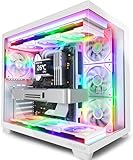
- Top Pick: MUSETEX Y6 PC Case, Pre-Installed 7 Infinity Mirror PWM ARGB Fans, ATX Mid Tower Computer Case, Gaming PC Case with Type-C, 270° Full View Tempered Glass, White
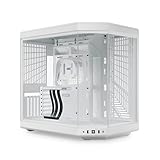
- Best Value: HYTE Y70 Touch Infinite Modern Aesthetic Gaming PC Case – Integrated 2.5K LCD Touchscreen Screen Display – Dual Chamber ATX Desktop Chassis – 10 Fan Capacity – Luxury PCIe 4.0 Riser Cable – Snow White
- Premium Choice: HYXN H1 HYXN ATX PC Case – Pre-Installed with 7 PWM ARGB Fans – Dual Cavity Mid-Tower PC Gaming Case – with Type-C – Can Hold up to 3X 360mm Radiator Support simultaneously (White, H1)
Affiliate disclosure: As an Amazon Associate we earn from qualifying purchases. This post contains affiliate links — if you buy through them we may earn a small commission at no extra cost to you. This never affects our recommendations.
As an Amazon Associate we earn from qualifying purchases at no extra cost to you.


White builds have taken over the gaming aesthetic conversation, and for good reason. Clean white cases paired with white motherboards, GPU shrouds, and RGB lighting create a look that feels premium, futuristic, and distinctly intentional — the kind of setup that stops a room cold. But white cases come with trade-offs that black builds don’t: dust shows faster, cheaper plastics yellow within a year, and not every white case is actually built for the thermals a serious gaming rig demands.
We’ve tested and researched the top contenders on the market in 2026, cutting through the noise to bring you five white gaming PC cases that deliver on both aesthetics and real-world performance. Whether you’re pushing a high-end RTX 5090 build or putting together a mid-range showpiece, there’s a pick here that fits your budget and your build goals. Here’s what actually holds up.
In a hurry? See the top-rated White Gaming PC Case deals available right now:
🛒 Check White Gaming Pc Case Prices on Amazon →🛒 Best Price Today on Amazon
Prime members get fast, free shipping on everything above, plus member-only deals. New members get a 30-day free trial — cancel anytime.
Start 30-Day Prime Free Trial →See Today’s Amazon DealsThe 5 Best White Gaming PC Cases in 2026
Lian Li Lancool 216 White
Specs at a Glance: ATX Mid-Tower | 2x 160mm PWM Fans Included | Up to 420mm GPU Clearance | Dual Front Mesh Panel | ~$100–$110
The Lancool 216 White is the airflow benchmark in this price range, and it earns that title without any asterisks. Lian Li ships it with two 160mm PWM fans up front — a spec you almost never see outside of premium builds — and the mesh front panel is genuinely open, not decorative. Real-world temperatures with a mid-to-high-end GPU stay impressively controlled even under sustained load, and the dual-chamber layout keeps PSU heat isolated from your main components.
Build quality is where Lian Li consistently separates itself from the competition. The steel is noticeably thicker than similarly priced rivals, the tempered glass side panel has satisfying magnetic closure, and the white finish itself is a true opaque white with a slight matte quality that resists fingerprints far better than glossy alternatives. It doesn’t feel like a painted black case — it was clearly designed from the ground up in this colorway.
Cable management is exceptional for the price. The rear chamber is deep enough for thick braided cables, rubber grommets are positioned sensibly, and the modular drive cage system lets you reconfigure storage placement to maintain airflow lanes. Velcro straps are pre-installed, which is a small touch that builders will appreciate on a deadline.
On the dust and yellowing front: Lian Li uses UV-stabilized plastics on the front panel and interior accents, which meaningfully extends the life of that white finish. Magnetic dust filters cover every intake. This is not a case that will look embarrassing two years from now.
Pros: Industry-leading airflow for the price, thick steel construction, excellent cable management, UV-stable white finish
Cons: Slightly industrial look won’t suit builders going for a soft aesthetic, top panel ventilation could be more open
NZXT H7 Flow White
Specs at a Glance: ATX Mid-Tower | 2x 140mm Fans Included | Up to 400mm GPU Clearance | Perforated Mesh Front & Top | ~$130–$150
NZXT built its reputation on clean, photographer-friendly aesthetics, and the H7 Flow White is arguably the prettiest case on this list. The perforated mesh front panel has a fine pattern that reads as almost solid white from a distance while still allowing substantial airflow — a clever visual balance that other brands haven’t quite matched. The interior is stark white with hidden cable routing channels that make the build look effortless even before you turn it on.
Airflow performance is a meaningful step up from the older H510 that NZXT used to push in this space. The dual 140mm fans move more air than typical 120mm setups, and the mesh top panel creates a strong exhaust pathway for heat. For most mid-to-high-end builds running a modern GPU in the 250–350W TDP range, thermals will be competitive. Where very high-end 400W+ GPUs and overclocked processors are concerned, you’ll want to add a third fan — the H7 Flow has the mounting points for it.

The H7 Flow’s cable management system is NZXT’s best work. A dedicated cable bar on the rear of the motherboard tray keeps everything bundled tightly, and the included velcro straps are color-matched to white. The PSU shroud is integrated and covers all power connectors cleanly. It’s the kind of case where the interior looks as good as the exterior — which matters if you have a glass panel.
One honest note: NZXT’s white plastic accents on the I/O cluster have a slightly different sheen than the steel panels. It’s not jarring, but in direct sunlight you’ll notice the mismatch. Also, white cases in general collect fine gray dust on interior surfaces noticeably faster than dark cases — NZXT’s magnetic top filter helps, but plan to blow it out every 4–6 weeks.
Pros: Best-looking case on the list, excellent integrated cable management, good airflow for mid-to-high builds, strong brand support
Cons: Premium price, minor plastic/steel color mismatch, needs extra fan for very high-end GPU builds
Check Price on Amazon
Corsair 4000D Airflow White
Specs at a Glance: ATX Mid-Tower | 2x 120mm Fans Included | Up to 360mm GPU Clearance | Mesh Front Panel | ~$95–$105
The Corsair 4000D Airflow White is the case to recommend when someone wants a solid, no-drama white build without spending over $100. Corsair’s mesh front panel on the Airflow variant is legitimately open — the company learned from the negative reception to the original 4000D’s tempered glass front — and the included 120mm fans are adequate for a typical gaming build. More importantly, the case is designed to accept up to six fans total, so scaling up as your components demand it is straightforward.
Tool-free installation is a genuine selling point here. The motherboard standoffs are pre-installed for ATX, Micro-ATX, and Mini-ITX, the drive mounts are screwless, and the PCIe expansion slot covers use thumb screws. First-time builders will appreciate the reduced friction. Corsair also includes a removable front panel filter and a top mesh filter, both of which pull out without tools for cleaning — something you’ll do more often with a white interior.
Build quality is honest for the price. The steel is slightly thinner than what Lian Li offers, and some of the internal plastic brackets have a budget feel, but nothing wobbles or flexes in a way that affects actual use. The white exterior paint holds up well to handling, and Corsair’s finish has proven consistent across production runs — you’re unlikely to get a case with visible paint inconsistencies.
The 4000D Airflow White’s one meaningful limitation is GPU length: 360mm maximum clearance keeps it compatible with most consumer cards, but if you’re planning to run an oversized flagship GPU, double-check your specific card’s dimensions. For mainstream RTX 4070 or RX 7800-class builds, it’s a non-issue.
Pros: Best value on the list, tool-free installation, strong fan expansion headroom, reliable Corsair build quality
Cons: Thinner steel than premium options, 360mm GPU limit worth checking, 120mm fans less impressive than 140mm alternatives
Fractal Design Pop Air White
Specs at a Glance: ATX Mid-Tower | 2x 140mm Fans Included | Up to 467mm GPU Clearance | Mesh Front Panel | ~$90–$100

Fractal Design’s Pop Air White has the brightest, most saturated white interior of any case on this list — and that’s a deliberate design choice. The company painted the interior panels, PSU shroud, and fan brackets in a warm bright white that photographs exceptionally well under RGB lighting. If the visual impact of a white build is your primary motivation, the Pop Air White delivers the most dramatic effect.
Performance follows the aesthetics. The two included 140mm fans push meaningful volume, and the mesh front panel provides unobstructed intake across its full surface area. GPU clearance is a standout at 467mm — you can run even the longest enthusiast-class cards without concern. The interior layout is spacious with a large PSU shroud that hides power cables entirely, and a removable HDD cage gives you flexibility to configure storage or open up airflow lanes.
Fractal’s build quality is typically thoughtful and the Pop Air is no exception. Panel gaps are tight, the tempered glass panel has a secure locking mechanism rather than just friction clips, and the I/O port placement on the top front edge is ergonomically sensible. One note: Fractal chose a slightly textured matte finish for the exterior steel that resists smudges well but reads as very slightly off-white compared to the interior. It’s a subtle difference and won’t bother most buyers, but worth knowing.
The honest caveat for white cases applies doubly here: that bright interior is gorgeous when clean and noticeably less so when dusty. Fractal includes dust filters on the front and top, but the Pop Air White rewards builders who maintain a clean environment and schedule regular interior wipe-downs.
Pros: Largest GPU clearance on the list, brightest white interior, excellent value, solid 140mm fans included
Cons: Exterior finish slightly different tone from interior, dust visibility high in bright-white interior, fewer cable management aids than NZXT
Phanteks Eclipse G360A White
Specs at a Glance: ATX Mid-Tower | 3x 120mm ARGB Fans Included | Up to 420mm GPU Clearance | Tempered Glass Side Panel | ~$85–$95
The Phanteks Eclipse G360A White punches well above its price point — the fact that it arrives with three 120mm ARGB fans already installed makes the under-$90 retail price feel almost too good. Those fans connect to a built-in ARGB controller with a front-panel button, meaning you can cycle through lighting effects without any additional software or motherboard headers. For a budget RGB white build, this is the easiest path to a lit-up interior that’s genuinely attractive from outside the case.
Airflow with three 120mm fans configured as intake is competitive with two 140mm setups from more expensive cases — the math on cumulative CFM works out reasonably well, and the mesh front panel (covering most of the front face) keeps intake resistance low. The tempered glass side panel is full-length and lightly tinted, which lets the ARGB lighting pop while giving the white interior a slightly warm, premium feel.
Build experience is positive overall. The modular interior accommodates up to 360mm radiators in the front, so this case is equally viable as a watercooling base as an air-cooled build. Cable management channels are present and functional, though not as refined as Corsair or NZXT’s implementations — you’ll want to take your time routing cables cleanly. The steel construction is adequate for the price tier without being a weak point.
Where the G360A White earns its strongest recommendation is for builders working with a strict budget who don’t want to sacrifice visual impact. Three ARGB fans, a full tempered glass panel, and an opaque white exterior at $85–90 is a legitimate value proposition. Builders planning to upgrade later can also mix in Phanteks’ own ARGB fans for a consistent ecosystem.
Pros: Three ARGB fans included, built-in lighting controller, 360mm radiator support, strong value under $95
Cons: Cable management less polished than premium options, steel slightly thinner at this price, ARGB controller limited compared to software-based systems

Check Price on Amazon
Comparison Table
| Case | Form Factor | Fans Included | GPU Clearance | Price (approx.) |
|---|---|---|---|---|
| Lian Li Lancool 216 White | ATX Mid-Tower | 2x 160mm PWM | 420mm | ~$100–$110 |
| NZXT H7 Flow White | ATX Mid-Tower | 2x 140mm | 400mm | ~$130–$150 |
| Corsair 4000D Airflow White | ATX Mid-Tower | 2x 120mm | 360mm | ~$95–$105 |
| Fractal Design Pop Air White | ATX Mid-Tower | 2x 140mm | 467mm | ~$90–$100 |
| Phanteks Eclipse G360A White | ATX Mid-Tower | 3x 120mm ARGB | 420mm | ~$85–$95 |
How to Choose the Best White Gaming PC Case
Prioritize airflow over aesthetics — then find a case that does both. The cases on this list all have mesh fronts for a reason: a restricted front panel kills thermals regardless of how many fans you install. If a case has a solid or tempered glass front panel and claims to be an “airflow” case, treat that skeptically. Every case here has a genuinely open mesh intake.
Match GPU clearance to your actual GPU. This sounds obvious but gets overlooked. Flagship-class GPUs from NVIDIA and AMD increasingly exceed 340mm in length. The Fractal Pop Air White’s 467mm clearance gives you maximum flexibility; the Corsair 4000D’s 360mm is the tightest on this list but still covers the vast majority of consumer cards. Look up your specific GPU’s length before purchasing.
White plastics yellow — but not equally. Lower-cost ABS plastic yellows noticeably within 12–24 months when exposed to UV light and heat. The Lian Li Lancool 216 uses UV-stabilized materials explicitly to counter this. For the others, positioning your build away from direct sunlight and keeping case temperatures managed are the most practical protections. This is worth factoring into a long-term value assessment.
Dust visibility is a real maintenance consideration. Every fingerprint and every layer of gray dust is more visible on a white interior than a dark one. If you’re not the type to open your case every month or two for a compressed-air blast, a very bright white interior may frustrate you over time. Cases with comprehensive magnetic dust filters — particularly at the front intake — mitigate this significantly.
Cable management affects the final look more than the case itself. A white case with messy cables behind a glass panel defeats the purpose. Budget time for clean routing, invest in white cable extensions if your PSU ships with black cables, and choose a case (like the NZXT H7 Flow or Corsair 4000D) with dedicated cable management infrastructure if this is your first build.
Fan count and size matter for high-TDP builds. Two 120mm fans are adequate for a mid-range build; they are not adequate for a top-end GPU pushing 400W+ alongside a high-core-count CPU. If you’re building at the enthusiast tier, choose a case with room for at least three 120mm or two 140mm fans, and budget to fill those slots.
Final Verdict
For most builders, the Lian Li Lancool 216 White is the straightforward recommendation: best-in-class airflow at a fair price, genuine build quality, and a white finish designed to last. It’s the case that makes the fewest compromises.
If the look of your build matters as much as thermals, the NZXT H7 Flow White is worth the premium. It photographs better than anything else here and its cable management system makes a pristine interior achievable without professional experience.
On a tight budget, the Phanteks Eclipse G360A White is the move — three ARGB fans, tempered glass, and a solid white exterior for under $95 is a deal that doesn’t exist at this quality level from most brands.
The Corsair 4000D Airflow White sits in the sweet spot for first-time builders who want a trusted brand, easy installation, and room to grow. The Fractal Design Pop Air White earns its spot for anyone planning to run a long GPU or wanting that high-contrast bright-white interior for maximum RGB impact.
White builds done well are genuinely striking — but the case is the foundation. Choose one that keeps your components cool and holds its look over time, and the aesthetic takes care of itself.
Frequently Asked Questions
Are white gaming PC cases harder to keep clean?
White cases show dust more visibly than black ones, so they need slightly more frequent cleaning. Good dust filters and positive air pressure help keep the interior looking fresh.
Do white PC cases cost more than black?
Sometimes slightly, as white is a less common finish. The difference is usually small, and the premium look of a clean white build is worth it for many gamers.
Should I match components to a white case?
For a cohesive look, pair a white case with white or light components such as the motherboard, RAM, fans, and cables. Many brands now offer white hardware for these builds.
Does a white case affect cooling performance?
No. Color does not impact thermals; airflow design, fan placement, and mesh paneling do. Choose a white case with good ventilation just as you would a black one.
Related Articles
Looking for more on this topic? Browse the hand-picked guides below — each one applies the same scoring rubric used in this review.