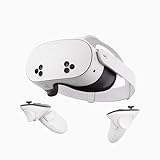
- Top Pick: Meta Quest 3S 128GB | VR Without Wires — Gorilla Tag Cardboard Monkenaut Bundle — Amazon Exclusive —Access to 100+ Games with a 3-Month Trial of Meta Horizon+ Included
- Best Value: Meta Quest 3 512GB | VR Without Wires — Gorilla Tag Cardboard Monkenaut Bundle — Amazon Exclusive— Access to 100+ Games with a 3-Month Trial of Meta Horizon+ Included
- Premium Choice: Meta Quest 3S 128GB | VR Headset — Thirty-Three Percent More Memory — Virtual Reality Without Wires — Access to 40+ Games with a 3-Month Trial of Meta Horizon+ Included (Renewed Premium)
The Meta Quest 3S has redefined accessible virtual reality, delivering standalone, wire-free VR at a price that finally makes the technology mainstream. For gamers weighing it against traditional Xbox console gaming, the Quest offers a fundamentally different, immersive experience, and it pairs surprisingly well with cloud and console streaming for the best of both worlds.
This review examines the Meta Quest 3S and its siblings, including the higher-end Quest 3 and Quest Pro, along with essential accessories. We focus on immersion, comfort, game library, and value, since the right headset and add-ons make all the difference in how much you enjoy VR.
Related guide: Best gaming controllers
As an Amazon Associate we earn from qualifying purchases at no extra cost to you.




🎮 Get More From Your Setup — Free
Prime Gaming gives you free PC games every month, in-game loot, and a free Twitch channel sub — plus fast free shipping on all the gear above. New members get a 30-day free trial.
Watch: Xbox Meta Quest 3s — Video Review
Design & Build
The Quest 3S is a well-built standalone headset that requires no PC or wires, with intuitive controllers and a comfortable default strap. The step-up Quest 3 offers a slimmer profile and sharper optics, while the Quest Pro targets enthusiasts with premium features. Build quality across the lineup is solid, and the bundled options, like the Gorilla Tag Cardboard Monkenaut editions, add value for newcomers. Comfort is good out of the box but improves significantly with accessories such as the Kawaye head strap with an integrated battery pack, which balances the weight and extends play sessions.
Performance
The Quest 3S delivers impressively immersive VR with responsive tracking and access to a huge library of over 100 games through the included Meta Horizon+ trial. It handles mixed reality, fitness, and gaming smoothly for a standalone device. The Quest 3 pushes further with roughly thirty percent sharper resolution and double the graphical processing power, making it the choice for those who want the crispest visuals. For console gamers, streaming Xbox Game Pass titles to the headset creates a giant virtual screen, complementing native VR. Battery life is the main limitation for long sessions, which is where a hot-swap battery strap becomes genuinely useful.
Pros & Cons
- Pro: Affordable, fully standalone VR with no PC or wires required.
- Pro: Access to 100-plus games plus a Meta Horizon+ trial.
- Pro: Supports mixed reality, fitness, and console game streaming.
- Pro: Comfort and battery life improve easily with accessories.
- Con: Built-in battery life is limited for long sessions.
- Con: The default strap benefits from a comfort upgrade.
- Con: The Quest 3S has lower resolution than the pricier Quest 3.
Alternatives to Consider
If you want the sharpest visuals and most graphical power, the Meta Quest 3 with 512GB is the step-up pick over the 3S. Enthusiasts chasing premium features can look at the Quest Pro, though it commands a much higher price. For most people, the Quest 3S paired with a comfort accessory like the Kawaye head strap with a hot-swap battery is the best value entry into VR, adding both comfort and extended playtime affordably.
Frequently Asked Questions
Do I need an Xbox or PC to use the Quest 3S?
No. The Quest 3S is fully standalone with its own games and processing. You can optionally stream Xbox Game Pass or PC VR titles for extra content, but neither is required.
Is the Quest 3S or Quest 3 better?
The Quest 3 offers sharper resolution and more graphical power, while the 3S delivers the same core experience for less. Choose the 3 for visuals, the 3S for value.
How long does the battery last?
Expect roughly two to three hours of play on the built-in battery. A head strap with an integrated or hot-swap battery pack significantly extends longer sessions.
Can I stream Xbox games to the headset?
Yes. You can stream Xbox Game Pass titles to a large virtual screen within the headset, combining flat-screen console gaming with native VR experiences.
Verdict
The Meta Quest 3S is the best-value gateway into VR, offering standalone immersion and a huge game library at an accessible price. Pair it with the Kawaye battery head strap for comfort and endurance, or step up to the Quest 3 if you want the sharpest possible visuals.