Affiliate disclosure: As an Amazon Associate we earn from qualifying purchases. This post contains affiliate links — if you buy through them we may earn a small commission at no extra cost to you. This never affects our recommendations.
In a hurry? See the top-rated Meta Quest 3S deals available right now:
🛒 Check Meta Quest 3S Prices on Amazon →🛒 Best Price Today on Amazon
Prime members get fast, free shipping on everything above, plus member-only deals. New members get a 30-day free trial — cancel anytime.
Start 30-Day Prime Free Trial →See Today’s Amazon DealsMeta Quest 3S Review: Affordable Mixed Reality for PC Gamers
The Meta Quest 3S represents Meta’s commitment to making VR gaming more accessible without sacrificing core functionality. Positioned as the budget-friendly alternative to the Quest 3, the 3S delivers mixed reality capabilities, solid performance, and compatibility with the massive Meta Quest game library. For PC gamers looking to dip their toes into VR without investing $500+, the Quest 3S offers compelling value. This comprehensive review examines the 3S’s display quality, performance capabilities, comfort features, and whether it’s worth choosing over the more expensive Quest 3. We’ll compare it with other entry-level VR headsets and help you determine if this affordable option meets your gaming expectations.
Quick Verdict
The Meta Quest 3S is the best entry point to VR gaming, offering mixed reality passthrough, respectable processing power, and access to an enormous game library at an unbeatable price. If your budget is limited or you want to experience VR before committing significant funds, the 3S is the smarter choice than the Quest 3. While it sacrifices some visual fidelity compared to the Meta Quest 3, the difference is negligible for casual gamers. It vastly outperforms the Pico 4 Ultra in game availability and offers better PC connectivity than the Samsung Galaxy XR.
As an Amazon Associate we earn from qualifying purchases at no extra cost to you.




Display & Lenses: Solid Visuals at Budget Price
The Quest 3S features dual 1824 x 1920 LCD panels per eye—a step down from the Quest 3’s 2064 x 2208 resolution, but still competitive for a $249 headset. The 90-degree horizontal and 96-degree vertical field of view provides good immersion without feeling cramped. Fresnel lenses deliver acceptable clarity across the visual field, with only subtle god-ray artifacts under extreme lighting conditions. The 90Hz refresh rate (with 120Hz support on select titles) ensures smooth gameplay without motion sickness concerns. Colors appear vibrant in games like Beat Saber and Superhot, though the display doesn’t match the premium color accuracy of higher-end PCVR headsets like the Pimax Crystal Light. Mixed reality passthrough using color cameras lets you blend virtual content seamlessly with your real environment, a feature that distinguishes the 3S from non-MR headsets. The display quality is sufficient for narrative-driven games, puzzle titles, and most action games—you’ll only notice the resolution drop in extremely detailed sim racing scenarios.
Tracking & Controllers: Reliable and Responsive
The Quest 3S uses the same inside-out tracking system as the Quest 3, with four cameras providing accurate headset and controller position sensing. Hand-tracking works smoothly for games that support it, though the accuracy isn’t quite as precise as dedicated optical systems in enterprise VR solutions. The Touch Plus controllers feel premium with responsive buttons and satisfying haptic feedback. Controller tracking remains solid during fast-paced games, though occasional edge-of-view moments (like throwing grenades) can cause brief tracking loss. Battery life is impressive—controllers run for 15-20 hours on two AA batteries, eliminating frequent charging interruptions. Compared to the HTC Vive Focus Vision‘s more advanced tracking, the Quest 3S is slightly less precise but much more affordable and beginner-friendly.


As an Amazon Associate we earn from qualifying purchases. Product prices and availability are accurate as of the date/time indicated.
Performance & Comfort: Light and Balanced
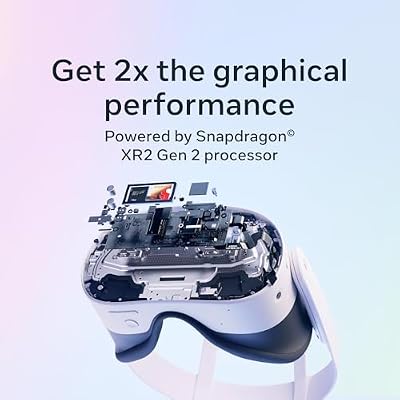
Powered by the Snapdragon XR Gen 2 processor, the Quest 3S handles the majority of VR games at high settings with consistent 72-90Hz frame rates. Performance is noticeably smoother than budget alternatives, making it suitable for demanding titles like Half-Life: Alyx (via PC streaming). The headset weighs 575 grams—about 25 grams lighter than the Quest 3—making it one of the more comfortable standalone headsets. The adjustable head strap distributes weight evenly across your head, and the soft face cushion is comfortable for 2-3 hour gaming sessions without fatigue. Thermal management is adequate, with minimal throttling during intense gameplay. Storage options of 128GB or 256GB are sufficient for 4-8 large titles, and most players manage storage well by uninstalling completed games. Battery life ranges from 2-2.5 hours depending on game intensity—enough for an evening session but not a full day of gaming.
Game Library: Access to 500+ Titles
The Quest 3S has full access to the Meta Quest Store’s extensive library of over 500 optimized games. Standout titles include Resident Evil 4 VR, Blade & Sorcery, Echo VR, and many indie gems. Cross-buy games let you own titles on both standalone and PCVR with one purchase, maximizing value. Using Meta Air Link or a USB-C cable, you can stream SteamVR games from a PC, unlocking thousands of additional titles. The Quest 3S is particularly well-suited for PC VR users who want the flexibility of both standalone and tethered gameplay. Regular sales on the Meta Store provide excellent deals, with premium titles often dropping to $15-30 after a few months. Multiplayer gaming works seamlessly with Discord integration and built-in voice chat.
Pros & Cons
| Pros | Cons |
|---|---|
| Extremely affordable ($249-299) | Lower resolution than Quest 3 |
| Lightweight and comfortable | Battery life limited to 2-2.5 hours |
| Full access to Quest game library | Smaller storage options (128GB/256GB) |
| Mixed reality passthrough included | Hand-tracking less precise than premium options |
| Excellent PC VR connectivity | Performance slower than Quest 3 on demanding games |
| Solid build quality and comfort | Requires Meta account for full functionality |
Versus Alternatives
Compared to the Meta Quest 3, the 3S sacrifices visual fidelity and processing power but maintains 90% of the gaming experience at half the price—an excellent trade-off for budget-conscious buyers. Against the Pico 4 Ultra, the Quest 3S offers superior game library and ecosystem maturity. When compared to PCVR-only headsets like the Bigscreen Beyond 2, the 3S doesn’t require a PC tether for basic gameplay, offering more freedom. The Samsung Galaxy XR is a newer option but lacks the proven ecosystem and game library of the Quest 3S.
Who Should Buy It?
The Quest 3S is perfect for budget-conscious gamers, PC VR enthusiasts who want flexibility, casual players dipping into VR for the first time, and parents buying a VR headset for teenagers. If you’re not sure whether you’ll enjoy VR long-term, the Quest 3S is the safest investment—you’ll save $250+ if VR turns out not to be your thing. It’s also ideal for multiplayer gaming and social VR applications. However, if you’re a hardcore gamer demanding maximum visual fidelity or own a high-end gaming PC optimized for PCVR, the Quest 3 or a dedicated PCVR headset might be better suited to your needs.
Meta Quest 3S Specifications
| Specification | Value |
|---|---|
| Display Resolution | 1824 x 1920 per eye |
| Field of View | 90° H x 96° V |
| Refresh Rate | 90Hz / 120Hz (select titles) |
| Processor | Snapdragon XR Gen 2 |
| RAM | 8GB |
| Storage | 128GB / 256GB |
| Weight | 575g (1.27 lbs) |
| Battery Life | 2-2.5 hours |
| Controller Battery | 15-20 hours |
| IPD Adjustment | Mechanical (55-75mm) |
| Hand Tracking | Yes (4 cameras) |
| Passthrough MR | Yes (color) |
| Price | $249-299 |




As an Amazon Associate we earn from qualifying purchases. Product prices and availability are accurate as of the date/time indicated.
Frequently Asked Questions
Is the Quest 3S better value than the Quest 3?
For most casual and mid-core gamers, yes. The 3S delivers 85-90% of the Quest 3’s experience at a $250 lower price point. Only serious visual enthusiasts or players of extremely demanding titles benefit from the Quest 3’s superior resolution.
Can the Quest 3S run demanding PC VR games?
Yes, via Air Link or USB-C streaming from a PC. However, you’ll need a gaming PC with an RTX 2070 or better to achieve smooth 72Hz performance. The Quest 3S itself can’t run PC VR games natively—it streams them from your computer.
How does the Quest 3S compare to the Pico 4?
The Quest 3S has significantly more games available, better controllers, and superior hand-tracking. The Pico 4 is cheaper in some regions but lacks the ecosystem maturity and support.
Is 128GB storage enough?
For most players, yes. You can install 3-5 large games simultaneously and manage storage by deleting completed titles. However, the 256GB model is recommended if you like keeping 8+ games installed.
Does the Quest 3S work with the original Quest controllers?
No. The Quest 3S uses Touch Plus controllers, which aren’t compatible with the original Quest. However, controller replacements are affordable ($70-90) if needed.
Final Verdict
The Meta Quest 3S is the best budget VR headset available in 2026. It democratizes VR gaming by eliminating the $500+ barrier to entry, delivering respectable performance and access to an enormous game library. While it doesn’t match the visual fidelity of premium PCVR headsets or the processing power of the Quest 3, it offers incredible value for casual and mid-core gamers. If you’re new to VR or want an affordable gateway to mixed reality gaming, the Quest 3S is an outstanding choice. Buy it with confidence knowing you’re getting a proven platform with years of support and a thriving developer community behind it.
Related Articles
Looking for more on this topic? Browse the hand-picked guides below — each one applies the same scoring rubric used in this review.