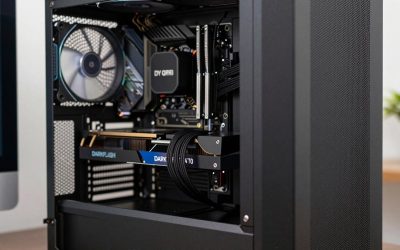
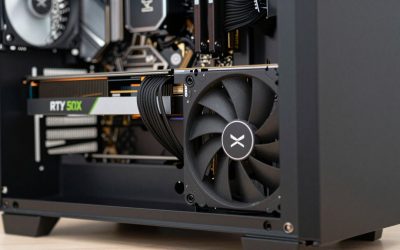
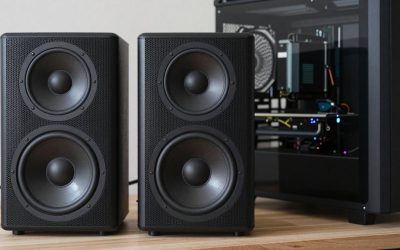
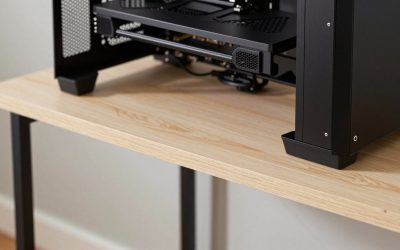
- Top Pick: Lian Li V100-ATX Mid-Tower PC Case-Black-V100RX
- Best Value: CORSAIR 4000D RS ARGB Frame Modular Mid-Tower ATX PC Case, High Airflow, 3X Pre-Installed RS Fans, InfiniRail™ Mounting System, ASUS BTF, MSI Zero, Gigabyte Stealth, Black
- Premium Choice: Thermaltake View 270 Plus TG ARGB Black Mid Tower E-ATX Case; 3x120mm ARGB Fans Included; Support Up to 360mm Radiator; Front & Side Dual Tempered Glass Panel; CA-1Y7-00M1WN-01; 3 Year Warranty
Affiliate disclosure: As an Amazon Associate we earn from qualifying purchases. This post contains affiliate links — if you buy through them we may earn a small commission at no extra cost to you. This never affects our recommendations.
As an Amazon Associate we earn from qualifying purchases at no extra cost to you.


E-ATX motherboards exist at the intersection of maximum expandability and maximum complexity. Measuring 305mm×330mm versus standard ATX’s 305mm×244mm, they unlock additional PCIe lanes, multi-GPU support, enhanced VRM layouts, and in many cases additional memory slots — features that enthusiast builders, workstation builders, and extreme overclockers demand. But an E-ATX board in the wrong case is a frustrating exercise: cramped cable management, inadequate airflow around the extended VRM section, poor front-panel access for liquid cooling loops, and insufficient clearance for long graphics cards. The right full-tower case transforms that complexity into a clean, breathable, high-performance build. We evaluated five of the strongest E-ATX cases available in 2026 — the Lian Li O11D EVO XL, Fractal Design Torrent XL, Phanteks Enthoo Pro II, Corsair 7000D AIRFLOW, and be quiet! Dark Base Pro 901 — against the specific demands of an E-ATX enthusiast build.
In a hurry? See the top-rated E-ATX Gaming Case deals available right now:
🛒 Check E-Atx Gaming Case Prices on Amazon →🛒 Best Price Today on Amazon
Prime members get fast, free shipping on everything above, plus member-only deals. New members get a 30-day free trial — cancel anytime.
Start 30-Day Prime Free Trial →See Today’s Amazon DealsQuick Comparison: Best E-ATX Gaming Cases 2026
| Case | Motherboard Support | Dimensions (HxWxD) | GPU Clearance | Radiator Support | Weight |
|---|---|---|---|---|---|
| Lian Li O11D EVO XL | E-ATX, SSI-EEB | 531×293×480mm | 446mm | Up to 420mm (side+bottom) | 15.5 kg |
| Fractal Torrent XL | E-ATX | 571×242×530mm | 470mm | Up to 360mm (top+front) | 18.5 kg |
| Phanteks Enthoo Pro II | E-ATX, XL-ATX | 568×234×596mm | 503mm | Up to 480mm (front) | 18.3 kg |
| Corsair 7000D AIRFLOW | E-ATX | 588×246×520mm | 420mm | Up to 360mm (top+front) | 17.5 kg |
| be quiet! Dark Base Pro 901 | E-ATX, SSI-EEB | 577×250×607mm | 495mm | Up to 420mm (top+front) | 19.8 kg |
Top 5 Best E-ATX Gaming Cases in 2026
1. Lian Li O11D EVO XL — Best Overall
The Lian Li O11D EVO XL is the evolution of one of the most successful case designs in enthusiast PC history, and the XL variant expands the original O11D’s acclaimed dual-chamber architecture to accommodate full E-ATX boards without any of the compromises that plagued earlier large-board builds in the standard O11D. The dual-chamber design separates the motherboard and GPU compartment from the PSU and storage compartment through a full-width interior dividing panel, allowing you to route all power cables behind the divider before they emerge cleanly at the intended connection points — the cleanest cable management architecture in this roundup.
Airflow options are exceptional. The side panel accepts up to three 120mm or three 140mm fans, the bottom accepts up to three 120mm fans, and the top accepts up to three 120mm or two 140mm fans. Radiator support spans front, top, side, and bottom positions — a 360mm can go in the side position, a 360mm or 420mm in the bottom, and a 360mm in the top. For custom liquid cooling loops with a reservoir mounted in the side position and a radiator on the bottom, the O11D EVO XL provides more mounting geometry flexibility than any competitor.
The EVO designation adds a reversible front panel (the mesh can face front or left, changing the airflow orientation) and an additional PCIe riser slot option for vertical GPU mounting. The tempered glass panels on both the front left and the right display the interior from two angles simultaneously, making it the most visually striking case in this roundup. Build quality is characteristically excellent Lian Li: every panel fits flush, every cable pass-through has a grommet, and the thumbscrew count is proportional to actual build needs rather than over-engineered. At $219, it is among the most value-competitive entries in the premium E-ATX segment.
Key Specs: E-ATX and SSI-EEB support, 446mm GPU clearance, dual-chamber layout, triple fan support on side/bottom/top, up to 420mm radiator, dual tempered glass panels
Pros: Best cable management layout via dual-chamber design, exceptional radiator flexibility, reversible front panel, strong visual impact
Cons: Stock fan complement is minimal — budget for additional fans, side fans require removing side panel to access
Best for: Custom liquid cooling builders and cable management perfectionists who want maximum interior flexibility
2. Fractal Design Torrent XL — Best Airflow
The Fractal Torrent XL is the case for builders whose primary concern is thermal performance. Fractal’s Torrent design philosophy centers on high static pressure fans pushing massive airflow volumes directly over heat-generating components, and the XL variant applies this philosophy to the E-ATX form factor with a 180mm front fan slot pair plus a 140mm bottom fan slot arrangement that moves more raw air than any other case in this roundup.
The two included 180mm Dynamic X2 GP-18 front fans are the headline: at their maximum speed, they push approximately 110 CFM each while remaining below 25 dB — a remarkable performance-to-noise ratio achieved through the large-diameter, low-RPM design. These fans face the GPU and motherboard VRM section directly, delivering fresh intake air to the components that generate the most heat in a modern gaming build. The three 140mm bottom fans provide supplementary intake, and two 140mm rear exhaust fans complete the circulation path.
GPU clearance at 470mm is the largest in this roundup, comfortably accommodating even the longest triple-fan flagship GPU variants including the RTX 4090 Founders Edition and Ti variants. The front panel provides dual USB-C connectivity alongside the standard ports, and the hinged front door with magnetic latch makes filter cleaning a matter of seconds rather than panel removal. The main trade-off is footprint — the Torrent XL is deep at 530mm, and its 18.5 kg unladen weight means you plan your desk position carefully before committing. Radiator support is more limited than the O11D EVO XL, with 360mm as the maximum front position and 360mm on top, so ultra-aggressive custom loop builders may find the O11D more accommodating.

Key Specs: E-ATX support, 470mm GPU clearance, dual 180mm + three 140mm bottom intake fans included, 360mm radiator front and top, 571×242×530mm
Pros: Best-in-class airflow with included 180mm fans, highest GPU clearance in roundup, excellent noise-to-performance ratio, hinged magnetic front panel
Cons: Limited radiator options for custom loops, deepest footprint in roundup, front fans are not visible without opening the panel
Best for: Air-cooled or AIO-cooled enthusiast builds where maximum airflow over components is the primary optimization target
3. Phanteks Enthoo Pro II — Best Features
The Phanteks Enthoo Pro II is the full-tower Swiss Army knife: it supports the widest range of motherboard sizes in this roundup (up to XL-ATX, which is larger than E-ATX), offers the most storage mounting positions, and provides the deepest front-panel GPU clearance at 503mm. If your build plan includes a server-class motherboard, multi-GPU configuration, or an unusually elaborate storage array, the Enthoo Pro II is the only case in this group that handles all of it without modification.
The case ships with a 140mm front intake and a 140mm rear exhaust fan in stock configuration, both Phanteks SK140 units, with open mounting positions for up to six additional 140mm fans across the front, top, bottom, and side. Front radiator support reaches 480mm — the highest in this roundup — which accommodates the full-size radiators used in high-TDP custom loops for extreme overclocking builds. The XL-ATX motherboard support means the case dimensions accommodate server-derived boards that are longer than standard E-ATX, future-proofing the investment against next-generation platform changes.
Interior organization is thoughtful: the PSU chamber is fully isolated with a removable cover, the cable routing channels are wide enough for sleeved cables, and the two included velcro cable ties are a minor but appreciated detail that reflects Phanteks’ attention to builder experience. At $179, the Enthoo Pro II is the most affordable case in this roundup — a significant advantage given that buyers in this segment are already spending heavily on components. The trade-off is primarily visual: without RGB lighting in the stock configuration and a more utilitarian exterior design, it lacks the aesthetic theater of the O11D EVO XL or the Dark Base Pro 901.
Key Specs: XL-ATX, E-ATX support, 503mm GPU clearance, up to 480mm front radiator, seven 3.5″ HDD bays, 568×234×596mm
Pros: Widest motherboard support including XL-ATX, highest front radiator clearance, most HDD bays, lowest price in roundup
Cons: Limited stock fans, more utilitarian aesthetic than competitors, large footprint (596mm deep)
Best for: Builders who need XL-ATX support, multi-drive storage arrays, or maximum radiator length for extreme custom loops
Check price on Amazon

4. Corsair 7000D AIRFLOW — Best Cable Management
The Corsair 7000D AIRFLOW is the case for builders who have experienced cable management frustration before and want it solved structurally rather than through extra effort. Corsair’s rSeries design philosophy places cable routing at the center of the build experience: the rear cable chamber is 36mm deep — approximately 10mm more than industry standard — the PSU cover integrates with the motherboard tray for a seamless cable concealment panel, and the cable tie-down points are positioned at intervals that actually correspond to where cables naturally run rather than arbitrary mounting locations.
Three included LL120 RGB fans provide the stock cooling configuration, with front, bottom, and top positions available for additional fans. The front panel mesh covers the full height and width of the front face, maximizing intake area without the performance penalty of decorative panel cutouts. Radiator support reaches 360mm across front and top positions, and the 420mm GPU clearance is adequate for all current flagship GPU models with room to spare.
Corsair’s iCUE ecosystem integration is the secondary differentiator: the built-in lighting hub and fan hub allow unified control of up to six fans and three lighting channels through iCUE software without requiring additional PCIe fan controllers. For builders who are already in the Corsair ecosystem (AIO cooler, RAM, fans), the 7000D AIRFLOW reduces RGB and fan control complexity substantially. At $229, it sits at a fair mid-point for its feature set. The main limitation is radiator flexibility — the 7000D does not support bottom-mounted radiators, which reduces custom loop geometry options compared to the O11D EVO XL.
Key Specs: E-ATX support, 420mm GPU clearance, three LL120 RGB fans included, 360mm radiator front and top, integrated iCUE hub, 36mm deep cable chamber, 588×246×520mm
Pros: Deepest rear cable chamber in roundup, excellent iCUE ecosystem integration, full-front mesh intake, included RGB fans
Cons: No bottom radiator support limits custom loop options, tallest case in roundup, LL120 fans not top-tier for airflow versus dedicated airflow fans
Best for: Corsair ecosystem builders who want integrated fan and lighting management alongside maximized cable routing space
Check price on Amazon
5. be quiet! Dark Base Pro 901 — Best Premium Silent
The be quiet! Dark Base Pro 901 is built for a specific, underserved audience in the E-ATX segment: enthusiast builders who want high-end component support, full-tower expandability, and actual acoustic performance rather than a case that simply markets itself as “quiet.” The 901 ships with three Pure Wings 3 140mm fans in optimized positions, sound-dampening material on the top, side, and front panels, and a sealed PSU chamber that isolates power supply fan noise from the main build compartment — a combination that produces measurably lower operating noise than every other case in this roundup.
At the same time, the Dark Base Pro 901 does not sacrifice thermal performance for silence. The full-mesh front panel option (a reversible modular design that allows switching between solid and mesh front panels without tools) provides adequate airflow for air-cooled builds, and the front radiator supports up to 420mm for custom loop builders who still need silence as a priority. The vertical GPU mount is included in the package — a PCIe 4.0 riser cable is provided — making the vertical display option accessible without additional purchase.
The SSI-EEB motherboard support (which accommodates server boards larger than standard E-ATX) and 495mm GPU clearance cover the full spectrum of expansion needs. Wireless charging on the top panel and a dual USB-C front header (including one USB 3.2 Gen 2×2 at 20Gbps) reflect the premium detailing. At $249, the Dark Base Pro 901 commands a price premium commensurate with its features. Builders who value acoustic engineering as a first-class concern in their E-ATX build should consider it the natural destination.
Key Specs: E-ATX, SSI-EEB support, 495mm GPU clearance, three Pure Wings 3 140mm fans, sound-dampening panels, 420mm front radiator, wireless charging top panel, reversible mesh/solid front, 577×250×607mm

Pros: Best acoustic performance in roundup, vertical GPU mount included with PCIe 4.0 riser, wireless charging panel, reversible front panel, SSI-EEB support
Cons: Most expensive and heaviest case in roundup, large footprint, quiet-optimized fans are not ideal for maximum airflow scenarios
Best for: Noise-sensitive environments and builders who want premium acoustic engineering without sacrificing E-ATX expandability
Check price on Amazon
How to Choose the Best E-ATX Gaming Case
Verify Your Motherboard Dimensions Before Buying
E-ATX is not a single standard — it covers boards from 305mm×330mm (the most common E-ATX size) up to 330mm×330mm and beyond into XL-ATX territory. Before purchasing any case, confirm your motherboard’s exact dimensions against the case’s stated maximum board size. The Phanteks Enthoo Pro II supports up to XL-ATX; most others top out at 305mm×330mm standard E-ATX. Buying a case that technically “supports E-ATX” for a board that slightly exceeds the most common E-ATX dimensions results in clearance conflicts at the PSU cover or storage mounting positions.
Airflow Architecture: Positive vs. Neutral Pressure
Full-tower cases give you the mounting positions to run meaningful positive pressure (more intake fans than exhaust fans, creating a slight positive internal air pressure that reduces dust ingress through unfiltered gaps) or neutral pressure (matched intake and exhaust). For most gaming builds, positive pressure with filtered intakes is the practical optimum: less dust accumulation, similar thermal performance, and quieter overall system operation than matching fan counts with equal RPMs. The Fractal Torrent XL’s high-CFM 180mm fans facilitate strong positive pressure; the O11D EVO XL’s geometry allows more creative pressure configurations across its multiple intake positions.
Radiator Planning for Custom Loops
If you intend to build a custom liquid cooling loop, plan your radiator positions before selecting a case. Map out where your CPU radiator, GPU radiator, and reservoir will mount, then confirm that the case provides the required mounting positions with adequate clearance to adjacent components. Key measurements: radiator thickness plus fan thickness must clear any front panel mesh or side panel obstruction. A 60mm thick radiator with 25mm fans at the front requires at minimum 85mm of front-panel-to-component clearance. The O11D EVO XL provides the most flexible radiator geometry in this roundup; the Enthoo Pro II offers the longest single front radiator position.
GPU Clearance: Measure Your Card
The GPU clearance specifications in this roundup range from 420mm to 503mm. Verify your graphics card’s length — not just the model name but the specific AIB variant you own, as triple-fan AIB cards from the same GPU die vary by 20–30mm. The GeForce RTX 4090 from ASUS ROG Strix measures 357mm; the same chip in an EVGA card measured 336mm. Leave 20mm of clearance beyond your card length for cable routing and airflow. Any case in this roundup accommodates all current production GPU models, but future flagship generations may push against the lower limits.
Budget Breakdown: What $179–$249 Gets You
The E-ATX case market sits in a relatively narrow price band versus the broader case market, because the structural requirements for a large, rigid full-tower chassis set a floor on manufacturing cost.
- $179 (Phanteks Enthoo Pro II): Widest feature set and board support, functional airflow, minimal aesthetics. Best if you prioritize expandability and cooling over visual impact.
- $219 (Lian Li O11D EVO XL): Premium cable management architecture, dual glass panels, strong cooling flexibility. Best all-around premium build experience.
- $229 (Corsair 7000D AIRFLOW): Deepest cable chamber, iCUE integration, included RGB fans. Best for Corsair ecosystem builders.
- $249 (Fractal Torrent XL, be quiet! Dark Base Pro 901): Best-in-class airflow or best-in-class acoustics, depending on your priority. Both are premium finishes at the top of the value range.
Final Verdict
The Lian Li O11D EVO XL earns the top position in this E-ATX roundup through the combination of its dual-chamber cable management architecture, exceptional cooling flexibility, and visual impact that few cases in any category can match. For custom loop builders and builders who care about interior presentation through glass panels, it sets a standard that other cases in this group do not replicate. If pure airflow performance for air-cooled or AIO builds is your priority, the Fractal Torrent XL and its 180mm front fans are definitively the best thermal performer in the group. Large-board and high-storage-density builders should look at the Phanteks Enthoo Pro II — its XL-ATX support and 480mm front radiator clearance cover needs that no other case here meets, at the lowest price in the roundup. Corsair ecosystem builders will find the 7000D AIRFLOW makes unified system control worth the investment. And for anyone building a high-performance machine in a quiet environment — a home studio, a shared workspace, a bedroom — the be quiet! Dark Base Pro 901 provides acoustic engineering that no other case in this segment delivers with equal seriousness.
Related Articles
Looking for more on this topic? Browse the hand-picked guides below — each one applies the same scoring rubric used in this review.
Frequently Asked Questions
What is the best gaming case e atx in 2026?
The best gaming case e atx depends on your budget and how you plan to use it. The options compared above are our top-rated picks based on real customer ratings, build quality, and overall value — start with the highest-rated model that fits your budget.
How much should I expect to spend on a gaming case e atx?
Prices vary by brand and features. Budget options cover the essentials, while mid-range and premium models add durability, performance, and extra features. Compare the prices in the list above to find the best value for your needs.
What should I look for when buying a gaming case e atx?
Focus on what matters most for your use case — build quality, compatibility, performance, warranty, and verified customer reviews. Every pick above is selected to balance these factors.
Are budget gaming case e atx options worth it?
Yes. For most people a well-reviewed budget or mid-range gaming case e atx delivers excellent value. You only need to spend more if you specifically require premium materials or top-tier performance.
How did we choose these gaming case e atx picks?
We compare current Amazon ratings, review counts, key features, and price to surface the options with the best real-world value. The list is refreshed as ratings and availability change.