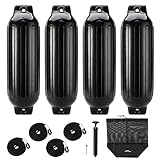
- Top Pick: Pontoon Fenders 2 Pack, Inflatable Boat Bumpers for Docking Pontoon, Marine Boat Fenders Heavy Duty Ribbed with Locking Groove Grip Handle, Boat Dock Bumpers with Ropes Pump and Needles – Black
- Best Value: Dreizack Boat Fenders 4 Pack 6.5"x23", Boat Bumpers for Docking with 4 Ropes, Inflatable Ribbed Marine Pontoon Boat Fender Bumper for Docks with 1 Storage Bag, 1 Air Pump and 4 Needles, Blue
- Premium Choice: Dreizack Boat Fenders 4 Pack 6.5"x23", Boat Bumpers for Docking with 4 Ropes, Inflatable Ribbed Marine Pontoon Boat Fender Bumper for Docks with 1 Storage Bag, 1 Air Pump and 4 Needles, Black
The best fenders for pontoon boats are 8.5″ x 27″ to 10″ x 30″ cylindrical fenders with at least 20-mil vinyl thickness and a center rope tube or reinforced eyelet, because pontoon rails sit higher off the water and exposed logs need longer vertical coverage than standard center-console fenders provide.
As an Amazon Associate we earn from qualifying purchases at no extra cost to you.


What Makes Pontoon Fenders Different
Pontoons don’t have a curved fiberglass hull to cradle a round fender. You have two aluminum logs, a flat fence/railing, and often a thin vinyl rub rail. A fender that is too short will slip between the dock and the log, and a fender that is too thin will puncture on dock bolts and cleats. For most 18 to 24-foot pontoons, you need more length and more abrasion resistance than a typical 6″ x 20″ runabout fender offers.
Pontoon-specific issues to solve:
- High freeboard: The deck sits 18-24 inches above the waterline, so the fender must hang low enough to contact the dock while still being tied to the railing.
- Flat sides: Cylinders roll less than round buoys against a flat fence panel.
- Storage: You have no hull-side fender racks, so deflated or flat-storage designs matter more.
Comparison by Key Buying Criteria
1. Size and Coverage
Diameter determines how far your pontoon sits off the dock. Length determines whether the fender can protect both the aluminum log and the lower fence at the same time.
For pontoons, length is more important than diameter. A 10-inch diameter fender holds you 5 inches off a piling, which is plenty. A 15-inch long fender, however, will disappear between a fixed dock and a pontoon on a wave.
| Fender Class | Dimensions (Diameter x Length) | Vinyl Thickness (Typical) | Best For Pontoon Length | Hangs Below Deck |
|---|---|---|---|---|
| Compact Cylinder | 6.5″ x 22″ | 18-20 mil | 16-19 ft (protected marinas only) | ~10″ |
| Standard Pontoon | 8.5″ x 27″ | 20-22 mil | 20-23 ft (most popular size) | ~15″ |
| Large Pontoon / Tritoon | 10″ x 30″ | 22-26 mil | 24-27 ft, rough water or tidal docks | ~18″ |
| Flat / Contoured Pontoon Fender | 8″ x 28″ (flat profile) | 20-24 mil | Any size where roll is an issue | ~16″ |
| Round Buoy (A-Style) | 12″ Diameter | 24-28 mil | Rafting or lock walls, not for daily docking | Varies |
Rule of thumb: Use at least 1 inch of fender diameter for every 2.5 feet of boat length. A 22-foot pontoon needs roughly an 8.5 to 9-inch diameter. Then maximize length within that diameter class.
2. Shape: Cylinder vs. Flat vs. Round
Cylindrical with center rope tube: The standard for pontoons. Models like the Taylor Made Hull-Gard and Polyform G-Series (G-4, G-5, G-6) and Polyform HTM series use this shape. The center tube lets you hang the fender vertically from the railing so it covers the log and fence in one piece. Best all-around protection and easiest to adjust for different dock heights.
Flat / Contoured Pontoon Fenders: Designed specifically for pontoons, such as the Taylor Made Pontoon Fender. One side is flat or slightly concave to sit flush against the fence, the other side is rounded for the dock. They don’t roll or swing like cylinders do. Trade-off is they are bulkier to store and usually cost more, usually $40–$80 per fender versus usually $25–$50 for a standard cylinder.
Round / A-Series Buoy Fenders: Polyform A-1 or similar. Excellent for rafting up with other boats or for very rough fixed docks with pilings, because the ball shape provides deep cushion. Not ideal as your primary fender because the pontoon’s flat side will push the ball to one side and leave a gap.
If you can only buy one type, get cylinders. Add one flat contoured fender at the stern gate where passengers board if your dock has a lot of movement.
3. Vinyl Thickness and Construction
Spec sheets list vinyl gauge in mils. Thicker is not just about puncture resistance, it determines how long the fender holds pressure and resists UV seam failure.
- 18 mil: Light duty. Fine for inland lakes with composite docks, but will show wear quickly on wood docks with exposed screws.
- 20-22 mil: The sweet spot for pontoons. Heavy enough for aluminum logs and dock hardware, still soft enough to compress on impact.
- 24-28 mil: Commercial grade. Found on Polyform G-6, Taylor Made Big B series. Stiffer, better for tritoons or boats kept in a slip year-round.
Look for one-piece molded vinyl with integrated ribs and a needle valve or screw-in inflation valve, not a seam-glued two-piece fender. One-piece construction resists splitting at the seam when the fender is wedged between a pontoon log and a dock corner.
4. Rope Attachment: Eyelet vs. Center Rope Tube
How the rope attaches changes how you hang it from a pontoon fence.
Center Rope Tube (Center Hole): A tube runs top-to-bottom through the fender. You thread your line through it. This is the most versatile for pontoons because you can tie to the top rail and let the fender hang vertically at any height, and adjust the line to drop the fender low enough to hit the log. Found on most Taylor Made Hull-Gard and Polyform G-series.
Dual End Eyelets: An eye at each end. You hang it horizontally along the side. Horizontal hanging looks clean and protects a long stretch, but on a pontoon you need two attachment points on the railing, and many railings don’t have them in the right places. Horizontal also tends to ride too high to protect the log.
Single Reinforced Eyelet: Common on flat pontoon fenders. Simple vertical hang, very strong, but less height-adjustable than a center tube.
For pontoon rails, a center rope tube with a fender line and a quick-adjust pontoon rail clip (such as Taylor Made Pontoon Rail Fender Adjuster) is the most practical. It prevents line chafe on square aluminum rails.
5. Inflation and Pressure
Most cylindrical vinyl fenders ship deflated and require inflation with a hand pump or air compressor via a needle valve (like a basketball needle) or a Boston-style screw valve.
Do not over-inflate. A rock-hard fender bounces and transfers impact to the fence. A correctly inflated fender will depress about 0.5 to 1 inch when you press hard with your palm. In summer heat, vinyl expands. Deflate slightly in July/August to maintain that softness, then re-inflate in fall.
If you trailer frequently, deflatable fenders save enormous space. A 10″ x 30″ cylinder deflates to about the size of a rolled towel. Flat pontoon fenders often use integrated air chambers that cannot fully deflate and need dedicated deck storage.
6. Docking Protection and How Many You Need
Worked Coverage Calculation
Don’t guess coverage. Calculate it.
Example: You have a 22-foot pontoon (264 inches of waterline length). You dock along a fixed wood dock with moderate wake.
- Effective protection per fender: A vertically hung 8.5″ x 27″ cylinder protects about 24 inches of vertical dock contact at the waterline, but you need overlap.
- Recommended spacing: One fender every 6 to 8 feet for calm water, every 5 to 6 feet for wavy or tidal conditions.
- Calculation: 22 ft / 7 ft spacing = 3.14. Round up to 4 fenders per side for calm water, 4 fenders for the dock side if you only equip one side.
- Minimum viable: 3 fenders on the dock side will leave a 7+ foot gap mid-ship where the fence can contact a piling during a crosswind.
For that 22-foot boat, buy 4 fenders of the Standard Pontoon class. Hang one at the bow log curve, one forward of the gate, one aft of the gate, and one at the stern corner. Tritoon owners or boats on Lake of the Ozarks-style rough water should add a fifth.
7. Storage on a Pontoon
Pontoons have no side lockers. Your options are under-seat storage, in the bow storage compartment, or clipped to the railing while underway.
- Cylinders deflated: Store 4 deflated G-4/G-5 size fenders in a single under-seat compartment.
- Cylinders inflated: Need fender hooks or rail clips. They will intrude into walkway space.
- Flat contoured fenders: Store upright against the fence, but they block seating if left out. They are best for boats that stay in a slip.
If you trailer and have limited storage, prioritize cylinders with needle valves that you can inflate dockside with a 12V pump in under 2 minutes each.
Decision Matrix: Which Fender Class Matches Your Situation
| Your Situation | Recommended Choice | Why |
|---|---|---|
| 20-23 ft pontoon, inland lake, floating dock | 3-4x 8.5″ x 27″ cylinder, 20-22 mil, center rope tube | Best balance of length, storage, and cost. Handles high freeboard. |
| 24-27 ft tritoon or pontoon on rough / tidal water | 4x 10″ x 30″ cylinder, 22-26 mil | Larger diameter for distance, thicker vinyl for continuous slip use. |
| Boat stays in slip full season, fixed wood dock with pilings | 2x cylinder + 2x flat contoured pontoon fenders | Flats prevent rolling at boarding gate, cylinders cover bow/stern curves. |
| Trailer frequently, limited storage | 4x deflatable 8.5″ x 27″ cylinder with needle valve | Deflate and stow under seat. Re-inflate dockside. |
| Often raft up with other boats | Add 1-2 round A-1 buoys as extra | Balls handle boat-to-boat movement better than cylinders alone. |
Specific Models to Compare in 2026
Stick to proven lines where replacement valves and true vinyl gauge are published. These are widely available in marine supply ranges and typically fall in the ranges below:
- Taylor Made Hull-Gard (5.5″ x 22″ to 10″ x 30″): One-piece vinyl, center rope tube, needle valve. The 8.5″ x 27″ is the default pontoon pick. Usually $25–$55 per fender.
- Polyform G-Series (G-3, G-4, G-5, G-6): Heavier ribbed construction, integral rope tube, high-tensile vinyl. G-4 (8.5″ x 22″) is slightly short for pontoons, G-5 (8.5″ x 27″) and G-6 (11″ x 30″) are preferred. Usually $30–$70 per fender.
- Polyform HTM Series: Hole-through-middle design similar to G-series but with reinforced tube. HTM-2 and HTM-3 sizes map well to pontoons. Usually $35–$65 per fender.
- Taylor Made Pontoon Fender: Flat-sided, contoured to fence, single eyelet. Excellent dock rash prevention but does not deflate flat. Usually $45–$80 per fender.
Avoid novelty inflatable dock edging or foam noodles as primary protection. They compress to zero on a hard impact and offer no standoff distance.
How to Hang Fenders on a Pontoon Correctly
Correct height is lower than you think. The center of the fender should align with the dock’s rub strake or the top of the dock board, not with your deck. On most fixed docks, that means the bottom of the fender is 2-4 inches above the water.
- Use a 3/8-inch double-braid nylon fender line, 5-6 feet long, with a loop for the rail clip. Nylon stretches and absorbs shock; polypropylene does not.
- Tie to the horizontal top rail, not vertical spindles, to prevent sliding.
- Space fenders evenly, but bias one toward the stern where wind will push the heavier outboard end into the dock.
- Check chafe weekly. Square aluminum rails will saw through thin line. Use chafe guard or dedicated pontoon fender adjusters with plastic sleeves.
FAQ
Can I use 6″ x 20″ fenders on a pontoon?
You can, but they are undersized for anything over 19 feet. They sit too high to protect the log and leave the fence exposed when the boat rocks. Keep them as backups, not primaries.
Should I hang fenders horizontally?
Only if your rail has two solid attachment points 24+ inches apart and your dock is very low. Vertical hanging with a center rope tube gives better log protection and is more adjustable for changing water levels.
How firm should my fenders be?
Soft enough to dent with a firm palm press. If you can stand on it and it doesn’t give, it’s over-inflated and will bounce the boat instead of cushioning it. Check pressure monthly and on the first hot day of summer.
Do I need fender covers?
Optional. Acrylic fender covers (usually $15–$25 each) prevent vinyl scuff marks on light-colored fences and reduce squeaking. They also protect the vinyl from UV. If your pontoon fence is white or cream, covers are worth it.
Ready to decide? Our #1 pick for 2026 is the Compact Cylinder.
Live price & availability on Amazon.