- Top Pick: Aula WIN60 HE – 60% Mechanical Gaming Keyboard Wired, Magnetic Switch Hot Swappable, Adjustable Actuation Rapid Trigger Mode, 8000 Hz Polling Rate, RGB Small Keyboard 60 Percent Compact Design for PC
- Best Value: Razer Huntsman Mini 60% Gaming Keyboard, Linear Optical Switches, Black
- Premium Choice: GEODMAER 65% Gaming Keyboard, Wired Backlit Mini Keyboard, Ultra-Compact Anti-Ghosting No-Conflict 68 Keys Membrane Gaming Wired Keyboard for PC Laptop Windows Gamer
Affiliate disclosure: As an Amazon Associate we earn from qualifying purchases. This post contains affiliate links — if you buy through them we may earn a small commission at no extra cost to you. This never affects our recommendations.
- Quick Comparison: Best 60% Gaming Keyboards 2026
- What You Actually Lose (and Gain) With a 60% Layout
- 1. Ducky One 3 Mini — Best Overall 60% Gaming Keyboard
- 2. Anne Pro 2 — Best Wireless 60% Gaming Keyboard
- 3. Razer Huntsman Mini — Best 60% for FPS Gaming
- 4. HyperX Alloy Origins 60 — Best 60% for Beginners
- 5. Keychron K12 Pro — Best 60% for Mac Compatibility
- Final Comparison Table
- Our Verdict
- FAQ
- Related Articles
- Frequently Asked Questions
- Related Articles
As an Amazon Associate we earn from qualifying purchases at no extra cost to you.



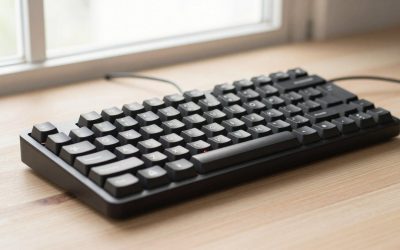
If your mousepad feels cramped and your desk setup is perpetually cluttered, a 60% keyboard might be the single biggest quality-of-life upgrade you can make. These compact boards strip the layout down to roughly 61 keys — gone is the numpad, gone is the function row, gone are the dedicated arrow keys and navigation cluster. What stays is every letter, number, modifier, and punctuation key you actually use while gaming or typing. The result is a board that sits 40% smaller than a full-size layout, sliding your mouse hand closer to center and giving you room to make wide, low-sensitivity sweeps without bumping plastic.
That trade-off sounds steep on paper. In practice, FN layers handle everything you lose. Pressing FN + WASD (or FN + ;'[]) gives you arrow key access. A secondary layer covers F1–F12 and media controls. Most shooters, MOBAs, and real-time strategy games never touch the function row mid-session, so you barely notice what’s missing — you just notice how much freer your elbow feels.
This guide covers five of the best 60% gaming keyboards you can buy in 2026, with full specs, real pros and cons, and honest verdicts on who each board suits best.
In a hurry? See the top-rated 60% Gaming Keyboard deals available right now:
🛒 Check 60% Gaming Keyboard Prices on Amazon →🛒 Best Price Today on Amazon
Prime members get fast, free shipping on everything above, plus member-only deals. New members get a 30-day free trial — cancel anytime.
Start 30-Day Prime Free Trial →See Today’s Amazon DealsQuick Comparison: Best 60% Gaming Keyboards 2026
| Keyboard | Switch Type | Hot-Swap | Wireless | Mount | Best For |
|---|---|---|---|---|---|
| Ducky One 3 Mini | Cherry MX (multi) | No | No | Tray (foam-dampened) | Overall best |
| Anne Pro 2 | Gateron / Kailh | No | Yes (BT 4.0) | Tray | Wireless on a budget |
| Razer Huntsman Mini | Razer Optical | No | No | Tray | FPS speed |
| HyperX Alloy Origins 60 | HyperX Mechanical | No | No | Aluminum tray | Beginners |
| Keychron K12 Pro | Gateron G Pro | Yes | Yes (BT 5.1 / 2.4 GHz) | Gasket | Mac users |
What You Actually Lose (and Gain) With a 60% Layout
Before diving into individual keyboards, it’s worth being precise about the trade-offs — because a 60% is not for everyone.
What’s removed:
- Function row (F1–F12) — accessed via FN layer; fine for gaming, mildly annoying for IDE shortcuts
- Arrow keys — accessed via FN + WASD, FN + ;'[], or a dedicated momentary layer depending on the board
- Numpad — gone entirely; FN + top number row fills the gap for most uses
- Navigation cluster — Home, End, PgUp, PgDn, Delete, Insert all move to FN layers
What you gain:
- Mouse room — the single biggest gaming benefit; your right hand sits 10–15 cm closer to center
- Travel portability — a 60% fits in most laptop bags; tenkeyless boards often don’t
- Desk aesthetics — cleaner, more symmetrical setup
- Focus — fewer keys means fewer accidental presses in high-pressure moments
Arrow key access matters more than people admit. Boards like the Ducky One 3 Mini use FN + ;'[] (right-hand side) which feels more natural when your left hand is already on WASD. The Anne Pro 2 offers a tap-layer system where tapping ;'[] sends arrow inputs without holding FN. The Keychron K12 Pro has dedicated arrow keys crammed into the bottom-right via a compressed layout — arguably the friendliest 60% for people who type heavily alongside gaming.
Hot-swap support at 60% is still relatively rare but growing. The Keychron K12 Pro is the standout here, letting you pull switches without soldering. This matters if you want to experiment with tactile, linear, or clicky switches without buying a new board.
Standard bottom row is critical for custom keycap compatibility. Boards with a non-standard 6.25u spacebar or unusual modifier sizing will limit your keycap options significantly. Every board on this list uses a standard bottom row.
1. Ducky One 3 Mini — Best Overall 60% Gaming Keyboard
Buy on Amazon — ~$99
The Ducky One 3 Mini is the board most enthusiasts point to when someone asks for a no-compromise 60% recommendation. Ducky has spent years refining this form factor, and the One 3 Mini is the result — a keyboard that feels premium, types beautifully, and will outlast most of the competition without demanding any tinkering.
Specs
| Spec | Detail |
|---|---|
| Layout | 60% (61 keys) |
| Switches | Cherry MX (Red, Brown, Blue, Silent Red, Speed Silver) |
| Hot-Swap | No |
| Backlight | RGB (per-key) |
| Wireless | No |
| Mount | Tray with foam dampening |
| Keycaps | Double-shot PBT |
| USB | Detachable USB-C |
| Dimensions | 302 × 108 × 40 mm |
Why It’s the Best Overall
Double-shot PBT keycaps straight out of the box is unusual at this price. Most keyboards in the $80–100 range ship with ABS keycaps that shine within weeks of use. Ducky’s PBT legends stay crisp for years, and the surface texture is exactly right — not too grainy, not too slick.
The foam dampening inside the tray mount noticeably reduces the hollow, pingy sound that plagues cheaper boards. Cherry MX switches are polarizing among enthusiasts (some find them slightly scratchy compared to Gateron), but they are the most battle-tested switches on the market and feel precise under fast gaming inputs. The Silent Red variant is worth considering if you share a room.

RGB implementation is excellent — individual key lighting with multiple layers and Ducky’s own per-key macro system that doesn’t require software to configure. Everything is programmed on-board. If you distrust RGB software bloat, this matters.
Arrow key access uses FN + ;'[] on the right side. With your left hand on WASD for gaming, you’re unlikely to need arrows mid-session anyway.
Pros
- Double-shot PBT keycaps included (not a $20 upgrade later)
- Foam dampening gives a quieter, more premium sound profile
- No software required — full macro and RGB configuration on-board
- Wide switch selection at purchase
- Standard bottom row, excellent keycap compatibility
- Detachable USB-C cable
Cons
- No hot-swap; switching Cherry MX requires desoldering
- No wireless option
- Cherry MX can feel slightly scratchy vs. Gateron at the same actuation force
- Availability varies by colorway and region
Best for: Gamers who want a long-term board they’ll never need to upgrade, preferring reliability and premium build over wireless flexibility.
2. Anne Pro 2 — Best Wireless 60% Gaming Keyboard
Buy on Amazon — ~$79
The Anne Pro 2 was one of the first widely-available wireless 60% keyboards to not embarrass itself at the task, and it remains the best value wireless 60% you can buy. Bluetooth 4.0 with four-device pairing lets you switch between your gaming PC, laptop, and tablet without pulling a cable. Battery life is solid — around 8 hours with RGB on, stretching past 20 hours with backlighting off.
Specs
| Spec | Detail |
|---|---|
| Layout | 60% (61 keys) |
| Switches | Gateron Red/Blue/Brown, Kailh Box Red/Brown |
| Hot-Swap | No |
| Backlight | RGB (per-key) |
| Wireless | Bluetooth 4.0 (4-device pairing) |
| Mount | Tray |
| Keycaps | Double-shot PBT (some SKUs) |
| USB | Detachable Micro-USB |
| Dimensions | 285 × 97 × 35 mm |
Why It’s the Best Wireless Option
The Anne Pro 2’s tap-layer system is genuinely clever. You can configure the right-side keys (;'[]) so that a quick tap sends an arrow key input while a held press sends the normal character. This sidesteps FN layer awkwardness entirely for light arrow key use, though it does add a small input delay on those keys. Most gamers disable the tap layer and use standard FN + WASD for arrows.
Gateron switches are smoother than Cherry MX at comparable spring weights, and the linear Red variant is a popular choice for fast gaming inputs. The Kailh Box options add extra dust and moisture resistance — not a standard feature at this price point.
Obinskit software (the companion app) is functional but occasionally unstable. On-board memory retains your configuration, so you can skip the software entirely after initial setup.
The Micro-USB port is the only real sore point — USB-C would be preferable for 2026, and you’ll want to keep a spare cable handy.
Pros
- Genuine Bluetooth wireless with 4-device pairing
- Tap-layer arrow key system is unique and useful for typists
- Gateron switches feel smooth stock
- Competitive price for wireless functionality
- Solid battery life with RGB off
Cons
- Micro-USB instead of USB-C is dated
- Companion software (Obinskit) can be buggy
- No 2.4 GHz wireless option — Bluetooth only means slightly higher latency than wired for competitive play
- Build quality feels slightly plasticky compared to Ducky
Best for: Gamers and work-from-home users who want a clean, cable-free desk and switch between multiple devices regularly.
3. Razer Huntsman Mini — Best 60% for FPS Gaming
Buy on Amazon — ~$79
Razer’s optical switch technology is the headline here. Instead of physical metal contacts, the Huntsman Mini uses an infrared light beam to register keystrokes. There’s no contact bounce, no debounce delay — actuation is as close to instantaneous as current switch technology allows. For FPS games where fractions of a millisecond matter, this is a meaningful advantage.
Specs
| Spec | Detail |
|---|---|
| Layout | 60% (61 keys) |
| Switches | Razer Linear Optical / Clicky Optical |
| Hot-Swap | No |
| Backlight | RGB (per-key, Chroma) |
| Wireless | No |
| Mount | Aluminum tray |
| Keycaps | Doubleshot ABS |
| USB | Detachable USB-C |
| Dimensions | 293 × 103 × 40 mm |
Why It Wins for FPS
Razer’s Linear Optical switches actuate at 1.0mm — earlier than most mechanical switches — with zero debounce delay. In first-person shooters, strafing, crouch-peeking, and counter-strafing all benefit from the shortest possible gap between physical keypress and registered input. The aluminum top plate also contributes to a firm, stable typing surface that doesn’t flex under aggressive gaming inputs.

Razer Chroma RGB integration is the best in this list if you’re already in the Chroma ecosystem — dynamic lighting reacts to in-game events in supported titles. Outside the ecosystem, it’s polished but not exceptional.
The keycaps are ABS rather than PBT, and they will develop shine over time — a notable step down from the Ducky’s double-shot PBT at a similar price point. If keycap longevity matters, budget $20–30 for an aftermarket PBT set. The standard bottom row means compatibility is not an issue.
FN + WASD handles arrow key access. Razer’s on-board memory stores one profile without Synapse; full customization requires the Synapse 3 software.
Pros
- Optical switches with near-zero actuation delay — genuine FPS advantage
- Aluminum plate adds rigidity and premium feel
- Detachable USB-C
- Strong Chroma RGB ecosystem integration
- Standard bottom row
Cons
- ABS keycaps will shine over time
- Requires Synapse software for full customization
- No wireless option
- No hot-swap; Razer optical switches are proprietary
Best for: Competitive FPS players (CS2, Valorant, Apex) who prioritize raw input speed above all else and already use Razer peripherals.
4. HyperX Alloy Origins 60 — Best 60% for Beginners
Buy on Amazon — ~$59
The HyperX Alloy Origins 60 makes 60% keyboards accessible. At $59, it undercuts every other board on this list while delivering an aluminum frame, decent switches, and reliable HyperX software — the exact combination a first-time 60% buyer needs to determine whether the form factor works for them without a significant financial commitment.
Specs
| Spec | Detail |
|---|---|
| Layout | 60% (61 keys) |
| Switches | HyperX Red (linear), Aqua (tactile), Blue (clicky) |
| Hot-Swap | No |
| Backlight | RGB (per-key) |
| Wireless | No |
| Mount | Aluminum tray |
| Keycaps | Double-shot PBT |
| USB | Detachable USB-C |
| Dimensions | 293 × 102 × 34 mm |
Why It’s the Best Beginner Choice
HyperX Red switches are HyperX-branded linear switches with a 45g actuation force — light, smooth, and forgiving for new mechanical keyboard users. The double-shot PBT keycaps at this price are genuinely impressive; competitors at $59 typically ship ABS. The aluminum top frame eliminates the flex common in plastic budget boards.
NGENUITY software is straightforward. Three lighting layers, basic macro programming, and profile management — nothing that will overwhelm a beginner. On-board memory stores one profile for use without the software installed.
The board does have a tray mount without additional dampening, so the sound profile is louder and more hollow than the Ducky. For someone buying their first 60%, this is unlikely to matter. For someone coming from a premium board, it’s noticeable.
Arrow keys sit on FN + WASD. The board also supports FN + arrow-cluster positions (;'[]) as a secondary layer.
Pros
- Best price-to-feature ratio on this list at ~$59
- Aluminum frame at budget pricing
- Double-shot PBT keycaps — unusual at this price
- Detachable USB-C
- Simple, reliable software
- Standard bottom row
Cons
- Louder, hollower sound than foam-dampened boards
- No wireless
- No hot-swap
- HyperX switches are competent but not exceptional compared to Gateron or Cherry MX
Best for: First-time 60% buyers, students, or anyone who wants to try the form factor without committing $100+.
5. Keychron K12 Pro — Best 60% for Mac Compatibility
Buy on Amazon — ~$89
The Keychron K12 Pro is the most feature-complete 60% on this list. Hot-swappable switches, genuine 2.4 GHz wireless alongside Bluetooth 5.1, Mac and Windows layouts in the box, and a gasket mount at under $90 — it punches well above its weight class. If you work on a Mac and game on a PC (or vice versa), this is built for you.

Specs
| Spec | Detail |
|---|---|
| Layout | 60% (61 keys, compact arrow cluster) |
| Switches | Gateron G Pro Red/Blue/Brown (hot-swap) |
| Hot-Swap | Yes (South-facing, 3-pin and 5-pin) |
| Backlight | RGB (per-key) |
| Wireless | Bluetooth 5.1 + 2.4 GHz USB dongle |
| Mount | Gasket |
| Keycaps | Double-shot PBT |
| USB | Detachable USB-C |
| Dimensions | 290 × 101 × 34 mm |
Why It’s the Best Mac-Compatible 60%
Keychron ships Mac keycaps (Command, Option) alongside Windows keycaps (Win, Alt), with a physical switch on the bottom to toggle between OS key mappings. No software required for basic Mac/Windows switching. This alone makes the K12 Pro the obvious choice for anyone running both platforms.
The gasket mount is the structural differentiator. Where tray mounts screw the PCB directly to the bottom case (creating a stiff, bouncy feel), a gasket mount suspends the PCB between layers of silicone or foam, absorbing keystroke impact. The result is a softer, quieter sound profile with a slight flex that many typists and gamers find more comfortable over long sessions. Gasket mounts are typically found on $150+ custom keyboards — getting one at $89 is exceptional value.
Hot-swap support means you can pull Gateron G Pro switches and install whatever you prefer — Boba U4 tactiles, Gateron Yellow linears, even box switches — without soldering. This is the only board on this list with this capability.
The compact layout squeezes dedicated arrow keys into the bottom-right corner by slightly reducing the right Shift and modifiers. It’s a smart compromise that makes the K12 Pro easier to transition to from a tenkeyless or full-size board.
Pros
- Hot-swappable switches — swap to any 3-pin or 5-pin switch
- Gasket mount for superior sound and feel
- Both 2.4 GHz and Bluetooth 5.1 wireless
- Mac and Windows layouts included
- Battery life up to 4000 mAh
- Compact dedicated arrow keys — less FN layer dependency
- Double-shot PBT keycaps
Cons
- Slightly heavier and larger than ultra-compact 60% boards (the arrow key compromise costs some size)
- Software (Keychron Launcher) is basic compared to competitors
- 2.4 GHz dongle adds a small USB port commitment
- Gasket mount introduces very slight wobble some users dislike
Best for: Mac and Windows dual-platform users, switch enthusiasts who want to experiment without re-buying, and anyone who values build quality over brand name recognition.
Final Comparison Table
| Keyboard | Hot-Swap | Wireless | Mount | Keycaps | Verdict |
|---|---|---|---|---|---|
| Ducky One 3 Mini | No | No | Foam tray | PBT | Best overall |
| Anne Pro 2 | No | BT 4.0 | Tray | PBT (some SKUs) | Best wireless value |
| Razer Huntsman Mini | No | No | Aluminum tray | ABS | Best FPS speed |
| HyperX Alloy Origins 60 | No | No | Aluminum tray | PBT | Best beginner pick |
| Keychron K12 Pro | Yes | BT 5.1 + 2.4 GHz | Gasket | PBT | Best Mac compatible |
Our Verdict
For most gamers, the Ducky One 3 Mini earns the overall recommendation — PBT keycaps, foam dampening, and on-board configuration without software make it the most well-rounded 60% at any price. If you need wireless, the Anne Pro 2 delivers at $79 with Bluetooth multi-device pairing. Pure FPS speed goes to the Razer Huntsman Mini and its optical switches. Budget shoppers should start with the HyperX Alloy Origins 60 — it’s hard to beat at $59. And anyone who works across Mac and Windows, or wants to experiment with switches, should look no further than the Keychron K12 Pro.
FAQ
Do 60% keyboards work for gaming without arrow keys?
Yes — and for most gaming, you’ll never miss them. In shooters, RPGs, and MOBAs, movement and abilities map to WASD and surrounding keys. Arrow keys are rarely needed mid-game. When you do need them (navigating menus, text editing), FN + WASD or FN + ;'[] covers it. After a short adjustment period — usually 1–2 weeks — most gamers report the extra mouse room outweighs any FN layer inconvenience.
What is a 60% keyboard’s FN layer and how does it work?
An FN (function) layer is a secondary set of inputs activated by holding the FN key. On a 60%, holding FN transforms number keys into F1–F12, WASD into arrow keys, and other keys into media controls, delete, and navigation commands. Some boards (like the Anne Pro 2) support tap-layer behavior where quickly tapping a key sends one input and holding sends another, reducing the need to hold FN at all. You configure layers either through software or on-board key combinations.
Is a 60% keyboard good for typing as well as gaming?
It depends on your workflow. Pure gaming: yes, excellent. Programming in an IDE with heavy F-key or arrow key use: expect a short adjustment period and slightly slower navigation. Touch typists who rarely look down adapt fastest. The Keychron K12 Pro’s compact dedicated arrow keys make it the friendliest 60% for heavy typists who also game. If you write long documents or do data entry regularly, a 65% layout (which adds a dedicated arrow cluster and a few navigation keys without adding much size) may suit you better.
Can I put custom keycaps on a 60% keyboard?
Yes, provided the board uses a standard bottom row — a 6.25u spacebar with standard-sized modifiers. Every keyboard on this list meets this requirement. You can install any keycap set marked as “60% compatible” or “full keyboard compatible with standard bottom row.” Avoid boards with a 6u spacebar or non-standard right-side modifiers, as keycap options become extremely limited. Hot-swap boards like the Keychron K12 Pro let you change both switches and keycaps for a fully personalized feel.
Related Articles
Looking for more on this topic? Browse the hand-picked guides below — each one applies the same scoring rubric used in this review.
Frequently Asked Questions
What keys does a 60 percent keyboard remove?
It drops the number pad, function row, arrow keys, and navigation cluster, leaving around 61 keys. Those functions move to a layer accessed with a function key, so pressing Fn plus a number gives F1 through F12 and Fn plus WASD or IJKL gives arrows depending on the layout.
Is a 60 percent layout actually better for gaming?
The benefit is desk space and mouse room rather than any input advantage. Removing about 40 percent of the board width lets you centre the keyboard and swing the mouse freely at low sensitivity. Games rarely need the missing keys, though some sim and strategy titles use the function row heavily.
How long does it take to adapt to no arrow keys?
Most people are comfortable within one to two weeks of daily use, and text editing is the main friction point. Boards that support VIA or QMK let you remap the layer to match your habits, which shortens the adjustment considerably compared with a fixed manufacturer layout.
Should I choose 60 percent or 65 percent?
65 percent adds dedicated arrow keys and usually a Delete key for barely any extra width, which most users find a better compromise. Choose true 60 percent only if you want the smallest possible footprint, a symmetric look, or plan to use custom keycap sets that fit the standard layout.
What switches and features suit a compact board?
Linear switches remain the gaming favourite, and hot-swap sockets are especially valuable on a small board since replacing one failed switch is easy. Look for onboard profile storage so your layer remappings survive on any computer, and PBT keycaps with clear legends for the secondary layer functions.