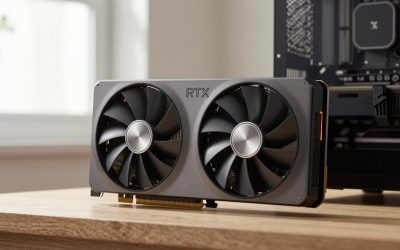
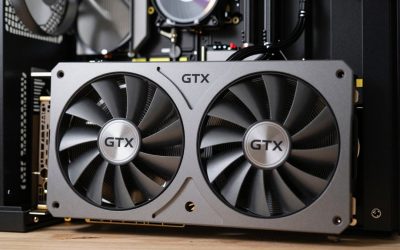
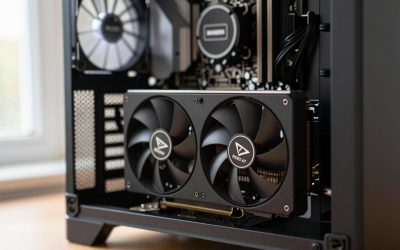
For most 1080p gamers the RTX 5060 is the card to buy. Published benchmark data puts it roughly 20 to 45% ahead of the Arc A770 in modern games, and it draws far less power and supports DLSS 4 with Multi Frame Generation. The Arc A770 16GB is only worth choosing if you find it well below the 5060’s price and you specifically need 16 GB of VRAM, for example for high-resolution texture packs, heavy modding, or GPU compute and creative work that fills memory.
The A770 launched in October 2022 at $329 as Intel’s first serious desktop gaming flagship. The RTX 5060 arrived in May 2025 at $299 as NVIDIA’s mainstream Blackwell card. One card offers twice the memory; the other offers a newer architecture, better drivers and much better efficiency.
Quick answer: Our top pick in 2026 is the Architecture — our #1 rated choice. See the full ranked comparison, alternatives and buying advice below.
Arc A770 and RTX 5060 Specifications
| Intel Arc A770 | NVIDIA RTX 5060 | |
|---|---|---|
| Architecture | Generation 12.7 (Alchemist) | Blackwell 2.0 |
| Release date | 12 October 2022 | 19 May 2025 |
| Launch MSRP | $329 | $299 |
| Shader units | 4096 | 3840 CUDA cores |
| Boost clock | 2400 MHz | 2497 MHz |
| Process | 6 nm | 5 nm |
| TDP | 225 W | 145 W |
| Memory | 16 GB GDDR6 | 8 GB GDDR7 |
| Bus width | 256-bit | 128-bit |
| Bandwidth | 512.0 GB/s | 448.0 GB/s |
| L2 cache | 16 MB | 32 MB |
| Interface | PCIe 4.0 x16 | PCIe 5.0 x8 |
| Power connectors | 1x 6-pin + 1x 8-pin | 1x 8-pin |
| Length | varies by model | 241 mm |
| Width | 2-slot | 2-slot |
| Outputs | 1x HDMI 2.1, 3x DP 2.0 | 1x HDMI 2.1b, 3x DP 2.1b |
On paper the A770 looks stronger, with more shaders, a wider bus, more bandwidth and twice the memory. Real-world gaming tells a different story, because Alchemist never converted its hardware into frame rates as efficiently as NVIDIA’s designs. Blackwell’s 32 MB L2 cache and GDDR7 memory let the 5060 do more with a 128-bit bus.
How They Compare in Games
Reviews of the RTX 5060, together with aggregated data from benchmark databases, consistently put it clearly ahead of the A770 at 1080p. Most sources land in the 20 to 45% range in recent titles, and individual games swing well outside it in both directions. Results vary widely by game:
- Typical modern AAA at 1080p high: the RTX 5060 often lands in the 70 to 100 FPS range in demanding titles, while the A770 more commonly sits around 50 to 75 FPS. Figures vary with settings, CPU and patch.
- Older DirectX 11 games and some esports titles: results are mixed. Intel’s driver work has closed much of the old gap, and a few titles still favor the A770.
- Memory-heavy games at maximum textures: the A770’s 16 GB can win outright where the 5060 runs out of VRAM. This happens mainly at 1440p and in a handful of newer 1080p releases.
At 1440p the gap narrows because the A770’s memory capacity and wider bus help more. The 5060 usually stays ahead in average frame rate, but 1% lows can favor the Intel card when a game overruns 8 GB.
Ray tracing
Alchemist’s ray tracing was respectable for a first-generation design and generally ahead of AMD’s RDNA 2 at the time. The RTX 5060’s fourth-generation RT cores are more capable, and RT-on gaps usually exceed raster gaps. In heavier RT scenes some benchmarks show the 5060 doubling the A770’s frame rate. Turning on full RT at 1080p on either card still needs upscaling to stay smooth.
DLSS 4 Versus XeSS 2
Feature support is a big part of this decision.
- RTX 5060: DLSS 4 with transformer-based Super Resolution, Frame Generation and Multi Frame Generation (up to three generated frames per rendered frame), plus Reflex. DLSS appears in hundreds of games, and the NVIDIA app can override older DLSS versions to newer models in many titles.
- Arc A770: XeSS 2 support, including XeSS Super Resolution, XeSS Frame Generation and Xe Low Latency in supported games. On Arc hardware XeSS runs its higher-quality XMX path. Fewer games support XeSS 2 than DLSS.
Multi Frame Generation can make the 5060 feel much faster on a high-refresh monitor, but it works best from a solid base frame rate, roughly 50 to 60 FPS before generation. It does not rescue a game that is already struggling.
The 8 GB Question
The RTX 5060’s 8 GB buffer is its main weakness, and reviewers called it out at launch. At 1080p with high or ultra textures, most games still fit. A growing number of recent releases need texture quality reduced one step to avoid stutter. At 1440p the limit appears more often. The A770 never has this problem; 16 GB is more than it can use for gaming at its performance level.
One more detail matters for older systems. The RTX 5060 uses a PCIe 5.0 x8 link. On a PCIe 3.0 motherboard it runs at PCIe 3.0 x8, and when a game overflows 8 GB the narrow link makes the stutter worse. If you are on a PCIe 3.0 board and play newer games, this points somewhat back toward a 16 GB card.
Power, PSU and Physical Fit
The efficiency gap is large: 225 W for the A770 against 145 W for the 5060. Here is a PSU estimate using GPU TDP, a typical 125 W gaming CPU and about 150 W of headroom:
- Arc A770: 225 + 125 + 150 = 500 W, so choose a quality 550 to 650 W unit with both a 6-pin and an 8-pin PCIe connector.
- RTX 5060: 145 + 125 + 150 = 420 W, so a good 450 to 550 W unit with one 8-pin connector is enough.
If you game around 3 hours a day, an 80 W difference comes to roughly 85 to 90 kWh per year. Whether that matters depends on local electricity rates, but it also means less heat and fan noise.
Both cards are 2-slot designs. The RTX 5060’s 241 mm reference length suits most micro-ATX and many mini-ITX cases, and several partners sell even shorter compact models. A770 dimensions depend on the partner design, so check your case’s GPU clearance against the specific model.
Intel Arc also needs Resizable BAR enabled to perform properly. Without it the A770 can lose a large share of its performance. The RTX 5060 benefits from ReBAR but does not depend on it.
Price-to-Performance and the Used A770
Using launch MSRPs and setting the A770 at 100 with the 5060 at about 130 (the middle of the published 20 to 45% range):
- Arc A770: $329 / 100 = $3.29 per performance point
- RTX 5060: $299 / 130 = about $2.30 per performance point
At launch prices the RTX 5060 gives about 30% more performance per dollar. For the A770 to match it, the A770 would need to sell for around $230. Used A770 16GB cards commonly appear in roughly the $170 to $240 range, so a used card near the bottom of that range is competitive on value if VRAM matters to you. Remember that a used card has no warranty and lacks DLSS.
Pick by Resolution and Budget
| Scenario | Recommendation |
|---|---|
| 1080p, 144 Hz monitor, mainstream AAA and esports | RTX 5060 |
| 1080p on a 450 to 550 W PSU or in a small case | RTX 5060 |
| 1440p with high-resolution textures or heavy mods | Arc A770 16GB if well priced, otherwise consider a 16 GB card from the current generation |
| Older PC without Resizable BAR | RTX 5060 |
| GPU compute, video work or AI tools that need memory | Arc A770 16GB |
| Used budget under ~$200 | Used Arc A770 |
Frequently Asked Questions
Is the RTX 5060 better than the Arc A770?
For gaming, yes, in most cases. Published benchmarks put the RTX 5060 roughly 20 to 45% ahead at 1080p, and its lead in ray tracing is larger. The A770 wins only in situations where its 16 GB of VRAM matters, such as maxed textures that overflow the 5060’s 8 GB.
Does the Arc A770 support frame generation?
Yes. The A770 supports XeSS 2, which includes XeSS Frame Generation in games that implement it. It cannot use NVIDIA’s DLSS Frame Generation. FSR frame generation also works in supported titles.
Is 8 GB of VRAM on the RTX 5060 enough?
At 1080p, 8 GB handles most games at high settings, but some recent releases need lower texture settings to avoid stutter. At 1440p the limit shows up more often. If you plan to keep the card for years and play new AAA games, the 8 GB buffer is the main trade-off.
Will the RTX 5060 lose performance on a PCIe 3.0 motherboard?
Usually only a little, as long as games stay within 8 GB of VRAM. The card uses an x8 link, so on PCIe 3.0 it has a quarter of its PCIe 5.0 bandwidth. When VRAM overflows, that narrow link makes stutter noticeably worse, so keep textures in check on older boards.
Do I need a new PSU to switch from an A770 to an RTX 5060?
No. Any PSU that ran an A770 properly will run an RTX 5060, since the 5060 needs about 80 W less and only one 8-pin connector. A quality 450 to 550 W unit is enough for the 5060 with a mainstream CPU.
Ready to decide? Our #1 pick for 2026 is the Architecture.
Live price & availability on Amazon.