Academia: School Simulator, Squeaky Wheel Studio’s school-management game published by Paradox Interactive, left Early Access in January 2021 with builds for two platforms. Steam’s record flags Windows and Mac, and every layer underneath agrees: the one purchase package grants those two systems and no third. Yet Linux players searching this record will find something stranger than a plain refusal — the paperwork of a Linux build exists on it, filed where only the developer’s testers were meant to reach it.


That distinction is the whole story here. A size-less test depot and a launch entry locked to a test branch are not a port, and no buyer can download a single Linux byte of this game. What Linux players get instead is a clean Proton route and a Steam Deck badge whose paperwork, for once, matches the build on sale to the digit.
As an Amazon Associate, we earn from qualifying purchases.
Quick answer
Academia: School Simulator is not native on Linux. Steam’s record flags Windows and Mac only, the single purchase package grants no Linux, and the Linux traces on file — a size-less test depot and a launch entry locked to a test branch — deliver no build. The route is Proton: Platinum across ten reports, and a Playable Deck badge.
The status at a glance
| Question | Answer from the record |
|---|---|
| Native Linux build | No — flags, package and requirements deny it |
| Linux traces | A size-less test depot, a locked launch entry |
| Mac build | Yes — genuinely sold, own depot and tab |
| ProtonDB record | Platinum on all tiers, 10 reports, moderate confidence |
| Steam Deck verdict | Playable, tested July 2022 on the current build |
| GOG edition | Exists, Windows only — narrower than Steam |
What Steam actually sells
Steam’s appdetails record for Academia : School Simulator (app 672630) lists the platforms as Windows true, Mac true, Linux false. Developer Squeaky Wheel Studio Inc, publisher Paradox Interactive, release date 28 January 2021 — the version 1.0 launch that closed an Early Access run begun in September 2017. The identity is exact.
The purchase layer is as plain as it gets: one purchase package, package 191444, read directly on packagedetails, containing the base app alone and reading Windows true, Mac true, Linux false. No second edition or bundle exists in which a Linux grant could hide.
The requirements fields match. The Windows tab is populated in both tiers: Windows 7 through 10 in 64-bit, 2.0 GHz and 4 GB of RAM at minimum, rising to 2.8 GHz and 8 GB recommended, onboard graphics and 400 MB either way. The Mac tab is populated too: Mac OS High Sierra 10.13 or later, the same ladder, the same 400 MB. The Linux field is an empty list outright — not the empty shell of headings over blank lists, but no tab at all.
The fossils: a test depot and a locked launch entry
The depot list is where this record turns unusual. SteamDB lists four content depots. Three are ordinary: Windows 32-bit at 127.38 MiB, Windows 64-bit at 267.17 MiB, macOS 64-bit at 261.05 MiB. The fourth, depot 672634, is configured Linux 64-bit — and carries no size at all. Its registered name ends with the words Depot Test. A depot with no size holds no files; it is scaffolding for a port that was tried and never filled.
The launch configuration tells the same story. Four entries exist: Academia.exe for 32-bit Windows, Academia64.exe for 64-bit Windows, Academia.app for macOS — and Academia.x86_64, a Linux executable name in the correct format, gated to a beta branch named cts_test. The three public entries match the three real depots exactly; the Linux entry matches the size-less test depot, and both sit behind a branch no retail copy joins — SteamDB counts one private branch alongside the public one. No Linux client icon is registered.
Read together, the fossils describe an experiment, not a product: a Linux build given a depot and a launch path, tested privately, and never promoted. The ruling follows the layers that sell something.
The Mac build, by contrast, is real — and nothing else is attached
Every test that exposes the Linux traces as hollow confirms the Mac build as genuine: a 261.05 MiB macOS depot, a launch entry pointing at a real application bundle on the public configuration, a tab populated in both tiers, and a package granting Mac alongside Windows. The asymmetry is two delivered platforms versus one abandoned test. Nor can any add-on app blur the picture: the base record exposes no DLC array, and a store search for the full name surfaces the base app alone — no soundtrack, artbook, demo or expansion app exists to carry an all-true flag or dissent. The family sweep size is zero.
The Proton file
ProtonDB’s summary record for app 672630, read in full this session, is unanimous: Platinum on the headline, best-reported and trending tiers alike, across 10 reports with moderate confidence. Ten reports is a small file, but there is no split to explain away.
One element of the game’s ProtonDB page does not agree with Steam, and it is named here rather than repeated: the page heads its requirements block with the words Natively Supports, the classification ProtonDB prints for games it treats as native. Steam’s record contradicts that heading at every layer, so this article follows Steam. The heading is best read as a template artefact over a page whose reports are all Proton filings — the Windows build under Proton 4.11 through 10.0-3, mostly out of the box, one with a gamemoderun launch option set, and a note about minor graphics artifacts.
The Steam Deck sheet
Valve rates Academia Playable on Steam Deck, with SteamOS separately Compatible. One evidence note: Valve’s own compatibility endpoint returned garbled bytes this session, so the verdict and its paperwork were read through SteamDB’s republication of Valve’s record.
The paperwork is the pleasant surprise. Valve’s single test is dated 6 July 2022 and grades build 8506022 — which is, to the digit, the current public branch build, assembled in April 2022 and unmoved since. Most badges in this series grade an ancestor of the build on sale; this one grades the build itself. The recommended runtime is proton-stable. The deduction list holds a single entry: entering text requires manually invoking the on-screen keyboard, a predictable cost in a naming-heavy game. Against that, the sheet credits the default controller configuration as fully functional, the text as legible, and the default graphics as performing well. Its input line reads gamepad, which here means Steam Input translation.
The storefront ruling
A second, narrower edition exists. GOG sells Academia : School Simulator — ruled not from any search result, since GOG’s search endpoints returned nothing for this title even though the product stands in its catalogue, but from the identity-verified live product page and GOG’s product API record: Windows true, Mac false, Linux false. GOG’s copy lacks even the Mac build Steam’s package sells, and both routes lead a Linux buyer to the same Windows build under Proton.
Gear that fits the record
The gear below follows the record’s shape: the handheld whose badge was graded on the current build, two pads working through Steam Input translation, a mouse for desktop play, and library storage.
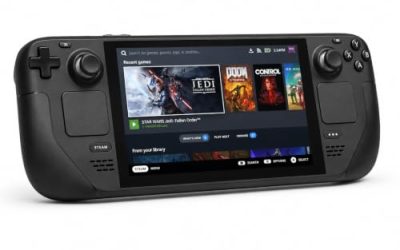
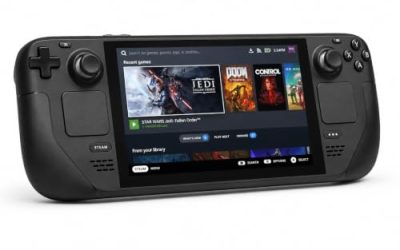
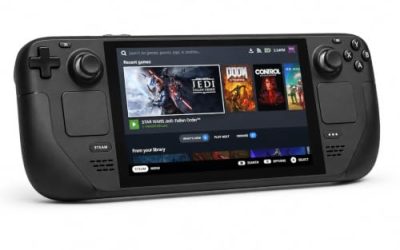
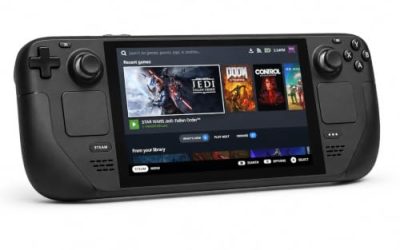
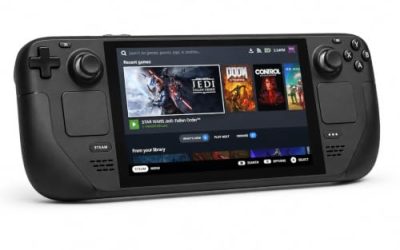
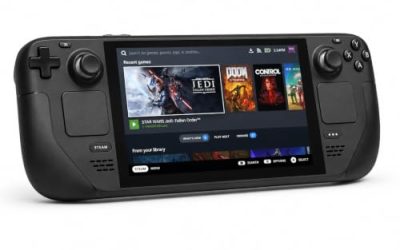
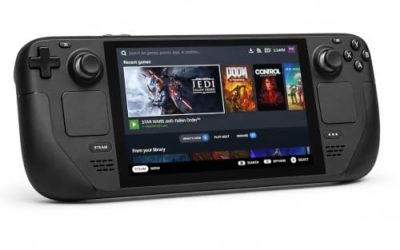
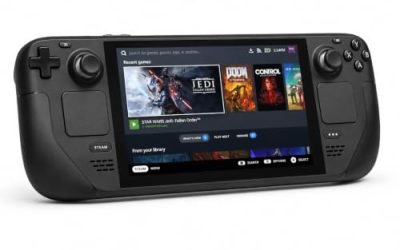
Valve Steam Deck OLED 512GB
The handheld the Playable badge was written for; Valve’s test graded the exact build on sale today. The one deduction — manual keyboard invocation for text entry — is a naming-screen pause, not a play problem.
Specs
- Display: 7.4-inch HDR OLED, 1280 by 800, up to 90 Hz
- Processor: AMD Zen 2 and RDNA 2 custom APU
- Memory: 16 GB LPDDR5
- Storage: 512 GB NVMe, plus a microSD slot
- Wireless: Wi-Fi 6E and Bluetooth
- Channel note: Valve sells the Deck mainly through its own store, so Amazon listings are third-party sellers
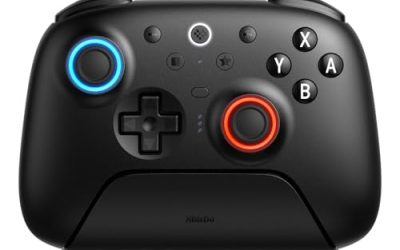
8BitDo Ultimate 2 Bluetooth Controller
The docked and desktop pad pick: Academia declares no controller support, so this pad reaches the game through Steam Input translation, the layer Valve’s Deck sheet grades. Back buttons make timetable grids comfortable from a couch.
Specs
- Connectivity: Bluetooth wireless and USB-C wired
- Joysticks: TMR electromagnetic, anti-drift design
- Triggers: Hall effect, with mode switching
- Extras: two remappable back buttons, motion control
- In the box: charging dock included
Xbox Wireless Controller, Carbon Black

The safest second pad for Steam Input play: pairing is painless, and the glyph conventions are the ones most prompts assume.
- Connectivity: Xbox Wireless and Bluetooth
- Port: USB-C for wired play
- Controls: hybrid D-pad, dedicated Share button
- Power: AA batteries or optional rechargeable pack
Logitech G502 HERO

Academia is a mouse-shaped game: floor plans, janitor routes, classroom grids and budget tables reward a precise pointer, and text entry wants a real keyboard beside it. Eleven programmable buttons cover the inputs a long session repeats.
Specs
- HERO optical sensor, up to 25,600 DPI
- 11 programmable buttons
- Adjustable weight system
- Wired USB connection
- On-board memory profiles
Samsung T9 Portable SSD 2TB

For carrying a Linux game library between machines, a fast USB-C drive is the simple answer. The headline figure needs a Gen 2×2 host port; on a lesser port the drive runs at that ceiling.
Specs
- Capacity: 2 TB portable SSD
- Interface: USB 3.2 Gen 2×2, USB-C connector
- Maker-rated speeds: up to 2,000 MB per second read, 1,950 MB per second write
- Features: Dynamic Thermal Guard, maker-rated drop resistance
How to choose
Choose the Steam copy over the GOG copy: both sell the same Windows build, but Steam’s package adds the genuine Mac build. On a Linux desktop or laptop, install and leave the compatibility tool at its default; a unanimous Platinum file says the build runs cleanly. On Steam Deck, install and play: the badge was graded on the current build. For input, budget-tier money belongs on a mouse and keyboard first — this is a planner — with a mid-range pad for couch sessions and premium-tier spending reserved for the handheld itself.
Who should skip
Skip this one if you are shopping for a native Linux management game: the test depot and locked launch entry are fossils, and no purchase delivers a Linux build. Skip it if you want a DRM-free copy that still covers a Mac, because GOG’s edition is Windows only. Skip it if a ten-report Proton file feels thin regardless of its tiers. And skip the pad-first setup if you dislike translation layers: every gamepad here works through Steam Input.
FAQ
Is Academia: School Simulator native on Linux?
No. Steam flags the game Windows and Mac only, the single purchase package grants no Linux, and the Linux requirements field is an empty list. The record holds a size-less test depot and a locked launch entry, but neither delivers a build to buyers.
What is the Linux depot on Academia’s record, then?
An empty test depot: configured for 64-bit Linux, registered with no size, so it holds no files. Together with the launch entry gated to a private test branch, it shows a port was tried internally. It was never flagged, packaged or sold.
How well does Academia run under Proton?
ProtonDB’s summary reads Platinum on all three tiers, across 10 reports with moderate confidence. Most filings describe an out-of-the-box run on current Proton versions, with a note about minor graphics artifacts.
Is Academia Playable on Steam Deck?
Yes — Valve rates it Playable, with SteamOS Compatible, and the paperwork is current: the July 2022 test graded build 8506022, the exact build the public branch still serves. The only deduction is manual keyboard invocation for text entry.
Final verdict
Academia: School Simulator is a two-platform release wearing the fossils of a third. Steam sells a Windows build and a genuine Mac build; the Linux build exists only as an empty test depot and a launch entry on a branch buyers cannot join, and GOG’s edition narrows the offer to Windows alone. What Linux players get instead is a clean route: a unanimous Platinum Proton file and a Playable Deck badge graded on the build on sale. Buy the Steam copy, play it under Proton, and read depot lists by size, not by name.
Product and ASIN Reference
| Product | ASIN |
|---|---|
| Valve Steam Deck OLED 512GB | B0CQ3RWQQZ |
| 8BitDo Ultimate 2 Bluetooth Controller | B0F194QFT2 |
| Xbox Wireless Controller, Carbon Black | B08DF248LD |
| Logitech G502 HERO | B07GBZ4Q68 |
| Samsung T9 Portable SSD 2TB | B0CHFS9K14 |