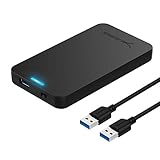
- Top Pick: SABRENT 2.5in SATA to USB 3.0 Tool-Free SSD/HDD Enclosure (EC-UASP)
- Best Value: SABRENT USB 3.0 to 2.5in SATA Adapter Cable for SSD & HDD, UASP (EC-SSHD)
- Premium Choice: ORICO 2.5 SSD SATA to 3.5 Hard Drive Adapter Internal Drive Bay Converter Mounting Bracket Caddy Tray for 7 / 9.5 / 12.5mm 2.5 inch HDD / SSD with SATA III Interface(1125SS)
The honest answer hasn’t changed in a decade: put your operating system on an SSD, and buy a hard drive only when you need a lot of terabytes for not much money. Everything below is the reasoning behind that sentence, because the wrong call in either direction costs you real money or real frustration.
As an Amazon Associate we earn from qualifying purchases at no extra cost to you.


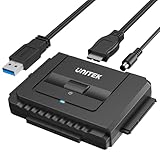

The real difference is random access, not the numbers on the box
A hard drive stores data on spinning magnetic platters, and an actuator arm physically moves the read head to each location. An SSD stores data in flash cells with no moving parts. That one fact explains everything else. Sequential transfer speeds differ by 3x to 50x, but random access — thousands of tiny scattered reads, which is what an OS actually does all day — is where HDDs fall apart. A 7200rpm drive manages roughly 150–200 IOPS on 4K random reads. A basic SATA SSD does 90,000+. An NVMe drive does several hundred thousand. That’s why slapping a $60 SSD into a five-year-old PC feels like buying a new computer.
Speed in real numbers
Sequential throughput: a 7200rpm desktop HDD does 150–270 MB/s on its outer tracks and drops well under 100 MB/s as it fills. Laptop 5400rpm drives manage 80–120 MB/s. SATA SSDs saturate their interface at ~550 MB/s. NVMe drives hit ~3,500 MB/s on PCIe Gen3, ~7,000 on Gen4, and 12,000+ on Gen5 — though you’ll only see those numbers moving huge files.
What you’ll actually notice: a Windows machine on an HDD takes 45–90 seconds to a usable desktop, with startup apps still loading for minutes after. The same machine on an SSD is fully responsive in 10–20 seconds. Game level loads drop from 30–60 seconds to 5–15. And newer titles built on DirectStorage genuinely stutter on spinning disks — a few now list an SSD as a minimum requirement, not a recommendation.
Cost per terabyte is the HDD’s only real argument
Prices shift, but the ratio is stable. Rough street pricing:
| Capacity | 3.5″ HDD | 2.5″ SATA SSD | M.2 NVMe SSD |
|---|---|---|---|
| 1TB | ~$45 | ~$60–70 | ~$65–80 |
| 2TB | ~$55–65 | ~$110–130 | ~$110–140 |
| 4TB | ~$80–100 | ~$200–240 | ~$220–280 |
| 8TB | ~$125–150 | ~$450+ | ~$500+ |
An 8TB HDD works out to roughly $16–19 per terabyte; a 2TB NVMe is $55–70 per terabyte — about 3–4x. Below 4TB, though, the HDD’s savings are too small to justify everything you lose.
How each one dies
Hard drives fail mechanically. Drop a running drive from desk height and there’s a fair chance it’s dead. The “click of death” means head or platter failure. Backblaze’s published stats put HDD failure rates at roughly 1–2% per year, concentrated in the first months and again after five-plus years. The upside: dying HDDs usually warn you — clicking, SMART errors, slow reads — and data recovery is sometimes possible.
SSDs fail differently. NAND wears out, but the ratings are generous — a typical 1TB TLC drive is rated for ~600 TBW, and most users write under 50TB in the drive’s lifetime, so wear isn’t the real risk. The real risks are controller or firmware failure, which is sudden and total, and retention: a worn consumer SSD is only guaranteed to hold data unpowered for about a year at 30°C, less in a hot garage. Don’t archive family photos on a drawer SSD. Neither technology is a backup — an SSD just gives you less warning before it goes.
Noise, power, and abuse
A 3.5″ HDD draws 6–9W and you can hear it — spin-up whine, seek chatter during scans. An SSD is silent at 2–4W, which matters for laptop battery life, and it survives drops that would kill a spinning drive. One SSD caveat: NVMe drives throttle hard when hot — sustained writes can push them past 70°C and they cut speed to protect themselves. The thin heatsink your motherboard ships with is enough; a bare drive in a dead-air slot is not.
Where the HDD is still the right buy
A Plex or media library doesn’t need speed — streaming a movie takes ~10 MB/s, and an HDD delivers fifteen times that. Backups belong on cheap spinning disks, ideally two. NAS arrays are fine on HDDs — just buy CMR drives, because bargain SMR drives collapse to single-digit MB/s on sustained writes and can take days to rebuild a degraded array. Anywhere you need 8TB or more on a budget, spending 3–4x for flash buys you nothing you’ll ever notice.
What I’d actually buy
For the main drive in a desktop or laptop, get a 1TB or 2TB Gen4 NVMe drive — check that your board has an M.2 slot first (most anything from 2017 onward does). Reviving an older SATA-only machine or a laptop with a 2.5″ bay? A 2.5-inch SATA SSD still transforms it — you lose the peak numbers, not the responsiveness. For bulk storage, an 8TB 3.5-inch 7200rpm drive is the value sweet spot. Skip 2.5″ HDDs entirely — 5400rpm and usually SMR, the worst of both worlds.
The swap itself is about twenty minutes with free cloning tools, or a clean OS install if the old system was a mess anyway. The one mistake still worth avoiding: buying a drive you’ll outgrow. Game installs run 100–150GB now — 1TB is the practical minimum, 2TB the comfortable pick.