SYNTHETIK: Legion Rising, Flow Fire Games’ top-down roguelite shooter from March 2018, never received a Linux port. That is not an inference from a quiet store page: every layer of Steam’s own record says the same thing. The platform flags name Windows alone, the Mac and Linux requirements fields do not exist in any form, and the package on sale contains one content depot, a Windows build. No port hides behind a fossil icon or a mislabelled depot, because there is no second depot at all.
What the game does have is depth of evidence on the compatibility route. Its Proton file is one of the thickest in this series, Valve has published a full Steam Deck test sheet for it, and a second storefront sells the same Windows build under a record that agrees with Steam’s.
As an Amazon Associate, we earn from qualifying purchases.
Quick answer
SYNTHETIK: Legion Rising is not native on Linux. Steam’s record flags Windows alone, ships a single Windows depot, and the one add-on matches. The Windows build travels well: ProtonDB settles it at Platinum across 122 reports, and Valve rates it Playable on Steam Deck. The Steam copy is the default buy; GOG sells the same Windows build.
One depot, one platform: what the record holds
Start with the flags. Steam’s record for app 528230 reads windows true, mac false, linux false. The Windows requirements tab is genuinely populated in both tiers: the minimum asks for Windows XP SP3 or Vista and up, a Celeron G1820 or FX 8320, 4 GB of RAM, a GeForce GTX 460 or Radeon HD 5770, DirectX 11 and 600 MB of storage. The Mac and Linux requirements fields are absent fields — empty lists, with no tab in any form, not even a populated shell.
The depot census is just as plain. The sold package carries one content depot, 528231, labelled Windows, at 621.94 MiB. The only other depot is the shared DirectX June 2010 redistributable — infrastructure, not game content. There is no Linux depot, no Mac depot, no shared depot and no ghost depot at zero bytes. The registered assets close the question from the other side: no LinuxClientIcon is registered in any form — neither the fossil shape, where an icon outlives a withdrawn build, nor the inverse case, where a real build ships without its icon.
Two smaller points matter below: Steam detects the GameMaker engine underneath the game, and the game’s own record lists full controller support — its claim about pads in general. What Valve’s testers found on the Deck specifically is a separate question, answered by the Deck sheet further down.
The add-on shelf: one pack, same flags
The full DLC array holds exactly one app, read on its own record. The SYNTHETIK – Supporter Pack (app 909610, October 2018) flags windows true, mac false, linux false, matching the base game flag for flag. There is no soundtrack app in this family, so the soundtrack all-true trap — an add-on claiming every platform beside a Windows-only base — cannot fire here. The family’s Linux-flag count is zero.
Platinum on paper: the Proton file
ProtonDB’s summary for this app reads settled Platinum, best-reported Platinum, trending Platinum, across 122 reports, with strong confidence. That is a full summary read, and the control app answered normally alongside it, so the figures stand as published. Recent desktop reports on current Proton and GE-Proton builds describe out-of-the-box runs, and online co-op draws repeated Excellent ratings, with players noting that its relay latency and sync quirks belong to the game itself, not the compatibility layer. Deck filings describe a game that plays well at low wattage caps, one reporting five to six hours of battery at a 7 W ceiling.
The file’s weak spots are old or narrow, and they are named here rather than smoothed over. Several 2024-era filings from Ubuntu-family systems describe launch failures caused by missing 32-bit NVIDIA driver libraries on those installs — a host packaging problem, not a game defect, and later filings from the same family report flawless runs. Older reports leaned on the PROTON_NO_ESYNC=1 launch option against a memory leak; newer filings say Proton updates have largely retired that workaround. One ProtonDB oddity deserves a direct note: the game’s page there carries a “Natively Supports:” heading above its requirements panel. That heading is wrong — Steam’s record denies a Linux build on every layer checked here, and the Platinum tier describes the Windows build under Proton, which is what the reports actually document.
On anti-cheat, the record names none, and the community anti-cheat index holds no entry for this game in either direction — documentation silence rather than a clearance; the Proton reports are the practical evidence that co-op works.
Playable, with four deductions: the Deck sheet
Valve’s own compatibility endpoint rates the game Playable on Steam Deck, and SteamOS separately Compatible. The sheet passes one check outright: the default graphics configuration performs well on the Deck. Four deductions hold it at Playable: some functionality is not accessible with the default controller configuration, requiring the touchscreen, the virtual keyboard or a community configuration; the game sometimes shows mouse, keyboard or non-Deck controller glyphs; entering some text requires manually invoking the on-screen keyboard; and some in-game text is small and may be difficult to read. A further note warns that the game does not default to external controllers for the primary player, so a docked pad may need a manual switch through the Quick Access Menu. ProtonDB’s Deck filings agree, and add a warning of their own: keep the game in fullscreen on the handheld.
The paperwork’s age needs stating plainly. The test metadata, read through SteamDB’s republication of Valve’s sheet and disclosed here as such, dates the test to 19 March 2022 against build 6762177; the current public build is 26298694, from October 2026. So the badge grades the 2021 version line, years behind the copy on sale today. Nothing in the recent Proton file suggests the current build behaves worse, but the badge is a supplement candidate: treat the 2022 sheet as a floor, not a measurement of today’s build.
The other storefront
GOG sells this game, and its record agrees with Steam’s. The ruling rests on GOG’s own product record, not on search: the store’s embedded search returns zero products for this title, a known blind spot, while the live product page exists and the product API record behind it lists compatibility as windows true, osx false, linux false. So the GOG edition is the same Windows build in a DRM-free wrapper, with the caveat on its page that GOG Galaxy is required for online co-op. It is not a Linux edition: on Linux, either copy runs under Proton.
Gear that fits the record
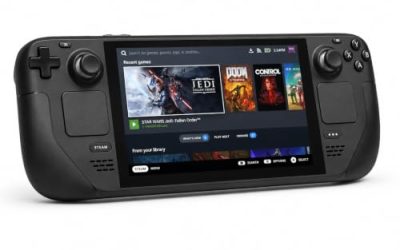
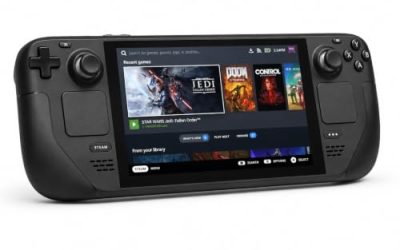
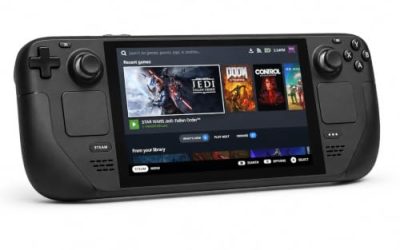
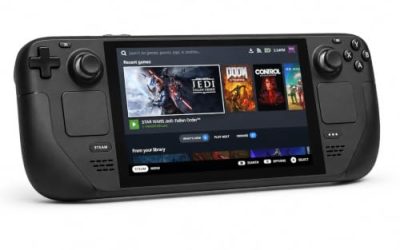
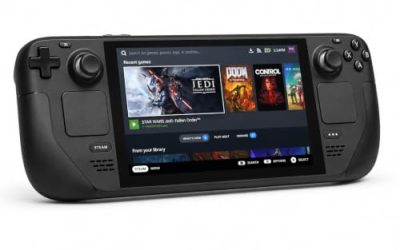
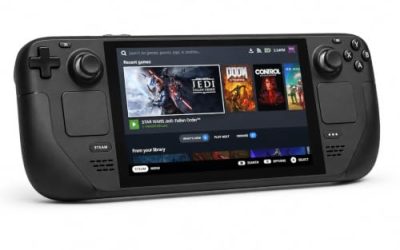
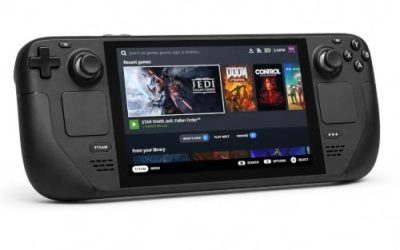
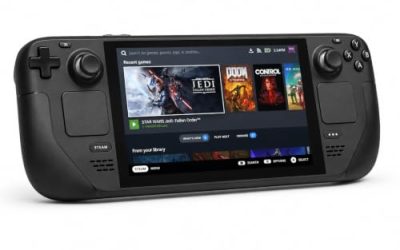
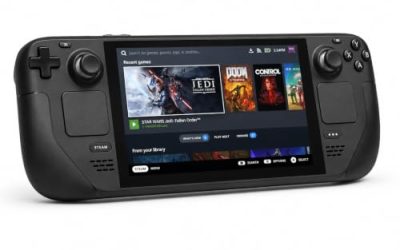
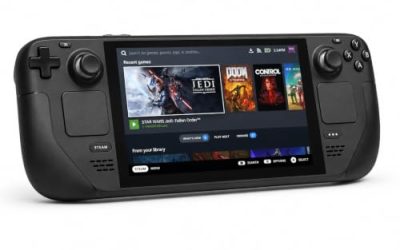
Valve Steam Deck OLED 512GB

The handheld Valve’s test sheet describes. The badge is Playable rather than Verified, with small text among the deductions, so the brighter OLED panel is the Deck version that suits this game best.
Specs
- Display: 7.4-inch HDR OLED, 1280 by 800, up to 90 Hz
- Processor: AMD Zen 2 and RDNA 2 custom APU
- Memory: 16 GB LPDDR5
- Storage: 512 GB NVMe, plus a microSD slot
- Wireless: Wi-Fi 6E and Bluetooth
- Channel note: Valve sells the Deck mainly through its own store, so Amazon listings are third-party sellers
8BitDo Ultimate 2 Bluetooth Controller
The docked and desktop pad pick. Steam’s record lists full controller support for this game; Valve’s sheet only warns that an external pad may not take over by default on the handheld, which a Quick Access Menu switch covers. The back buttons suit the reload and eject inputs the game leans on.
Specs
- Connectivity: Bluetooth wireless and USB-C wired
- Joysticks: TMR electromagnetic, anti-drift design
- Triggers: Hall effect, with mode switching
- Extras: two remappable back buttons, motion control
- In the box: charging dock included
Xbox Wireless Controller, Carbon Black
The safest guest pad in PC gaming: Steam Input support is universal, and it pairs over Bluetooth or its own wireless standard. On the handheld, the test sheet’s note applies: an external pad may need a manual Quick Access Menu switch before it takes over.
- Connectivity: Xbox Wireless and Bluetooth
- Port: USB-C for wired play
- Controls: hybrid D-pad, dedicated Share button
- Power: AA batteries or optional rechargeable pack
Logitech G502 HERO
A twin-stick shooter at heart, and at a desk a precise wired mouse is the classic way to aim. Eleven programmable buttons cover the weapon swap, item and reload inputs a long run repeats.
Specs
- HERO optical sensor, up to 25,600 DPI
- 11 programmable buttons
- Adjustable weight system
- Wired USB connection
- On-board memory profiles
Samsung T9 Portable SSD 2TB
For moving a Linux game library between machines, or keeping an offline backup of installers, a fast USB-C drive is the simple answer. The headline figure needs a Gen 2×2 host port; on a lesser port the drive runs at that ceiling.
Specs
- Capacity: 2 TB portable SSD
- Interface: USB 3.2 Gen 2×2, USB-C connector
- Maker-rated speeds: up to 2,000 MB per second read, 1,950 MB per second write
- Features: Dynamic Thermal Guard, maker-rated drop resistance
How to choose
Choose the Steam copy as the default: it is the build both compatibility records describe, its Proton file is Platinum across a thick 122-report sample, and the Deck badge sits ready-made. Choose the GOG copy only if a DRM-free installer matters more than Steam’s integration, knowing it is the identical Windows build under the same Proton layer, and that its co-op asks for GOG Galaxy. On the Deck, budget a few minutes for setup: enable the controller in the game’s settings, stay in fullscreen, expect small text in menus. On a desktop, leave the compatibility tool at its default; the historical workarounds belong to older builds and driver stacks.
Who should skip
Skip this one on Linux if you only buy native ports — there is none here, on either storefront, and the record gives no sign of one coming. Skip the Deck version if small interface text is a hard dealbreaker, because Valve’s sheet deducts for exactly that and no setting enlarges it. And if you are looking for the sequel, stop here: SYNTHETIK 2 is a separate app with its own record, and nothing on this page describes it.
FAQ
Is SYNTHETIK: Legion Rising native on Linux?
No. Steam flags the game Windows only, the Linux requirements field is absent, and the sold package contains a single Windows depot at 621.94 MiB. The GOG product record agrees. On Linux the game runs under Proton.
How well does it run under Proton?
ProtonDB settles it at Platinum — best-reported and trending tiers alike — across 122 reports at strong confidence. Recent filings describe out-of-the-box runs on desktop and Deck, and online co-op is repeatedly rated Excellent. Older filings document a 32-bit driver library problem on some Ubuntu-family installs, since overtaken by clean reports.
Is it Steam Deck Verified?
No — Valve rates it Playable, one tier below Verified. The default graphics configuration performs well, but the sheet deducts for a default controller configuration that is not fully functional, non-Deck glyphs, manual keyboard invocation for text entry, and small in-game text. The test dates to March 2022, against an older build.
Does the Supporter Pack change the Linux picture?
No. The Supporter Pack is the family’s only add-on app, and its own record flags Windows alone, matching the base game. No add-on carries a Linux flag, so the family’s platform answer is the same whichever apps you own.
Final verdict
SYNTHETIK: Legion Rising is a Windows-only game whose Linux story is nonetheless an easy recommendation. The record could not be cleaner: one platform flag set, one depot, one add-on in agreement, a second storefront saying the same thing. Against that, the compatibility evidence is deep — a Platinum Proton file across 122 reports and a Playable Deck badge whose only real caveat is its age. Buy the Steam copy, run it under Proton, and on the Deck spend two minutes on the controller setting first.
Product and ASIN Reference
| Product | ASIN |
|---|---|
| Valve Steam Deck OLED 512GB | B0CQ3RWQQZ |
| 8BitDo Ultimate 2 Bluetooth Controller | B0F194QFT2 |
| Xbox Wireless Controller, Carbon Black | B08DF248LD |
| Logitech G502 HERO | B07GBZ4Q68 |
| Samsung T9 Portable SSD 2TB | B0CHFS9K14 |