Stationeers, RocketWerkz’s station construction and management simulation, asks players to build and run orbital stations and planetary bases, plumbing gases, power and temperature systems while keeping a crew alive. It launched in December 2017, and Steam’s genre list still carries an Early Access label for it. What the record has never carried is a Linux build: the store flags the game for Windows alone, and every other layer points the same way.
That makes this a Proton question rather than a port question. The community compatibility file is deep and favourable, Valve has published a Steam Deck test sheet, and the game’s eight add-on packs, anti-cheat position and storefront position each need reading on their own terms.
As an Amazon Associate, we earn from qualifying purchases.
Quick answer
Stationeers is not native on Linux. Steam flags the game Windows only, its Linux requirements tab is an empty shell, and the only content depot is a Windows build. The route is Proton: ProtonDB rates it Gold with a Platinum best-reported tier across 88 reports, and Valve rates it Playable on Steam Deck.
What the store record actually says
Start with the game app itself, app 544550, developed and published by RocketWerkz. Its platform flags read Windows true, Mac false and Linux false. The Linux requirements field is an empty shell: the Minimum and Recommended headings are present, with empty lists beneath both, and the Mac field reads the same way. An empty shell is paperwork, not a specification; no Linux distribution, processor or graphics floor is published anywhere on the record.
The depot record closes the split-record question. Where some games pair a false flag with a populated tab or a live Linux depot, Stationeers shows neither: the single content depot is a Windows 64-bit build. Flag, tab and depots all agree. The published categories describe the game’s shape: Single-player, Multi-player, Co-op, Online Co-op and LAN Co-op, alongside Steam Achievements, Steam Workshop, Partial Controller Support, Steam Cloud, Stats and Family Sharing. The Windows minimum is the only specification published: Windows 7 or newer in 64-bit form, an Intel Core i5 2500K or AMD equivalent, 4 GB of memory, a GeForce GTX 660 with 2 GB or AMD equivalent, DirectX 11 and 5 GB of storage.
The family sweep: eight packs, no side door
Every add-on app on the game’s record was read individually. The family holds eight downloadable packs: the H.E.M Droid Species Pack, the Human Cosmetics Pack, the Zrilian Species Pack, the International Uniforms Pack, and four supporter items, three bobbleheads plus the Metallic Spray Paints. All eight flag Windows true, Mac false and Linux false.
Two absences matter as much as the eight readings. There is no demo app on the record, and no music-type app anywhere in the family. The soundtrack trap, where an album flags Linux beside a Windows-only game and misleads family-level scans, cannot form here: no album exists to carry the flag. The family Linux-flag count is zero of nine apps including the game.
DRM, accounts and anti-cheat: three silences
The record names no DRM product. There is no DRM notice on the game app, so no protection system can be quoted or attributed; Steam’s record is silent in that field, in either direction. The same applies to accounts: no external account notice appears, so no launcher layer is named.
Anti-cheat takes three readings, kept separate. Steam’s own record names none: no notice and no anti-cheat category, despite the published Online Co-op and LAN Co-op categories. SteamDB’s detected technologies are the Unity Engine, Discord SDK, Mono SDK, Sentry SDK, UnityBurst SDK and cURL SDK: engine, social, scripting, crash-reporting and networking components, with no anti-cheat system among them. Are We Anti-Cheat Yet carries no entry for this title, checked by name and by app id against its full dataset, which is an absence rather than a rating. Desktop and Deck positions agree: Valve’s test sheet carries no anti-cheat deduction either.
The Proton file
ProtonDB’s summary feed answers in full for this app. The headline tier is Gold, the best-reported tier is Platinum and the trending tier is Platinum, across 88 reports, with confidence rated strong. The split is worth stating exactly as published: the headline sits a step below the best the game has achieved, while the recent trend matches the ceiling.
Because the summary feed answered, the figures above are claimed from it directly. One check could not be completed: the game page returned only a script shell in this session, so no page-level classification heading is claimed either way. The practical reading is that the Windows build is a known quantity under Proton on current reports.
The Steam Deck sheet
Valve’s own compatibility record rates Stationeers Playable on Steam Deck, and SteamOS separately reads Compatible. The verdict and its items come from Valve’s endpoint directly. The caution lines are input- and text-shaped: some functionality is not accessible with the default controller configuration, requiring the touchscreen or virtual keyboard or a community configuration; the game sometimes shows mouse, keyboard or non-Deck controller icons; entering text requires manually invoking the on-screen keyboard; some in-game text is small; and graphics settings require manual configuration to perform well. The same sheet also states that all functionality is accessible when using the default controller configuration, and both lines stand here as published.
The paperwork behind the badge comes from SteamDB’s republication of Valve’s test record, disclosed as the source: the sheet is dated 1 September 2026, the tested build is 24703804, and the recommended runtime is proton-stable. The configuration names supported input as other, records that an external pad does not sit in the primary player’s slot by default, and requires no internet connection for setup or single-player play. Five caution lines fairly summarise a dense simulation on a handheld: the friction is in text entry, glyphs and settings, not launching.
The storefront ruling
There is no second PC edition to consider. GOG’s catalogue and embed searches return no product for this game, and the address a GOG product page would occupy redirects to that storefront’s general games catalogue, its behaviour for a title it does not sell. The Steam copy is the only PC edition and the buy.
Gear that fits the record
The record points at a desktop-first game with a workable handheld route: a Deck for portable sessions, two pads for docked play, a precise mouse for the dense construction menus, and fast storage for a Workshop-heavy library.
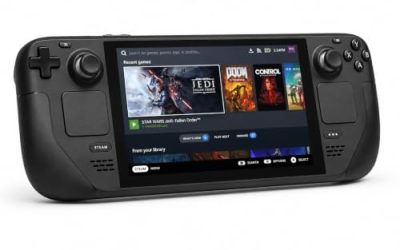
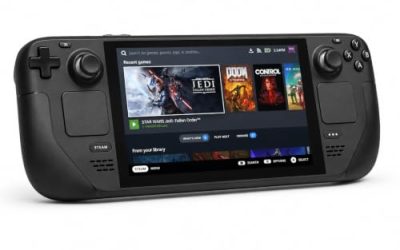
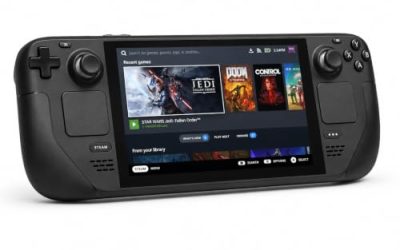
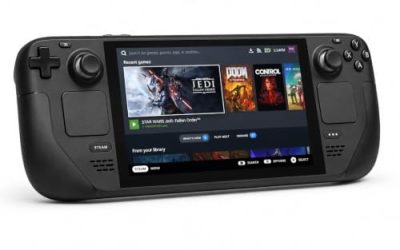
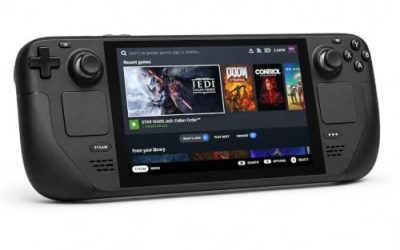
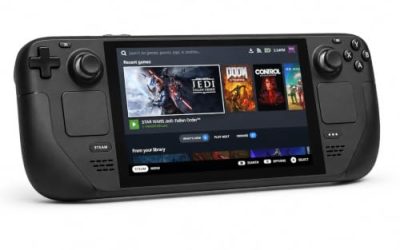
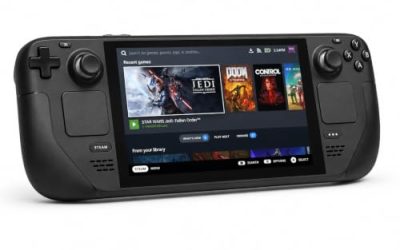
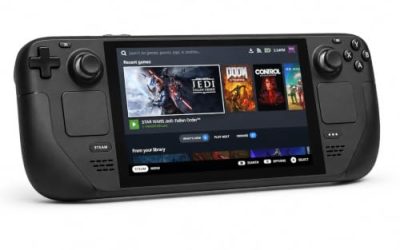
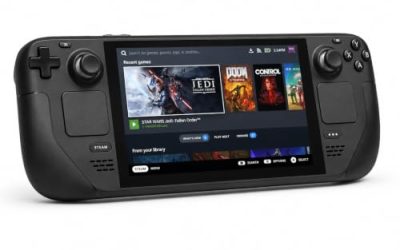
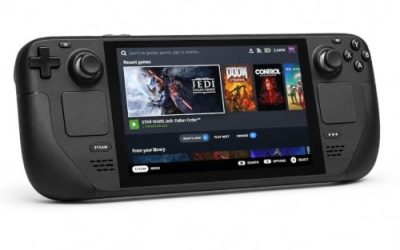
Valve Steam Deck OLED 512GB

The handheld behind the Playable badge. The sheet’s cautions concern text, glyphs and graphics settings rather than performance headroom, and the OLED panel’s clarity helps with the small interface text Valve flags.
Specs
- Display: 7.4-inch HDR OLED, 1280 by 800, up to 90 Hz
- Processor: AMD Zen 2 and RDNA 2 custom APU
- Memory: 16 GB LPDDR5
- Storage: 512 GB NVMe, plus a microSD slot
- Wireless: Wi-Fi 6E and Bluetooth
- Channel note: Valve sells the Deck mainly through its own store, so Amazon listings are third-party sellers
8BitDo Ultimate 2 Bluetooth Controller

The docked and desktop pad pick. Steam lists partial controller support, so a pad is a companion to the keyboard rather than a replacement, and this one covers couch sessions with modern sticks, triggers and back buttons.
Specs
- Connectivity: Bluetooth wireless and USB-C wired
- Joysticks: TMR electromagnetic, anti-drift design
- Triggers: Hall effect, with mode switching
- Extras: two remappable back buttons, motion control
- In the box: charging dock included
Xbox Wireless Controller, Carbon Black

The safest guest pad in PC gaming: Steam Input support is universal, the glyphs match what most games display, and it pairs over Bluetooth or its own wireless standard. On the handheld, an external pad does not take the primary slot by default.
- Connectivity: Xbox Wireless and Bluetooth
- Port: USB-C for wired play
- Controls: hybrid D-pad, dedicated Share button
- Power: AA batteries or optional rechargeable pack
Logitech G502 HERO

Stationeers is a game of pipe networks, wiring runs and inventory grids, and at a desk a precise wired mouse is the primary tool. Eleven programmable buttons cover the build, rotate and confirm inputs a long session repeats.
Specs
- HERO optical sensor, up to 25,600 DPI
- 11 programmable buttons
- Adjustable weight system
- Wired USB connection
- On-board memory profiles
Samsung T9 Portable SSD 2TB

Workshop content and a growing station library argue for fast portable storage, for moving a Linux game library between machines or keeping an offline backup. The headline figure needs a Gen 2×2 host port; on a lesser port the drive runs at that ceiling instead.
Specs
- Capacity: 2 TB portable SSD
- Interface: USB 3.2 Gen 2×2, USB-C connector
- Maker-rated speeds: up to 2,000 MB per second read, 1,950 MB per second write
- Features: Dynamic Thermal Guard, maker-rated drop resistance
How to choose
Choose the Steam copy; it is the only PC edition, and its Windows build is the one both compatibility records describe. On a desktop or laptop, install under Proton and start from the default compatibility tool: the Gold headline with Platinum best-reported and trending tiers across 88 reports says the current build is a known quantity. Expect the work to be in the game itself, not the layer: Stationeers simulates gases, pressure and temperature in depth, and its interface assumes a keyboard and mouse nearby. On Steam Deck, treat the Playable badge literally: text entry needs the on-screen keyboard called up by hand, graphics settings need manual tuning, and a community controller configuration may serve better than the default. For co-op, no anti-cheat gate is named on any source checked.
Who should skip
Skip the native-build hunt entirely: there is no Linux version to find, on Steam, in the add-on family or on any other PC storefront checked. Skip the Deck as your only machine if small interface text and manual graphics tuning would spoil a dense simulation for you. And skip the game itself if you want a gentle introduction to the genre: its systems-first design is the opposite of a casual station builder, on any operating system.
FAQ
Is Stationeers native on Linux?
No. Steam flags the game Windows only, the Linux requirements field is an empty shell with no specification under its headings, and the only content depot is a Windows 64-bit build. None of its eight add-on packs flags Linux either, and no soundtrack app exists to blur the picture.
How well does Stationeers run under Proton?
ProtonDB’s summary rates the Windows build Gold at headline, Platinum on its best-reported tier and Platinum on its trending tier, across 88 reports with strong confidence. That is the record the Linux route rests on.
Is Stationeers Playable on Steam Deck?
Yes, at Valve’s Playable tier, with SteamOS separately rated Compatible. The test sheet, dated 1 September 2026 in SteamDB’s republication of Valve’s record, cautions on controller configuration, non-Deck glyphs, manual keyboard invocation, small text and manual graphics settings.
Can I buy Stationeers on GOG instead?
No edition exists there. GOG’s own searches return no product for the game, and the address its product page would use redirects to the general catalogue. The Steam copy is the only PC edition sold.
Final verdict
Stationeers on Linux is a Proton story with unusually tidy paperwork. The native answer is no at every layer: false flag, empty-shell tab, a Windows-only depot and a nine-app family without a single Linux flag. Against that, the Windows build carries a Gold ProtonDB headline with Platinum best-reported and trending tiers on 88 strong-confidence reports, no anti-cheat system named by any source checked, and a Playable Deck sheet whose cautions concern text and input rather than launch failures. Buy the Steam copy, play it on desktop first, and treat the Deck as a capable second screen.
Product and ASIN Reference
| Product | ASIN |
|---|---|
| Valve Steam Deck OLED 512GB | B0CQ3RWQQZ |
| 8BitDo Ultimate 2 Bluetooth Controller | B0F194QFT2 |
| Xbox Wireless Controller, Carbon Black | B08DF248LD |
| Logitech G502 HERO | B07GBZ4Q68 |
| Samsung T9 Portable SSD 2TB | B0CHFS9K14 |