Pioneers of Pagonia is Envision Entertainment’s settlement builder in the classic Settlers mould: procedurally generated islands and shared co-op for up to four players. It left Early Access for its full release in December 2025, published by Headup, and Linux players face the usual question: is there a native build, or is Proton the only way in?
There is no native Linux build, and the record is not ambiguous. Steam flags the game Windows-only, its Linux tab is an empty shell, and the one Linux flag in the game’s family sits on the soundtrack album. What the game offers instead is depth of evidence: a 200-report ProtonDB file and a Playable Deck rating whose deductions concern mice, not performance.
As an Amazon Associate, we earn from qualifying purchases.
Quick answer
Pioneers of Pagonia has no native Linux build: Steam flags the game Windows-only and its Linux requirements tab is an empty shell. The route in is Proton, where 200 community reports hold a Gold headline with a Platinum best-reported tier. On Steam Deck the game is rated Playable, with small text and display scaling as the named costs.
What Steam’s record actually says
Steam’s appdetails record for app 2155180 flags Windows true and both Mac and Linux false. The linux_requirements field is the empty shell: Minimum and Recommended headings printed over empty lists; the Mac field reads the same way. No split-record rescue applies: SteamDB’s depot listing shows the main content depot and a Windows shared-install redistributable, and no Linux depot exists. Flag, tab and depots agree.
The published Windows minimum asks for 64-bit Windows 10 version 1909 or newer, a quad-core processor, 8 GB of RAM, a GeForce GTX 1050 Mobile or Radeon RX 470, DirectX 12 and 10 GB of storage; the recommended tier raises the processor and memory to hexa-core and 16 GB. One note matters for Linux readers: the developer states that Intel integrated graphics are not supported, and that Intel Arc cards may cause problems due to open driver issues — a caution written about the Windows build.
The category list tells you how the game is meant to be played: single-player, multi-player, co-op and online co-op, achievements, trading cards, Steam Cloud and Family Sharing, plus an accessibility list that includes a mouse-only option. There is no controller-support category of any kind. This is a mouse-driven builder, and that explains most of what the Deck sheet says below.
The family sweep: the soundtrack trap fires
Every add-on app on the game’s record was read individually. The downloadable content is all Windows-only: Echoes of Aldramar, Meadowsong, the Cosmetics Pack: A Touch of Spring, and the Official Guide each flag Windows alone. The Wallpaper app, a separate listing, also flags Windows only. The one exception is the Original Soundtrack, a music-type app, which flags Windows, Mac and Linux all true.
That makes the family’s Linux-flag count one of six on the game’s own record, and the single flag sits on the music album. A soundtrack flagging Linux means the audio files can be sold to Linux accounts; it says nothing about a playable build.
DRM and accounts: a silent record
The game’s record carries no drm_notice, and no DRM product is named anywhere on it. It also carries no external account notice: no launcher and no third-party account layer is named. Both silences are reported as gaps rather than findings, because a record that names nothing cannot certify anything. SteamDB’s page prints no third-party DRM line either.
Anti-cheat, source by source
The three sources are kept separate, and on this game they agree by absence. Steam names no anti-cheat system: no notice and no anti-cheat category, despite the published online co-op categories. SteamDB’s detected technologies are Epic Online Services SDK, FMOD SDK, FreeImage SDK, Modio SDK, an NVIDIA GeForce Now SDK, NVIDIA Nsight Aftermath SDK and a dotnet SDK. The Epic entry is the co-op services layer and the Modio entry the mod platform; neither is an anti-cheat product.
Are We Anti-Cheat Yet carries no entry for this title: its full dataset was searched by name and by app id and returned nothing. The desktop and Deck positions agree — Valve’s sheet carries no anti-cheat deduction, and nothing suggests the co-op mode is gated by a blocking anti-cheat layer.
ProtonDB: a Gold headline with a Platinum ceiling
ProtonDB’s summary record answered in full this session. The headline tier is Gold, the best-reported tier is Platinum, the trending tier is Gold, across 200 reports with strong confidence — enough weight that the Gold headline cannot be waved away as a thin sample, and the Platinum tier shows the ceiling current builds reach. The split is the honest shape of a big simulation under Proton: a game simulating thousands of settlers will find the settings where it runs less happily.
The ProtonDB game page itself did not load in this session, so no page-level classification header is claimed either way; the figures above come from the summary feed.
Steam Deck: Playable, with a mouse-shaped catch
Valve’s own compatibility record, read directly from the Deck compatibility endpoint, rates the game Playable, category 2, and rates SteamOS separately as Compatible. The passing item matters most: the default graphics configuration performs well on Steam Deck. The deductions are four, and all four trace back to the mouse. The default controller configuration is not fully functional, requiring the touchscreen, the virtual keyboard or a community configuration. The game sometimes shows mouse, keyboard or non-Deck controller glyphs. Some in-game text is small and may be difficult to read. And the game is incorrectly scaled on the Deck display and may require manual resolution configuration; the sheet names the supported input as “other”.
The paperwork has an age caveat. SteamDB’s republication of Valve’s test record dates the test to 16 January 2024, on build 13000453, with proton-stable as the recommended runtime — during Early Access, close to two years before the December 2025 full release. The badge as published today still reads Playable, and the ProtonDB file’s 200 reports cover the current build far more recently.
The GOG edition exists, and it is Windows-only
GOG does sell this game, which its own search endpoints fail to show (both returned zero, the known blind spot), so the ruling rests on GOG’s live product page and the product record behind it. That record, for product 1094761599, lists exactly one supported operating system: Windows. A GOG edition exists, then, and it changes nothing for Linux readers: the same Windows build, while the Steam copy remains the one both compatibility records here describe.
The folder’s city-builders catalogue makes no claim about this game.
Gear that fits the record
The gear follows the record’s shape: the Playable-rated handheld, two pads framed as Steam Input devices for a mouse-shaped game, a proper mouse, and library storage.
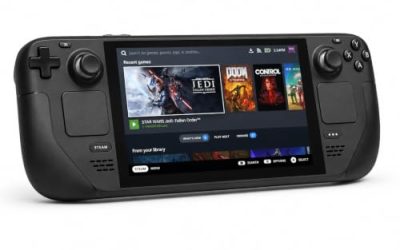
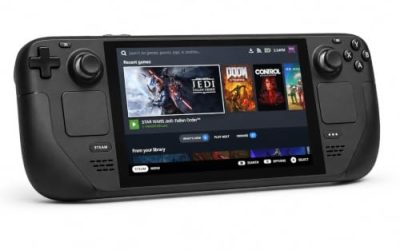
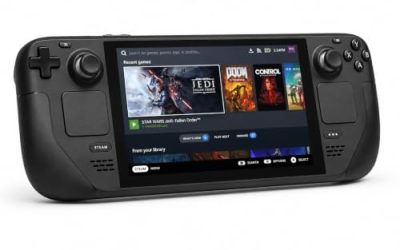
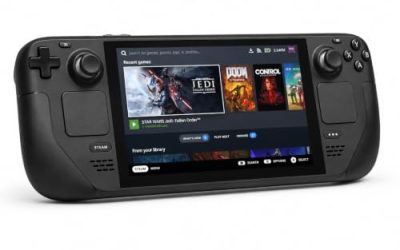
Valve Steam Deck OLED 512GB

The handheld’s Playable rating here is earned on performance: the default graphics configuration passes, and the costs are input and scaling rather than frame rate.
Specs
- Display: 7.4-inch HDR OLED, 1280 by 800, up to 90 Hz
- Processor: AMD Zen 2 and RDNA 2 custom APU
- Memory: 16 GB LPDDR5
- Storage: 512 GB NVMe, plus a microSD slot
- Wireless: Wi-Fi 6E and Bluetooth
- Channel note: Valve sells the Deck mainly through its own store, so Amazon listings are third-party sellers
8BitDo Ultimate 2 Bluetooth Controller

A pad is not this game’s native shape, and the record says so. Its place is a docked Deck or a co-op couch session, driving menus through Steam Input mapping, with back buttons for session shortcuts.
Specs
- Connectivity: Bluetooth wireless and USB-C wired
- Joysticks: TMR electromagnetic, anti-drift design
- Triggers: Hall effect, with mode switching
- Extras: two remappable back buttons, motion control
- In the box: charging dock included
Xbox Wireless Controller, Carbon Black

The standard guest pad, framed as a Steam Input device rather than a listed feature: the record names no controller support at all. Its value is familiarity and universal pairing for a second player.
- Connectivity: Xbox Wireless and Bluetooth
- Port: USB-C for wired play
- Controls: hybrid D-pad, dedicated Share button
- Power: AA batteries or optional rechargeable pack
Logitech G502 HERO

The natural fit for this record: a mouse-driven builder whose accessibility list includes a mouse-only option. At a desk, a precise wired mouse turns road layout and production chains into direct manipulation.
Specs
- HERO optical sensor, up to 25,600 DPI
- 11 programmable buttons
- Adjustable weight system
- Wired USB connection
- On-board memory profiles
Samsung T9 Portable SSD 2TB

The game asks for 10 GB, but a builder library grows, and a fast USB-C drive is the simple way to move installs between desktop and laptop. The headline figure needs a Gen 2×2 host port; on a lesser port the drive runs at that ceiling.
Specs
- Capacity: 2 TB portable SSD
- Interface: USB 3.2 Gen 2×2, USB-C connector
- Maker-rated speeds: up to 2,000 MB per second read, 1,950 MB per second write
- Features: Dynamic Thermal Guard, maker-rated drop resistance
How to choose
Choose the Steam copy: it is the build both compatibility records describe. On desktop, install under Proton and start from the default compatibility tool; a Gold headline over 200 reports with a Platinum best-reported tier is a strong starting point. On Steam Deck, budget a few minutes for a community controller layout, the touchscreen for text and menus, and possibly a manual resolution fix, in exchange for default graphics that perform well. Treat any pad as a Steam Input convenience, not a supported feature.
Who should skip
Skip this one if you are shopping for a native Linux builder: the flag, the empty tab and the depot list all agree there is none, and the family’s only Linux flag belongs to the soundtrack. Skip it if you want a DRM-free Linux installer from GOG, because the GOG edition is Windows-only too. Skip the Deck version if small text, imperfect scaling and a controller configuration that needs outside help are deal-breakers rather than setup steps.
FAQ
Is Pioneers of Pagonia native on Linux?
No. Steam flags the game app Windows-only, the Linux requirements tab is an empty shell, and SteamDB’s depot listing shows no Linux depot. The only Linux flag in the family sits on the Original Soundtrack, a music app.
How well does Pioneers of Pagonia run under Proton?
ProtonDB’s summary record reads Gold on the headline and trending tiers and Platinum on the best-reported tier, across 200 reports with strong confidence: the ceiling is Platinum, the typical report is Gold.
Is Pioneers of Pagonia playable on Steam Deck?
Yes, at Valve’s Playable tier rather than Verified. The default graphics configuration performs well, but the default controller configuration is not fully functional, some text is small, and the display output may need manual scaling. Valve’s test sheet is dated 16 January 2024, from Early Access.
Can I buy Pioneers of Pagonia on GOG instead?
Yes, but it does not help a Linux player. GOG sells the game, yet its product record lists Windows as the only supported operating system. The Steam copy is the one the ProtonDB file and the Deck record describe.
Final verdict
Pioneers of Pagonia is a Windows-only release. The native question is closed three times over: a false flag, an empty-shell tab and a depot list with no Linux entry. What remains is a genuinely usable Proton case: a Gold headline across 200 reports with a Platinum ceiling, no anti-cheat named by any source, no DRM or account layer named on the record, and a Playable Deck badge. Buy the Steam copy, play it under Proton with a mouse or the Deck’s trackpads, and do not let an album sell you a port that does not exist.
Product and ASIN Reference
| Product | ASIN |
|---|---|
| Valve Steam Deck OLED 512GB | B0CQ3RWQQZ |
| 8BitDo Ultimate 2 Bluetooth Controller | B0F194QFT2 |
| Xbox Wireless Controller, Carbon Black | B08DF248LD |
| Logitech G502 HERO | B07GBZ4Q68 |
| Samsung T9 Portable SSD 2TB | B0CHFS9K14 |