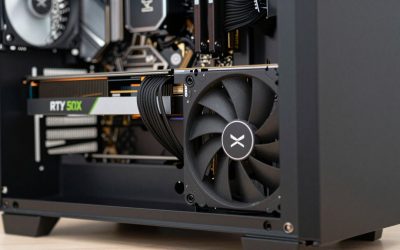
The RX 9070 arrived in early 2025 with RDNA 4’s biggest overhaul since the architecture’s inception, and the question every mid-range buyer now faces is whether it renders the RX 7800 XT obsolete or whether the older card still earns its place in a budget-conscious build. The answer depends heavily on what resolution you play at, whether you care about upscaler quality, and how much you can find a 7800 XT for on the secondary market.
This choice matters most for buyers who are either holding onto a pre-RDNA card (think RX 5700 XT or GTX 1080) and want a sensible step up, or who are shopping the used market for a 1440p workhorse. By 2026, the RX 7800 XT has settled into a price tier that makes the value calculus genuinely interesting rather than a simple generational skip.
As an Amazon Associate we earn from qualifying purchases at no extra cost to you.


Quick Verdict
The RX 9070 delivers roughly 15-25% more rasterization throughput depending on resolution, uses slightly less power, and gains access to FSR 4’s ML-based upscaling that the RX 7800 XT cannot replicate. If you are buying new today, the RX 9070 is the default recommendation at its MSRP. The RX 7800 XT only wins if you can secure one at or below $400 and you do not care about upscaler quality or platform features.
Specs Side by Side
| Specification | RX 9070 | RX 7800 XT |
|---|---|---|
| Architecture | RDNA 4 (Navi 48) | RDNA 3 (Navi 32) |
| Compute Units | 56 | 60 |
| Stream Processors | 3,584 | 3,840 |
| Game Clock | ~2,544 MHz | ~2,124 MHz |
| Boost Clock | ~2,970 MHz | ~2,544 MHz |
| Memory | 16 GB GDDR6 | 16 GB GDDR6 |
| Memory Bus | 256-bit | 256-bit |
| Memory Bandwidth | ~640 GB/s | ~624 GB/s |
| TBP | 250 W | 263 W |
| MSRP at Launch | $549 | $499 |
| Display Outputs | DP 2.1a, HDMI 2.1b | DP 2.1, HDMI 2.1 |
| Interface | PCIe 5.0 x16 | PCIe 4.0 x16 |
Gaming Performance
1080p
At 1080p the gap narrows considerably. TechPowerUp and Hardware Unboxed both place the RX 9070 at roughly 12-18% ahead of the RX 7800 XT in average 1080p frame rates across their respective benchmark suites. In practice this means both cards are often CPU-limited in esports titles like Valorant or Counter-Strike 2, so the difference in your competitive framerate may be negligible unless you are running a high-refresh monitor and pairing it with a top-end processor. For AAA titles at 1080p ultra, the RX 9070 pushes past 120 fps in games where the 7800 XT sits near 100.
1440p
This is where the comparison gets most interesting. Tom’s Hardware and TechSpot report the RX 9070 ahead by approximately 18-22% at 1440p across a broad game list. That translates to a tangible experience: in titles like Cyberpunk 2077 or Hogwarts Legacy at ultra settings, the RX 7800 XT averages around 70-80 fps while the RX 9070 clears 90-100 fps comfortably. If you are targeting a 144 Hz monitor at 1440p, the RX 9070 gets you closer to that ceiling without leaning as heavily on upscaling.
4K
At 4K the advantage widens to roughly 20-25% according to Hardware Unboxed and Gamers Nexus. The 7800 XT can technically run 4K in less demanding titles at medium-high settings, but it frequently drops below 50 fps where the RX 9070 holds a playable 60-70 fps range. Both cards still require upscaling or settings adjustments for 4K in the most demanding 2025-2026 releases, but the RX 9070 has more headroom to work with.
Power, Heat and Noise
Despite packing fewer compute units, the RX 9070 uses less power than the RX 7800 XT under gaming load. TechPowerUp’s power delivery analysis shows typical gaming draws around 220-240 W for the RX 9070 versus 230-250 W for the RX 7800 XT, depending on the AIB model. The RDNA 4 chip benefits from a refined 4nm node and improved power gating, so per-watt efficiency is meaningfully better.
Thermal performance is card-dependent, but both GPUs tend to settle into the 60-70 degree range with dual-fan or triple-fan coolers under full load. AIB partners like Sapphire, XFX, and PowerColor have released RX 9070 variants with vapor chambers that run a few degrees cooler than most stock 7800 XT designs. Noise levels on reference-equivalent coolers are similar at around 35-38 dBA, with premium aftermarket models dropping below 32 dBA.
Features
This is the category where the RX 9070 pulls furthest ahead. FSR 4, AMD’s new ML-based upscaler, is exclusive to RDNA 4 and RDNA 3.5 cards, meaning the RX 7800 XT is locked to FSR 3 and AFMF. In side-by-side quality comparisons noted by Gamers Nexus and Tom’s Hardware, FSR 4’s output is dramatically cleaner and closer to native rendering than FSR 3, which has visible ghosting and shimmering in many scenes.
Frame generation on the RX 9070 supports FSR 3’s Fluid Motion Frames and the newer frame gen built into FSR 4 pipeline. The RX 7800 XT supports AFMF frame gen but lacks the dedicated hardware flow accelerators that make RDNA 4’s implementation lower-latency and higher-quality.
Both cards include dual AV1 encode and decode engines, making them capable for streaming and video editing. PCIe 5.0 support on the RX 9070 is forward-looking but offers no measurable gaming benefit over PCIe 4.0 on the RX 7800 XT with current CPUs.
Price and Value
At a $549 MSRP, the RX 9070 carries a $50 premium over the RX 7800 XT’s $499 launch price. Street prices for new RX 7800 XT cards have drifted down to the $430-460 range, which makes the value equation tighter. If you calculate cost per frame at 1440p using the approximate performance figures above, the RX 9070 works out to roughly $6-6.30 per frame while the RX 7800 XT sits around $5-6.00 per frame at current street prices. The RX 7800 XT edges ahead on pure raster value, but the RX 9070’s access to FSR 4, better efficiency, and longer driver support window offset that gap for many buyers.
On the used market, RX 7800 XT cards can be found near $350-390 in some regions, which makes them a genuinely compelling option for budget 1440p builders who already have a compatible power supply and do not care about upscaler quality.
Who Should Buy Which
Competitive 1080p Players
Either card works if you are CPU-bottlenecked, which is common at 1080p in esports titles. The RX 7800 XT saves you money with negligible competitive downside. Pair it with a fast CPU and you are getting 300+ fps in Valorant regardless.
1440p High-Refresh (144-240 Hz)
The RX 9070 is the better choice here. The extra 18-22% headroom matters when you are pushing 120-160 fps in AAA titles and want to approach your monitor’s refresh rate without aggressive upscaling.
4K Gamers
Neither card is ideal for native 4K ultra, but the RX 9070’s larger margin means you can play at high settings with FSR 4 balanced and hit a consistent 60 fps in more titles. If 4K is your primary target, stretch to an RX 9070 XT or consider waiting for further RDNA 4 lineup options.
Creators and Streamers
Both cards feature AV1 hardware encoding that produces clean, low-bitrate streams suitable for Twitch or YouTube. The RX 7800 XT is a fine budget option for creators who want 16 GB of VRAM for timeline work. If you also game, the RX 9070’s efficiency means less heat and noise in a shared workspace.
Upgraders from Two Generations Back
Coming from an RX 5700 XT or GTX 1070 Ti, the RX 7800 XT is already a massive leap. If you find one under $400 used, it is a worthy purchase. If you are buying new and want the best per-dollar generational jump, the RX 9070’s FSR 4 support and longer software relevance make the extra $50-80 worthwhile.
FAQ
Can the RX 7800 XT get FSR 4?
No. FSR 4 requires the dedicated machine learning hardware accelerators present in RDNA 4 and RDNA 3.5 GPUs. The RX 7800 XT is limited to FSR 3 and AFMF, which produce noticeably lower image quality in demanding scenes.
Is 16 GB of VRAM enough on both cards going forward?
At 1440p, yes for the foreseeable future. At 4K with ultra textures, some 2026 titles are beginning to push past 14-15 GB, so both cards will eventually rely on upscaling or texture setting adjustments to stay within budget. Neither card has a VRAM disadvantage relative to the other.
Does the RX 9070 require a new power supply?
Not usually. Its 250 W TBP means a good 650 W unit handles it comfortably, same as the RX 7800 XT. If you already have a 650 W or 750 W supply from your 7800 XT or 5700 XT days, it will work fine with the RX 9070.
Which card is quieter under load?
It depends on the specific AIB model rather than the GPU itself. Both chips produce similar heat output, so cooling design determines noise. Premium triple-fan RX 9070 models from Sapphire Nitro+ or PowerColor Red Devil can run 3-5 dBA quieter than basic dual-fan RX 7800 XT variants simply because they have more heatsink mass per watt.
Sources and Methodology
The performance ranges cited in this article are approximate consolidations of publicly reported launch and follow-up review data from TechPowerUp, Tom’s Hardware, Gamers Nexus, Hardware Unboxed, and TechSpot. Figures represent averages across multiple game titles at each resolution and may vary by one to three percentage points depending on driver version and test suite composition. Power and thermal observations draw on TechPowerUp’s instrumented testing and Gamers Nexus’s thermal methodology. Price data reflects manufacturer MSRPs and widely available street listings as of mid-2026.