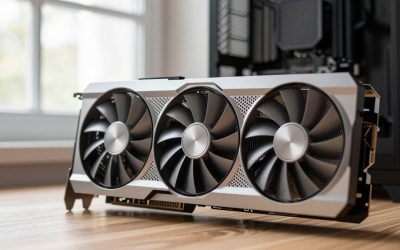
Upgrading from an RX 6950 XT to an RX 9070 XT is worth it mainly for ray tracing and FSR 4 image quality, where the gains are large, but in plain rasterized gaming the jump is a moderate one of roughly 25-35% with the same 16 GB of VRAM, so 1440p players who skip ray tracing can comfortably keep the RX 6950 XT another generation. The RX 9070 XT does this while drawing slightly less power and taking up less space, which makes it a cleaner card overall, but not a mandatory upgrade.
The RX 6950 XT was the top RDNA 2 card, launched in May 2022 at $1,099 as a refreshed RX 6900 XT. The RX 9070 XT arrived in March 2025 at $599 as RDNA 4’s flagship, positioned as an upper-mid-range card. That a card launched at roughly half the price is faster says plenty about how the market has moved, but the size of that lead depends heavily on which features you use.
Quick answer: Our top pick in 2026 is the Architecture — our #1 rated choice. See the full ranked comparison, alternatives and buying advice below.
Specifications Compared
| Specification | RX 6950 XT | RX 9070 XT |
|---|---|---|
| Architecture | RDNA 2.0 | RDNA 4.0 |
| Release date | 10 May 2022 | 6 March 2025 |
| Launch MSRP | $1,099 | $599 |
| Stream processors | 5120 | 4096 |
| Boost clock | 2324 MHz | 2970 MHz |
| Process | 7 nm | 4 nm |
| TDP | 335 W | 304 W |
| Memory | 16 GB GDDR6 | 16 GB GDDR6 |
| Memory bus | 256-bit | 256-bit |
| Bandwidth | 576.0 GB/s | 644.6 GB/s |
| L2 / L3 cache | 4 MB / 128 MB | 8 MB / 64 MB |
| Interface | PCIe 4.0 x16 | PCIe 5.0 x16 |
| Power connectors | 2x 8-pin | 2x 8-pin |
| Length / width | 267 mm / 3-slot | 267 mm / 2-slot |
| Outputs | 1x HDMI 2.1, 2x DP 1.4a | 1x HDMI 2.1b, 3x DP 2.1a |
On paper the RX 9070 XT has fewer stream processors and half the Infinity Cache. It wins through a much higher boost clock, a more efficient 4 nm design, about 12% more memory bandwidth and RDNA 4’s reworked compute units. The VRAM capacity and bus width are identical.
Raster Performance: A Modest Step
The RX 6950 XT generally performs a little above the RX 7800 XT and somewhat below the RX 7900 XT. According to TechSpot’s and GamersNexus’ RX 9070 XT launch reviews, the new card runs roughly level with or slightly ahead of the RX 7900 XT in rasterized games, with individual titles swinging a few percent either way. Placing those results together, the RX 9070 XT lands roughly 25-35% ahead of the RX 6950 XT at 1440p, with the gap similar or slightly larger at 4K.
As an approximate example that varies with game, settings, CPU and patch, a title running around 80-90 FPS on the RX 6950 XT at 1440p ultra would typically land around 100-120 FPS on the RX 9070 XT. That is noticeable on a high-refresh monitor, but it is not the dramatic doubling that usually justifies an upgrade on its own.
Ray Tracing: Where the Upgrade Earns Its Keep
RDNA 4 redesigned the ray tracing hardware, and AMD states its new RT units double ray-intersection throughput per compute unit compared with the previous generation. RDNA 2’s first-generation ray accelerators were the weakest part of the RX 6950 XT. Benchmark data from comparison sites shows the RX 9070 XT around 50% ahead in titles such as The Witcher 3’s ray-traced update at 1080p and 1440p, and roughly two-thirds ahead at 4K. In the heaviest RT and path-traced games the difference is even larger, because the RX 6950 XT often falls below playable frame rates entirely.
PCGamesN’s review highlighted Indiana Jones and the Great Circle, a game that requires ray tracing hardware, as running far better on the RX 9070 XT than on the RX 6950 XT. If you want to turn on ray tracing in modern games, this is the main reason to upgrade.
FSR 4 Changes Image Quality
The other big change is FSR 4, AMD’s machine-learning upscaler, which launched as an RX 9000 series feature. Compared with FSR 3.1’s analytical upscaling, FSR 4 produces noticeably cleaner detail and more stable edges, especially in Performance and Balanced modes. The RX 6950 XT is limited to FSR 3.1 upscaling and frame generation plus AMD Fluid Motion Frames. For players who rely on upscaling at 4K, FSR 4 makes the RX 9070 XT feel like a bigger upgrade than raw benchmark numbers suggest.
VRAM: No Change, No Problem
Both cards carry 16 GB on a 256-bit bus. That is a comfortable amount for 1440p and workable for 4K in current games, so neither card is VRAM-limited for typical gaming. The flip side is that upgrading does not buy any extra memory headroom; if you were hoping for more VRAM for heavy mods or 4K texture packs, this upgrade does not deliver it.
Power, PSU and Physical Fit
The RX 9070 XT is rated at 304 W versus 335 W for the RX 6950 XT, so it draws slightly less power while delivering more performance. Any PSU that ran an RX 6950 XT will handle the RX 9070 XT, and both use two 8-pin connectors, so no cable changes are needed. As a sanity check, using GPU TDP plus CPU plus about 150 W headroom:
- With a 125 W CPU: 304 + 125 + 150 = 579 W, so a quality 750 W unit offers comfortable margin.
- With a 250 W CPU: 304 + 250 + 150 = 704 W, so 850 W is the safer target.
Note that many partner RX 9070 XT models are factory overclocked with higher power limits, and some use three 8-pin connectors. Both reference cards are 267 mm long, but the RX 6950 XT is listed as three slots and the RX 9070 XT as two. Partner cards for both are often larger, so measure before buying.
Platform note
The RX 9070 XT supports PCIe 5.0 x16 but runs fine on PCIe 4.0 boards, with negligible performance difference. It also offers DisplayPort 2.1a, useful for high-refresh 4K monitors.
Cost per Performance and the Used Market
At launch MSRP, set the RX 6950 XT at 100 and the RX 9070 XT at about 130 (midpoint of the raster range):
- RX 6950 XT: $1,099 / 100 = about $10.99 per performance point.
- RX 9070 XT: $599 / 130 = about $4.61 per performance point.
The newer card offers well over twice the value at launch prices. The practical question is net cost: a used RX 6950 XT typically sells for roughly $350-$450, depending on cooler and condition. Selling it can cover a large share of an RX 9070 XT, making the effective upgrade cost fairly modest.
Should You Upgrade? A Quick Matrix
| How you play | Verdict |
|---|---|
| 1440p raster only, 144 Hz | Keep the RX 6950 XT |
| 1440p or 4K with ray tracing | Upgrade to RX 9070 XT |
| 4K with upscaling | Upgrade; FSR 4 is a major quality gain |
| Hot or noisy room, small case | Upgrade for efficiency and two-slot design |
| Need more than 16 GB VRAM | Neither; look at higher-tier cards |
Conclusion
For a pure rasterization player at 1440p, the RX 6950 XT remains a strong card and the 25-35% gain is a nice-to-have rather than a must-have. For anyone who wants ray tracing, uses upscaling heavily, or plays at 4K, the RX 9070 XT is a substantial upgrade thanks to RDNA 4’s ray tracing hardware and FSR 4. Selling the RX 6950 XT on the used market makes the move relatively affordable.
Frequently Asked Questions
How much faster is the RX 9070 XT than the RX 6950 XT?
In rasterized games, published review data suggests roughly 25-35% at 1440p. In ray-traced games the gap is much larger, often around 50% or more. Results depend on the game and settings.
Can the RX 6950 XT use FSR 4?
FSR 4 launched as an RX 9000 series feature. The RX 6950 XT supports FSR 3.1 upscaling and frame generation and AMD Fluid Motion Frames. That gap in upscaling quality is a key reason to consider the upgrade.
Do I need a bigger PSU for the RX 9070 XT?
No, if your PSU already handled the RX 6950 XT. The RX 9070 XT is rated at 304 W versus 335 W and uses the same two 8-pin connectors. Heavily overclocked partner models may need three 8-pin cables.
Is 16 GB on the RX 9070 XT enough for 4K?
For most current games, yes. 16 GB is a comfortable amount for 4K with high textures, especially with upscaling. Extreme texture mods may push past it.
Is the RX 6950 XT still good in 2026?
Yes, for rasterized gaming at 1440p and with upscaling at 4K. Its main weaknesses are ray tracing performance, high power draw and lack of FSR 4.
Ready to decide? Our #1 pick for 2026 is the Architecture.
Live price & availability on Amazon.